


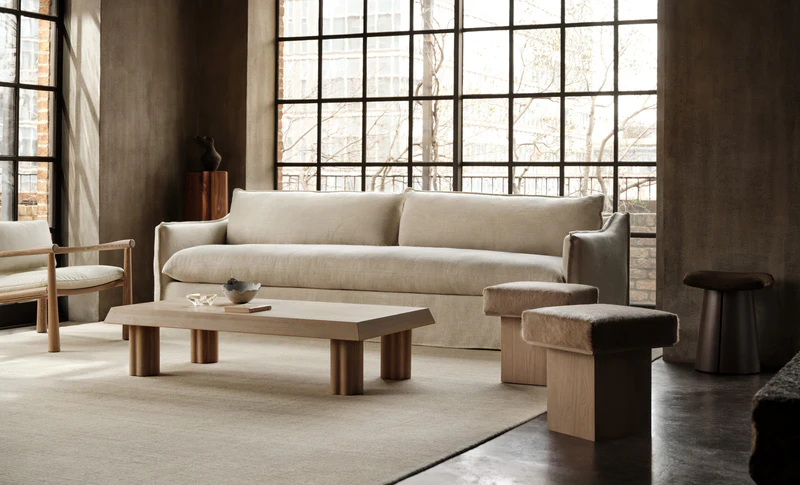
Sofa’s Guide: Art of contemporary luxury
A high-end sofa is recognised first by what you cannot see: a solid wood or steel frame, webbing or pocket-spring suspension, high-resilience foam of at least 35 kg/m³ and an upholstery fabric rated above 25,000 Martindale rubs. Then come the design, the signature of a great furniture house and the quality of the upholstery work. This guide brings together the leading luxury sofa brands, the iconic models, and an upholstery professional’s method for judging a sofa before you buy it.
It is part of our complete guide to high-end design furniture.
Contents
- The leading luxury sofa brands
- Iconic sofas to know
- The sofa through the styles
- How to recognise a well-made sofa
- Leather, velvet, bouclé, linen: choosing the right upholstery
- The right dimensions
- Budget, restoration and pre-owned
- Frequently asked questions
The leading luxury sofa brands
Most luxury sofa brands are Italian, clustered in the Brianza district between Milan and Lake Como. France, Denmark, Switzerland, Germany and the United States complete the picture with very different skills: frameless comfort, solid wood, thick leather or industrial precision.
| Brand | Country, founded | Signature | Key models |
|---|---|---|---|
| Cassina | Italy, 1927 | Re-editions of 20th-century masters and contemporary designs | Maralunga, Soriana, LC2 |
| B&B Italia | Italy, 1966 | Industrial innovation, moulded foam | Camaleonda, Charles, Tufty-Time |
| Poltrona Frau | Italy, 1912 | Mastery of leather | Kennedee |
| Flexform | Italy, 1959 | Down-filled cushions, enveloping comfort | Groundpiece |
| Minotti | Italy, 1948 | Architectural lines, large compositions | Collections designed by Rodolfo Dordoni |
| Edra | Italy, 1987 | Experimental forms and reconfigurable seating | On the Rocks |
| Gufram | Italy, 1966 | Radical and pop design | Bocca |
| Ligne Roset | France, 1860 | Comfort without a visible frame | Togo |
| Roche Bobois | France, 1960 | Modular sofas and designer collaborations | Mah Jong |
| Vitra | Switzerland, 1950 | Eames editions and contemporary designs | Eames Sofa Compact, Soft Modular Sofa |
| de Sede | Switzerland, 1965 | Thick leather, Swiss saddlery | DS-600 |
| Knoll | United States, 1938 | American modernism | Florence Knoll Sofa |
| Fredericia | Denmark, 1911 | Danish modernism, solid wood and leather | Mogensen 2213 |
| Gubi | Denmark, 1967 | Re-editions of icons | Pacha |
| COR | Germany, 1954 | German manufacturing rigour | Conseta |
A brand name is not a guarantee in itself: within the same house, quality varies with the range, the filling and the upholstery chosen. The criteria in our craftsmanship section apply to every brand.
More houses to know: Fritz Hansen and Danish modernism, Herman Miller, pillar of American modernism, Hermès furniture, and the confidential houses of collectible design.
Iconic sofas to know
An iconic sofa is a model whose design left its mark on design history and that is still produced, or re-issued, decades after its creation. Iconic sofas are also the ones that hold their value best on the pre-owned market.
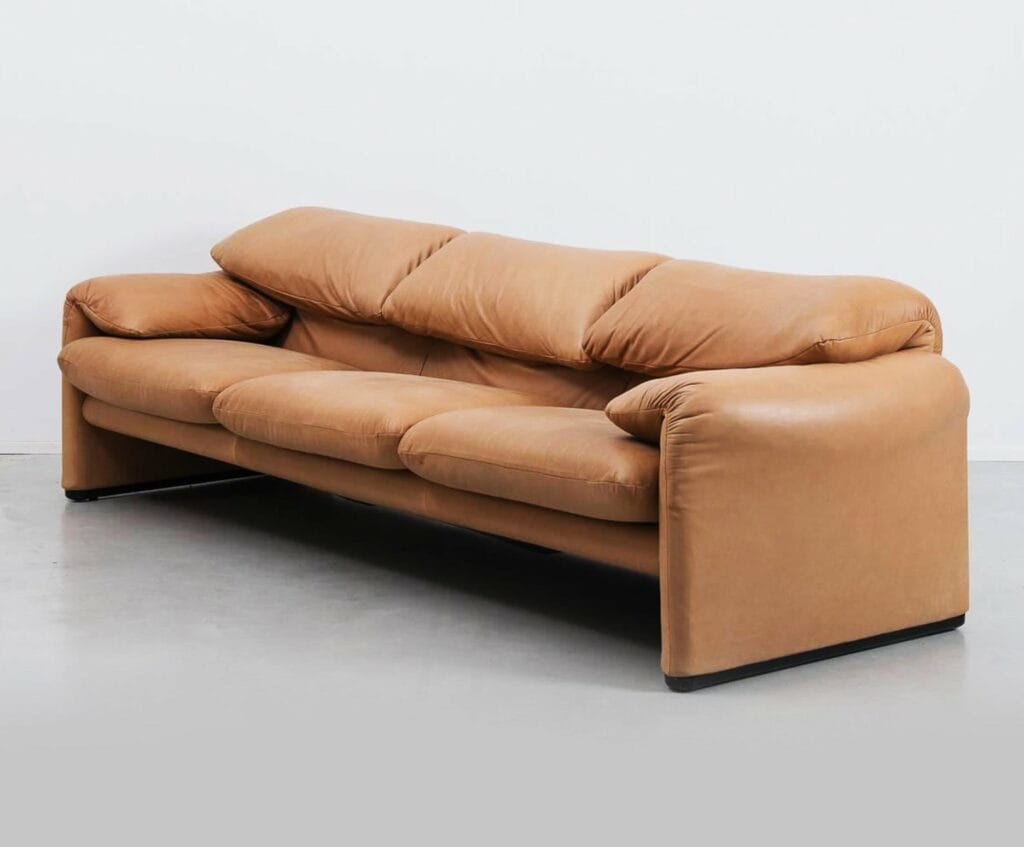
Maralunga, Vico Magistretti for Cassina (1973): its headrests fold down or lift up in one movement, turning a low seat into a high back that supports the neck, with no visible mechanism. Compasso d’Oro in 1979, re-issued in 2013 for its fortieth anniversary.
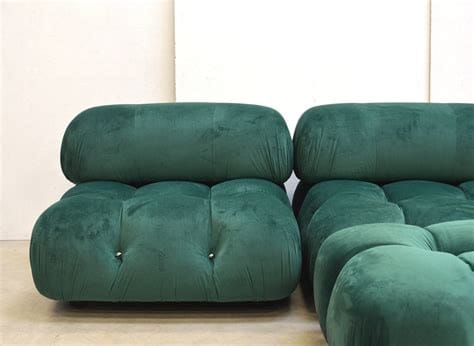
Camaleonda, Mario Bellini (1970): a modular sofa conceived like a construction game. Its 90 cm quilted modules, joined by cables, hooks and rings, can be rearranged endlessly. Re-issued by B&B Italia in 2020.
- LC2, Le Corbusier, Pierre Jeanneret and Charlotte Perriand (1928), Cassina: a cage of steel tubes holding leather cushions, the manifesto of modernist comfort. Le Corbusier as a designer
- Eames Sofa Compact, Charles and Ray Eames (1954), Herman Miller and Vitra: a slim sofa with a folding back, designed for smaller interiors. Charles and Ray Eames
- Florence Knoll Sofa (1954), Knoll: architectural rigour applied to comfort, a straight line on a chrome base. Mid-century modern
- Soriana, Afra and Tobia Scarpa (1970), Cassina: cushions held by a single steel clamp, a soft and generous silhouette. Italian design 1950-1980
- Togo, Michel Ducaroy (1973), Ligne Roset: a sofa with no rigid frame, made entirely of foam, now a classic. Organic design
- Pacha, Pierre Paulin (1975), re-issued by Gubi: a very low seat and rounded volumes, the lounge spirit of the 1970s.
- Charles, Antonio Citterio (1997), B&B Italia: the benchmark contemporary sofa, a deep seat on an aluminium base.
- Groundpiece, Antonio Citterio (2001), Flexform: soft down-filled cushions on a very low line, for those who like to sink in.
- Tufty-Time, Patricia Urquiola (2005), B&B Italia: quilted modules to compose freely, somewhere between sofa and daybed.
- Bocca, Studio 65 (1970), Gufram: red lips turned into a sofa, a symbol of Italian radical design. Radical design
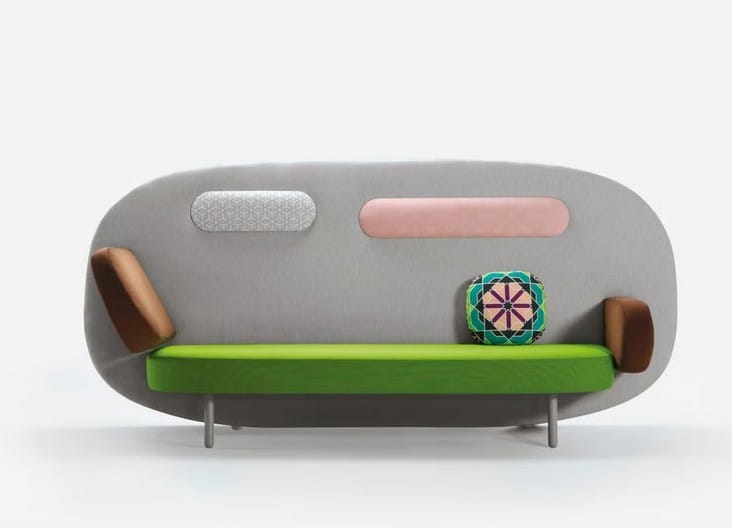
Eccentric sofas: some sofas are sculptures first. Our selection of the boldest models.
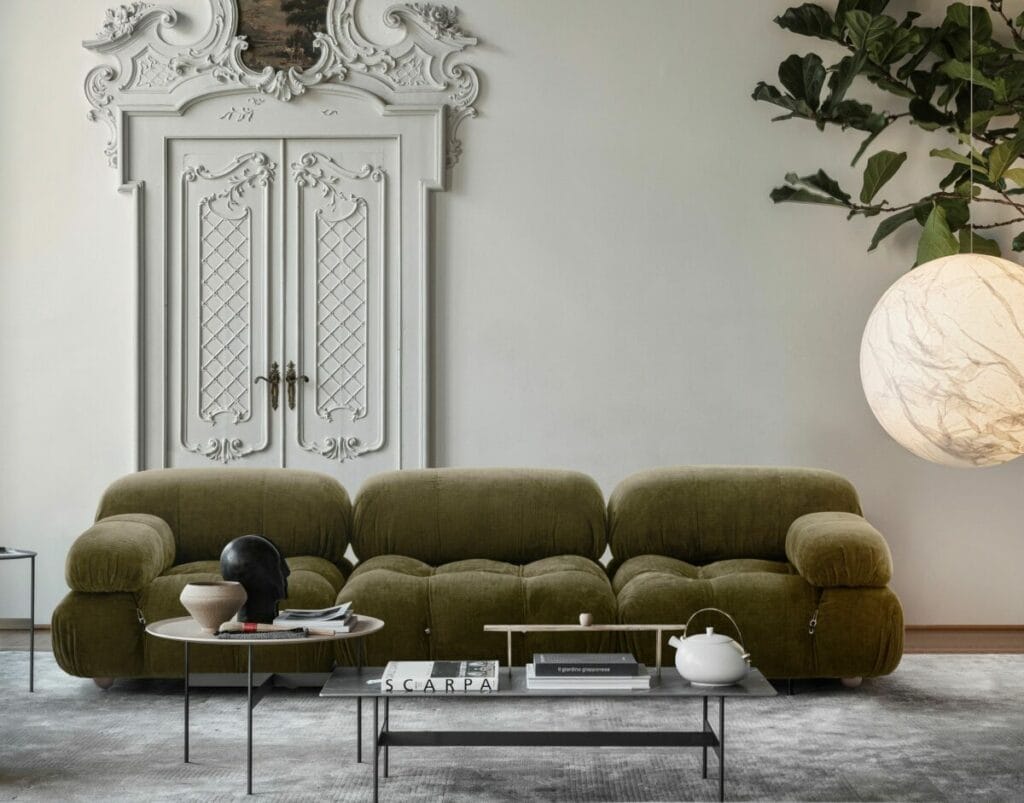
High-end sofas: iconic models and prices: our selection of the models that matter, their trends and their prices.
The designers behind these sofas: Vico Magistretti, Charles and Ray Eames, Le Corbusier, Joe Colombo, Gaetano Pesce, Eero Saarinen, Arne Jacobsen, Alvar Aalto, Matali Crasset.
For armchairs, see our selection of iconic egg and cocoon armchairs.
The sofa through the styles
Every era invented its own way of sitting together. Knowing these styles helps you choose a sofa that works with the rest of the room, or recognise an antique piece.
Historic styles
- Louis XV style: seating softens and the sofa becomes a piece of intimacy and conversation.
- Louis XVI style: a return to straight lines and the tapered legs of neoclassicism.
- Chippendale style: English mahogany and ball-and-claw feet.
- Directoire style: the age of Juliette Récamier and antique-inspired daybeds.
- Biedermeier style: the light-wood méridienne of the Viennese bourgeois interior.
- Louis-Philippe style: bourgeois comfort settles into the living room.
- Napoleon III style: the confident and the indiscret, conversation seats for two or three.
- Victorian style: the British bourgeois interior and its generously padded seats.
The 20th and 21st centuries
- Art Deco: geometric volumes and precious materials.
- Scandinavian design: solid wood, simple lines, lasting comfort.
- Mid-century modern: slender legs and low lines of the post-war years.
- Italian design 1950-1980: the golden age of the Brianza furniture houses.
- 1960s design: foam, plastics and free forms.
- Radical design and Memphis: the sofa as a manifesto.
- Postmodernism: colour, quotation and irony.
- Organic design: enveloping curves inspired by nature.
- Minimalism and quiet luxury: material over effect.
How to recognise a well-made sofa
The difference between a €2,000 sofa and a €10,000 sofa lies mostly inside: the frame, the suspension, the foam and the filling decide how it will hold up in ten years. Here is what to ask, and what to check.
The frame
The frame is the skeleton of the sofa. Ask for solid wood (beech, ash, oak) that is jointed, glued and dowelled, or steel. Thick multi-ply plywood is acceptable; particleboard and MDF should be avoided on load-bearing parts.
The suspension
The suspension carries the seat. Pocket springs and well-tensioned sinuous (zigzag) springs give lasting comfort; good-quality elastic webbing suits contemporary models. A simple stretched cloth under thick foam tires quickly.
Foam and filling
Seat foam should be high-resilience (HR) foam: HR35 at the very least, HR40 to HR43 for heavy use. Down or a down-and-fibre blend adds softness but needs regular plumping. Everything is explained in our guide to upholstery foams for chairs and sofas, and why foam prices are set to move in rising oil prices, foams and fabrics.
The upholstery work
Look at the seams: straight and even, patterns matched from one cushion to the next, piping taut without ripples. Removable covers should be genuinely removable, with hidden zips. Trimmings often signal the most demanding workshops.
The fabric
For a sofa in daily use, aim for at least 25,000 Martindale rubs, a weight of at least 400 g/m², twisted yarns to limit pilling and a light fastness of at least 6 out of 8. American mills often quote Wyzenbeek double rubs instead of Martindale: the two tests are not directly comparable. Everything is explained in our Martindale rub test guide, and to make it last, our upholstery fabric care guide.
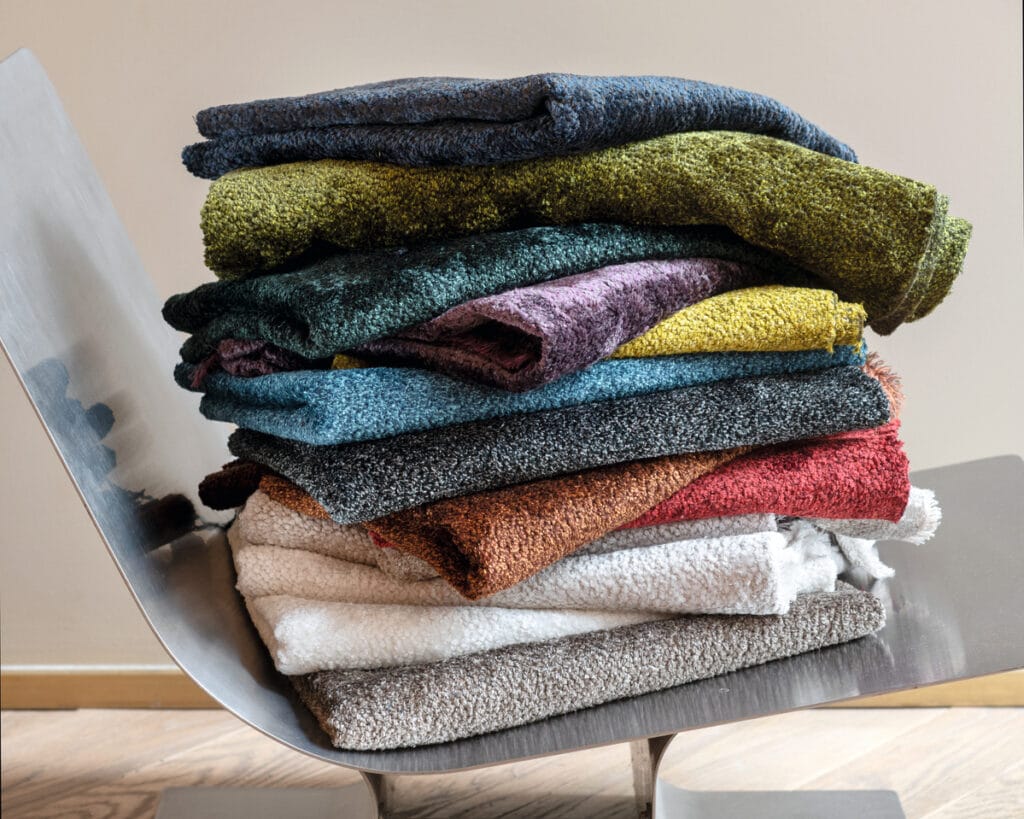
The Martindale rub test: how many rubs a sofa in daily use needs and how to read a fabric spec sheet. Our complete guide to fabric resistance.
The showroom checklist
- Sit for at least ten minutes, in the position you will use to read or watch a film.
- Lift one corner: a well-built sofa is heavy and does not twist.
- Ask in writing what the frame and suspension are made of.
- Ask for the density and grade of the foam (HR35 or higher).
- Ask for the fabric spec sheet: Martindale, weight, composition, care.
- Check the seams and pattern matching.
- Take fabric or leather samples home to see them in daylight.
- Confirm the lead time (often 3 to 6 months for high-end pieces), the warranty and after-sales service.
Leather, velvet, bouclé, linen: choosing the right upholstery
The upholstery sets the look of a sofa, but also its care and its lifespan. There is no single right choice, only the right choice for the way you live.
Before choosing, browse our upholstery fabric guides.
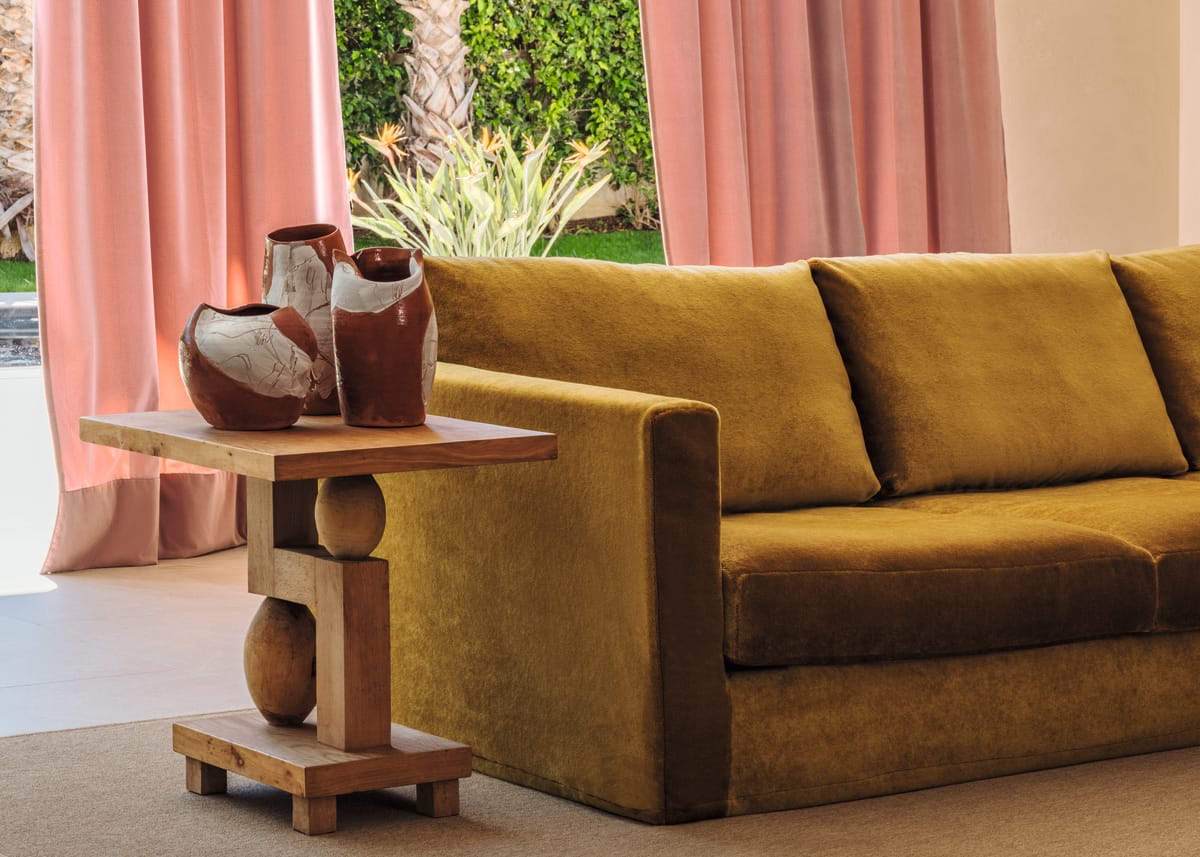
High-end upholstery fabrics: the brands from A to Z: the great fabric houses to dress a sofa, their origins, their production and their style.
| Upholstery | Strengths | Limits | Our guide |
|---|---|---|---|
| Full-grain leather | Durable, develops a patina over time | Cool to the touch, sensitive to scratches and light | Craftsmanship section above |
| Velvet | Depth of colour, warmth, play of light | Shows wear, needs a dense pile | Velvet |
| Bouclé | Enveloping texture, very current | Vulnerable to claws, durability varies with quality | Bouclé |
| Linen | Natural, fresh, relaxed elegance | Creases when light, best in a blend for a washable seat | Linen |
| Wool and mohair | Hard-wearing, warm, hides dirt | Expensive, can feel scratchy at average quality | Wool and mohair |
All the textile materials for a sofa
Natural fibres: linen, wool and mohair, alpaca. For outdoors: polypropylene fabrics.
To understand it all: our guide to noble and synthetic textile fibres, why natural fibres dominate luxury textiles, all our upholstery fabric guides and high-end upholstery fabric brands from A to Z. This season’s new fabrics: Paris Deco Off 2026.
The right dimensions
A comfortable sofa respects three measurements: a seat height of 42 to 46 cm (16.5 to 18 in), an overall depth of 85 to 95 cm (33.5 to 37.5 in) and a back height of 75 to 85 cm (29.5 to 33.5 in). The lower and deeper the seat, the more relaxed the sofa, but the harder it is to get up from.
- For entertaining: a higher, firmer seat and an upright back.
- For relaxing: a low, deep seat with down filling, like the Groundpiece.
- For reading: a high back or adjustable headrests, like the Maralunga.
- In a small living room: visible legs and slim arms, which lighten the volume.
Budget, restoration and pre-owned
Price brackets
Indicative European prices for a new three-seater; the upholstery alone can double the price.
- €2,000 to €4,000: Nordic premium and contemporary design brands.
- €4,000 to €8,000: the entry point to European high-end.
- €8,000 to €15,000: the great Italian names.
- Above €15,000: iconic models in leather, large compositions and bespoke pieces.
Restore rather than replace
A well-built high-end sofa can be reupholstered. New foam, restored suspension and new fabric usually cost €1,500 to €3,500 for a two- or three-seater, often far less than an equivalent new piece. Choose an upholsterer who can show comparable work and guarantees it. Find a workshop in our directory of the best upholstery workshops.
Buying pre-owned
Pamono and 1stDibs offer vintage and contemporary pieces from recognised houses. Icons such as the Maralunga, Camaleonda, Togo and LC2 resell well: a period piece in good condition keeps its value, and can gain more. Always check authenticity (label, number, invoice) and budget for reupholstering.
Frequently asked questions
What is the best luxury sofa brand?
There is no single best brand, only specialities: Cassina for design icons, B&B Italia for contemporary innovation, Poltrona Frau for leather, Flexform for down-filled comfort, Ligne Roset for frameless comfort. Quality also depends on the range and filling you choose.
How much does a high-end sofa cost?
In Europe, expect €4,000 to €8,000 to enter the high-end market, €8,000 to €15,000 for the great Italian names, and more for iconic leather models or large compositions.
How long does a high-end sofa last?
A well-built sofa lasts for decades: the frame does not move, and both foam and fabric can be replaced by an upholsterer. That is what sets it apart from an entry-level sofa.
Leather or fabric: which should I choose?
Full-grain leather lasts and develops a patina, but it feels cool and dislikes direct light. Fabric offers more colours and softness: choose one rated at least 25,000 Martindale rubs for daily use.
How can I tell if a sofa is good quality?
Ask what the frame (solid wood or steel), suspension (pocket or sinuous springs, quality webbing) and foam (HR35 minimum) are made of, then check the seams and the fabric spec sheet.