

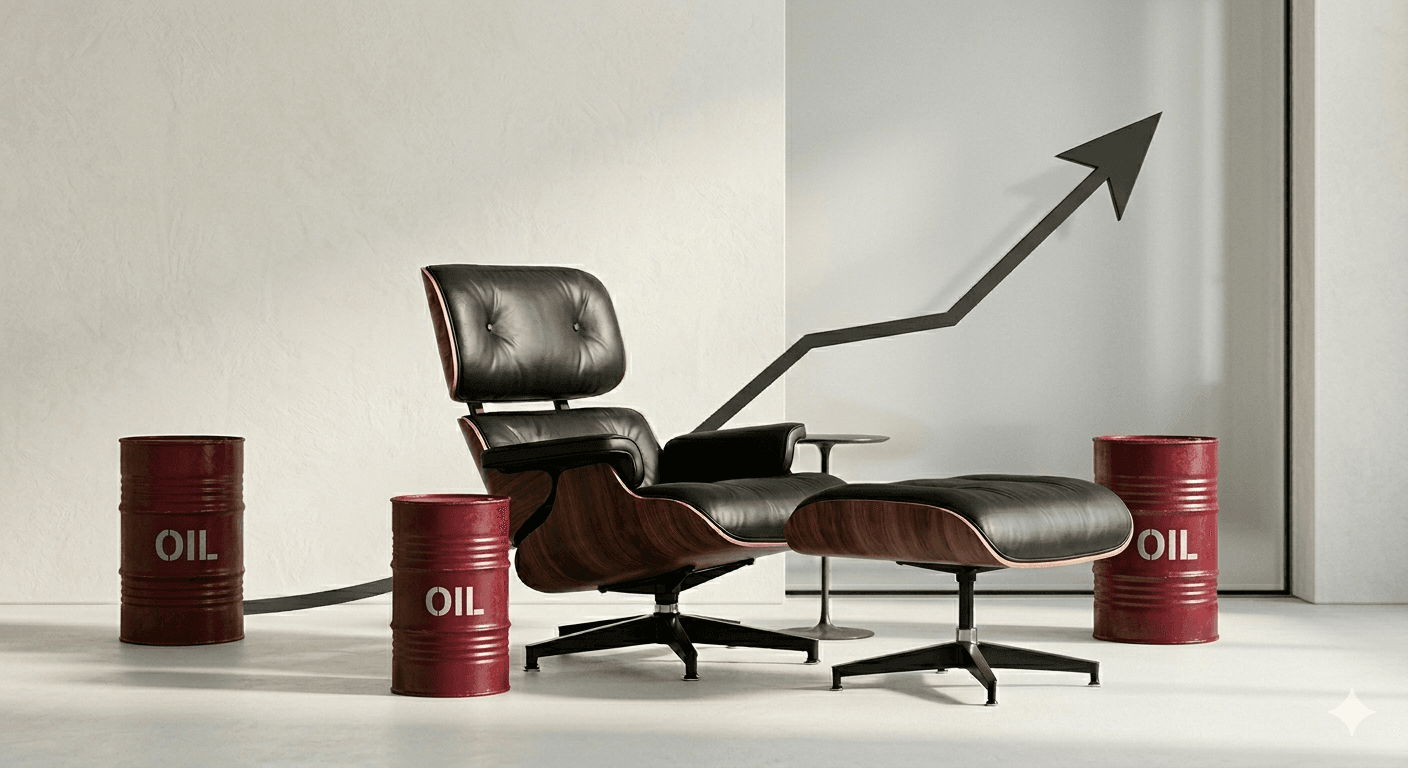
Rise in Oil Prices and Decoration: Foam, Fabrics, Transport: What Will Really Change
An Oil Shock at the Heart of Your Living Room
Since the Israeli-American strikes on Iran in February 2026, the global energy market has been experiencing what analysts are already calling the most severe supply-side oil shock in history. The Strait of Hormuz, through which nearly 20% of the world’s daily hydrocarbon production flows, has been brought to a near standstill. Brent crude crossed the $130 per barrel threshold. WTI surged by more than 35% in a single week, a record since the creation of futures contracts in 1983.
These figures may seem distant, confined to trading floors and the columns of financial newspapers. They are not. Behind every sofa delivered, every outdoor fabric ordered, every lighting fixture shipped from Asia lies a deep and structural dependency on oil. A dependency that the luxury design and decoration sector can no longer afford to ignore.
Oil Is Everywhere in Your Interior
The great misconception about oil is to believe it is confined to fuels and visible plastics. The reality runs far deeper. The petrochemical industry absorbs approximately 14% of global crude consumption and produces, from naphtha derived through refining, a cascade of molecules that run through every link in the furniture and decoration manufacturing chain.
Polyurethane, omnipresent in seat cushions and upholstery, is a direct petroleum derivative. Polyester, which makes up the majority of upholstery fabrics in the entry and mid-range segments, is another. Polypropylene, the dominant fibre in outdoor fabrics, is also born from naphtha cracking. Acrylic, nylon, vinyl, industrial adhesives, synthetic lacquers and textile treatment agents all follow the same petrochemical pathway. Add to that the protective packaging, foam inserts and plastic wrapping that envelop every piece at the point of shipment, and the picture becomes striking.
A sharp rise in the barrel price does not simply raise the cost of the fuel in the delivery truck. It simultaneously inflates the raw material of your seat, the thread in your curtain, the adhesive in your laminate and the protection around your packaging. This is a systemic shock, not a sectoral one. To fully grasp the extent of this dependency, the Hart guide to noble and synthetic textile materials provides an essential mapping of the global interior decoration supply chain.
Polyurethane Foam: The Core That Is About to Cost More
Among all the furnishing materials affected, polyurethane foam occupies a category of its own. It is the soul of almost every industrially produced seat, from the entry-level armchair to the high-end modular luxury sofa. Its chemical composition makes it directly dependent on the price of isocyanates and polyols, two families of compounds whose synthesis relies entirely on petroleum.
When the barrel price surges, the cost of these precursors follows with a lag of several weeks, the time it takes for the price increase to travel from the refinery to the chemist, from the chemist to the foam manufacturer, and from the manufacturer to the upholsterer. This lag creates an illusion of protection that dissolves quickly once the surge is sustained. The current conflict shows, at this stage, no structural signs of abating. To understand precisely what is inside your seat, the Hart guide to upholstery foams provides a comprehensive account of this industrial reality.
For upholstery workshops and manufacturers of high-end sofas, the impact translates concretely into revised quotes, compressed margins and, ultimately, higher retail prices. Iconic models whose generous padding is a defining aesthetic signature, such as the Camaleonda by B&B Italia or the Maralunga by Cassina, incorporate substantial volumes of foam. Their cost base is directly exposed.
Outdoor and Synthetic Fabrics: The End of a Low-Cost Era
The outdoor fabric market has exploded over the past fifteen years. Fitted pergolas, terraces treated as fully fledged living rooms, high-end garden furniture: exterior decoration has become a segment in its own right, driven by brands whose collections rely on high-performance synthetic fibres derived from the petrochemical industry. For those seeking the essential reference brands in this sector, the Hart guide to high-end upholstery fabrics offers a comprehensive panorama.
Polypropylene, the dominant fibre in this market, is produced from propylene, itself derived from naphtha cracking. Its resistance to UV light, moisture and mould makes it the material of choice for outdoor use. But that performance comes at a price, and that price is indexed to the barrel. When crude surges, polypropylene production costs follow, fabric manufacturers pass the increase on, and the pricing of outdoor collections climbs in cascade. The Martindale rub test, the benchmark for textile resistance, illustrates that the durability of premium synthetic fibres is achieved through growing chemical complexity, itself entirely dependent on petroleum.
The situation is made more acute by the fact that the majority of synthetic fibres used in upholstery textiles is produced in Asia, in countries such as China, India and Taiwan, whose petrochemical industries are themselves affected by the reduction in supplies coming from the Gulf. According to IEA data published in April 2026, Asian petrochemical producers have already begun curtailing their activity as raw material supplies dry up. This production slowdown will mechanically translate into tightening inventories and rising prices for synthetic fibres on global markets.
Freight: The Second Shock, Too Often Forgotten
If rising raw material costs represent the first front, the surge in transport costs is the second, equally powerful and even more immediate. Global maritime freight runs on heavy fuel oil, a direct petroleum derivative. When the barrel exceeds $100, the cost of a container between Shanghai and Rotterdam or Le Havre increases significantly, often in proportions that existing contracts cannot absorb.
The near-paralysis of the Strait of Hormuz is also forcing shipping companies to reroute around the conflict zone, extending maritime journeys by several days and deepening operating costs further still. Laden vessels are accumulating on the approaches to the Strait, unable to proceed. For the furniture sector, whose supply chains connect Italian, Scandinavian and British workshops to Asian sub-contractors for components and raw materials, these additional delays translate into stock shortages, delivery backlogs and unbudgeted logistics costs.
The great design furniture houses operating on lean inventory models are particularly exposed. A six-week lead time becomes ten weeks, and order books come under pressure. Brands such as Fritz Hansen, B&B Italia, Cassina and Vitra, which source raw materials across multiple continents, are today measuring the concrete cost of this global interdependency.
Medium and Long-Term Consequences: What Is Going to Change
Beyond the immediate crisis, several deep structural trends will accelerate and lastingly reshape the design and decoration market.
The revaluation of natural materials. Linen, wool, cotton, silk and certified woods will see their relative appeal rise against synthetics whose cost can no longer be hidden behind compressed margins. This movement was already under way driven by eco-design. The oil crisis gives it an economic dimension that goes well beyond the environmental argument. Natural fibres, long perceived as a luxury by virtue of their price, are becoming a rational choice in the face of synthetic volatility. Alpaca, mohair and raffia are asserting themselves as credible, durable and now economically justified alternatives.
Upward pressure on finished product prices. Manufacturers who have absorbed the first rounds of cost increases within their margins will not be able to defer passing them on to retail prices indefinitely. The 2027 collections will in all likelihood incorporate significant price revisions, particularly on products with high synthetic content. Informed consumers would be well advised to anticipate their purchases, especially on high-end sofas, upholstered furniture and outdoor collections. For professionals, anticipating material specifications on current projects is now a question of risk management, not merely aesthetic choice.
An accelerant for short supply chains and local manufacturing. Dependency on long, transcontinental supply chains subject to maritime freight has become a clearly identified strategic risk. Local craftspeople and art trades, master cabinetmakers, blacksmiths and metalworkers whose workshops are based in Europe are gaining in appeal not only for their intrinsic qualities, but for their resilience in the face of geopolitical shocks. This repositioning was already desirable. It is now urgent.
An opportunity for material innovation. Oil crises have historically been powerful accelerators of innovation. The first shock of 1973 drove a wholesale rethinking of insulation, transport and industrial processes. The 2026 crisis could trigger a genuine revolution in materials across sustainable interior design: the development of bio-based foams from soy or castor oil, the rise of technical plant fibres such as jute, sisal and hemp, and natural alternatives to synthetic lacquers. These avenues exist. What they lacked until now was the economic pressure needed to scale. According to the International Energy Agency, petrochemicals will remain the primary driver of global crude demand through 2030, confirming that this structural pressure on synthetic material costs is here to stay.
What You Should Do Now
For every design professional, interior architect or informed buyer, the current situation calls for concrete decisions, not merely cautious observation.
Anticipating orders on products with high synthetic content before the next wave of price revisions is a first measure of common sense. Revisiting material specifications to incorporate more natural fibres into current projects is a second. Favouring suppliers whose production is based in Europe mechanically reduces exposure to the logistics shock. Finally, considering the intrinsic longevity of purchased pieces takes on a new dimension: an object designed to last twenty years, repairable and reupholsterable, absorbs price volatility far better than a disposable product whose every replacement bears the full weight of the next price surge.
On this last point, quiet luxury interiors, built on the permanence and quality of materials rather than immediate effect, are proving themselves today not only as a desirable aesthetic but as a rational purchasing strategy. According to the annual report by Bain & Company on the global luxury market, high-end consumers are progressively redirecting their purchases towards objects with strong intrinsic value and long service life, a trend the oil crisis can only accelerate.
Luxury, in this context, rediscovers one of its most profound meanings. It is not what costs the most at the point of purchase. It is what costs the least over time, because it was well conceived, well made and designed to endure the turbulence of the world without losing either its form or its purpose.
A Crisis. Perhaps an Opportunity.
Design history tends to remember crises as founding moments. The material shortages of the post-war years gave rise to the moulded plywood of the Eames and the fibreglass of Saarinen. The oil shock of the 1970s accelerated reflection on building energy efficiency and led to a wholesale rethinking of interior spaces. The 2026 crisis, if it confirms the depth of its impact on global supply chains, may well accelerate a movement that consciousness had initiated but that economies had not yet truly enacted.
A design less dependent on fossil derivatives. Raw materials that are closer, more traceable, more durable. Local workshops restored to the centre of creation. Objects designed not to seduce at the moment of purchase, but to move through the decades with elegance. This is not a utopia. It is, perhaps, the next great chapter in the history of design.
Sources: International Energy Agency (IEA), monthly report April 2026. La Finance Pour Tous, March 2026. Connaissance des Énergies, April 2026. Franceinfo, March 2026.

Digital entrepreneur and craft artisan.
My work bridges craftsmanship, design history and contemporary creation, shaping a personal vision of luxury interior design.
Since 2012, I have been based in my workshop on the shores of Lake Annecy, creating bespoke interiors for architects, decorators and private clients.