

Declercq Passementiers: the house that dresses Versailles is facing extinction
When a business closes, it is sometimes more than numbers, sometimes the lost is bigger than what it seems… So Declercq, that would be something, like a cultural loss and an awfull new for the (true) luxury industry.
So yes, you understand what is at stake. Declercq is a historic institution running on empty. And it raises a question that goes far beyond one family business: is this the French Paradox?
Founded in 1852, passed down through seven generations of the same family, this house from Montreuil-aux-Lions in the Aisne region is today on the edge of financial collapse. What it risks taking with it reaches far beyond the fate of a small struggling company.
When Declercq’s existence hangs by a thread
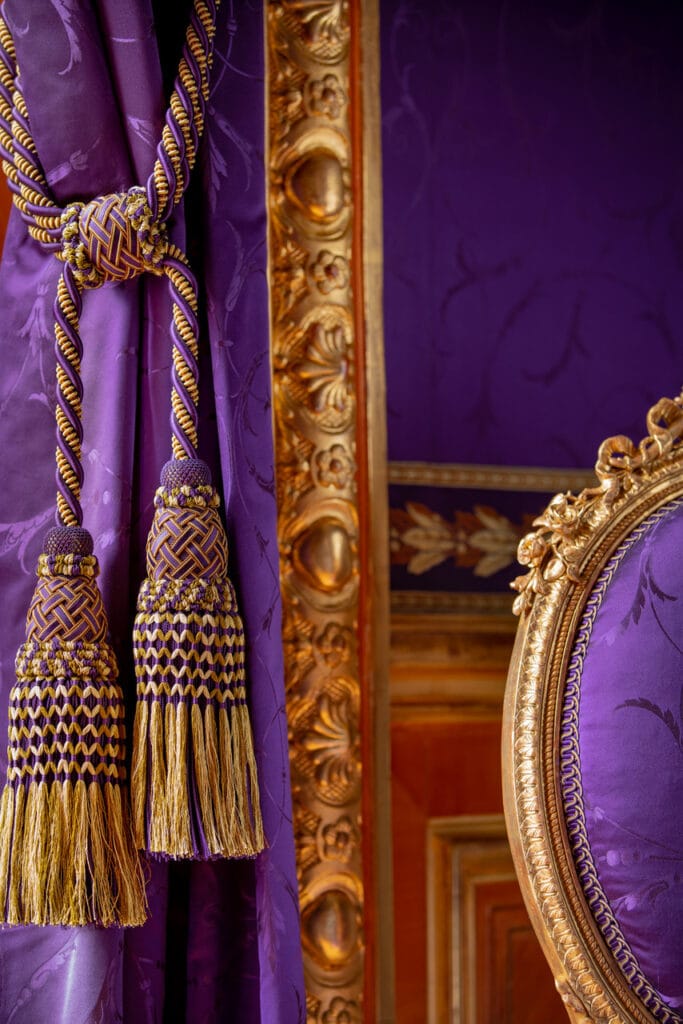
Its threads, fringes, braids and tassels have dressed the defining moments of French interior decoration. Versailles, Chantilly, Fontainebleau, Vaux-le-Vicomte. The Opéra Garnier. The Hôtel de la Marine, reopened in 2021 after a six-year restoration. The house of Pierre Loti in Rochefort. And most recently, the passementerie for the King’s private bedroom at the Palace of Versailles. These are not commissions for ordinary suppliers. They call for custodians of rare knowledge, craftspeople who can recreate the exact twist of a silk thread, the density of a tassel, the precision of a handmade braid as it was executed in the seventeenth century.
And all of this could stop. Not for lack of orders. Not for lack of clients. But for lack of cash.
172 years. Seven generations. A heritage that cannot be replicated
Passementerie is one of those crafts that is easy to misunderstand from a distance. It looks like decorative accessory work, superfluous ornament, the kind of thing the minimalist era should have swept away. The opposite is true.
Passementerie is the textile signature of an era, the element that gives an interior its identity, coherence and finish. It is to upholstery what embroidery is to haute couture: the detail that says nothing was left to chance.
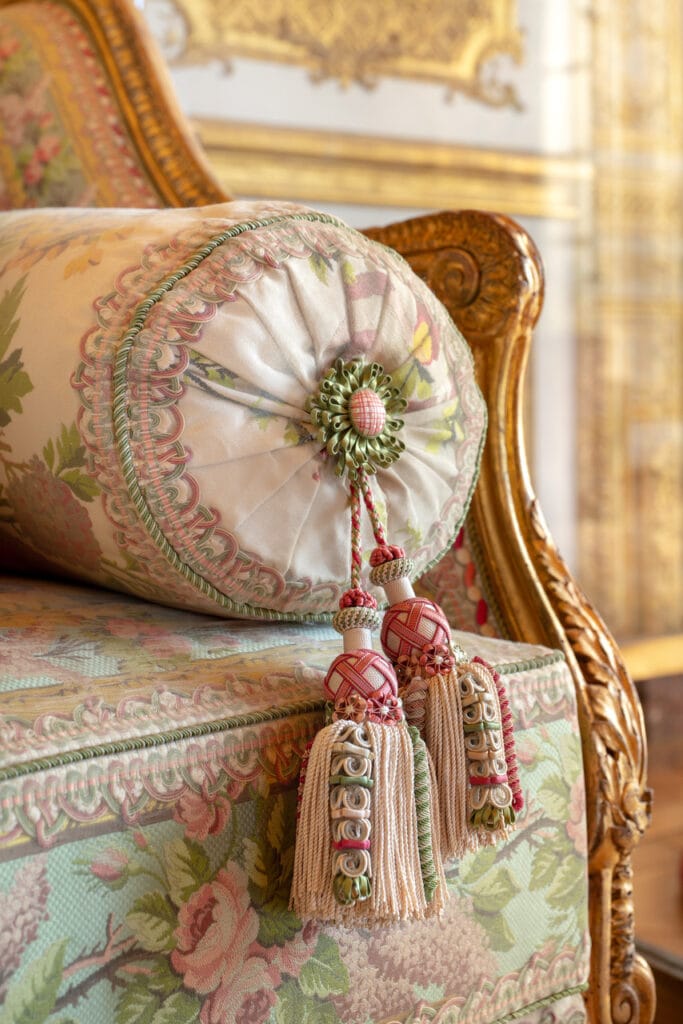
At Declercq, there are no standardised collections; there are archives. Displayed in the house’s Paris showroom, they form a vertiginous panorama of French and European decorative history. Louis XIV models sit alongside Art Deco creations; Second Empire reissues in dialogue with contemporary pieces. These archives are not a museum.
They are a working tool, a living memory drawn upon by interior architects, historic monument restorers and the most demanding decorators in Europe, seeking the precision of a past era or a piece that carries its DNA without impersonating it.
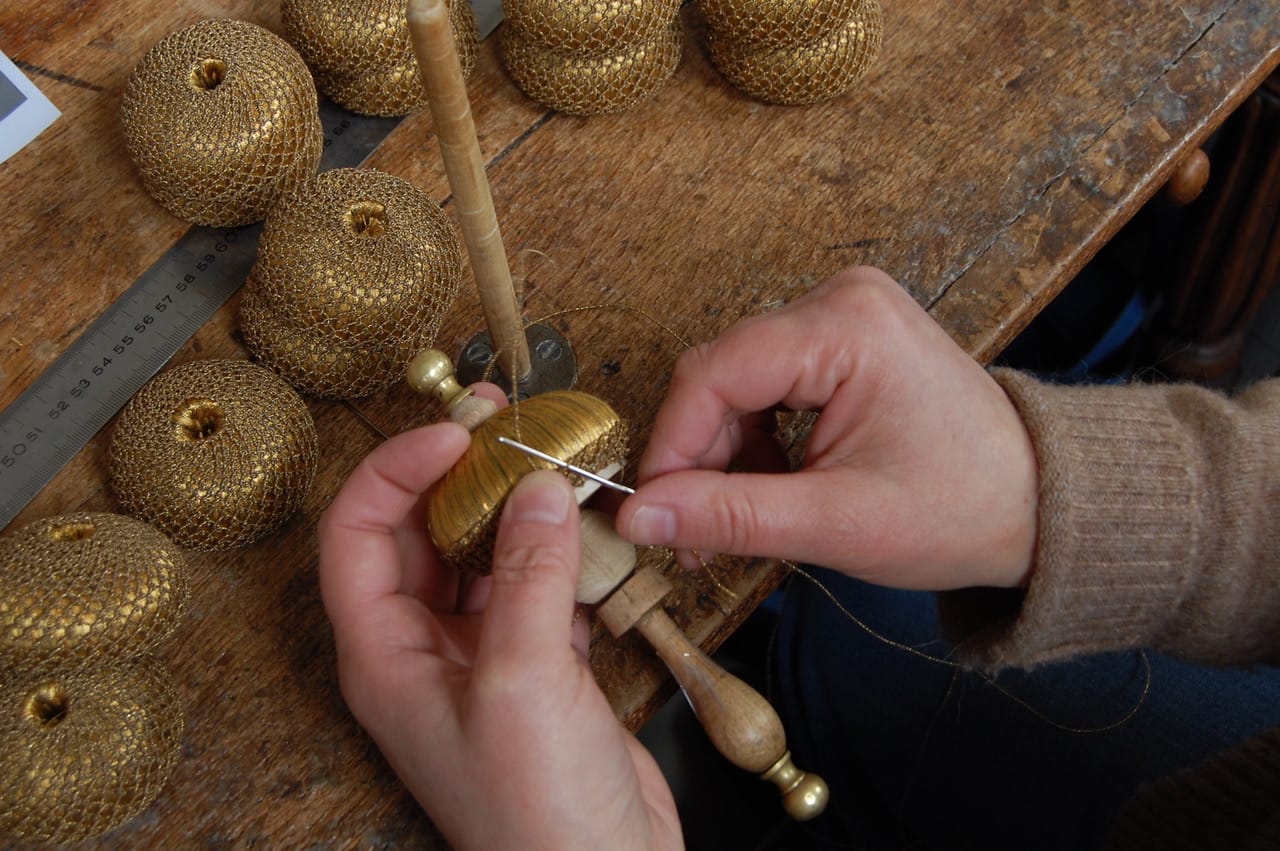
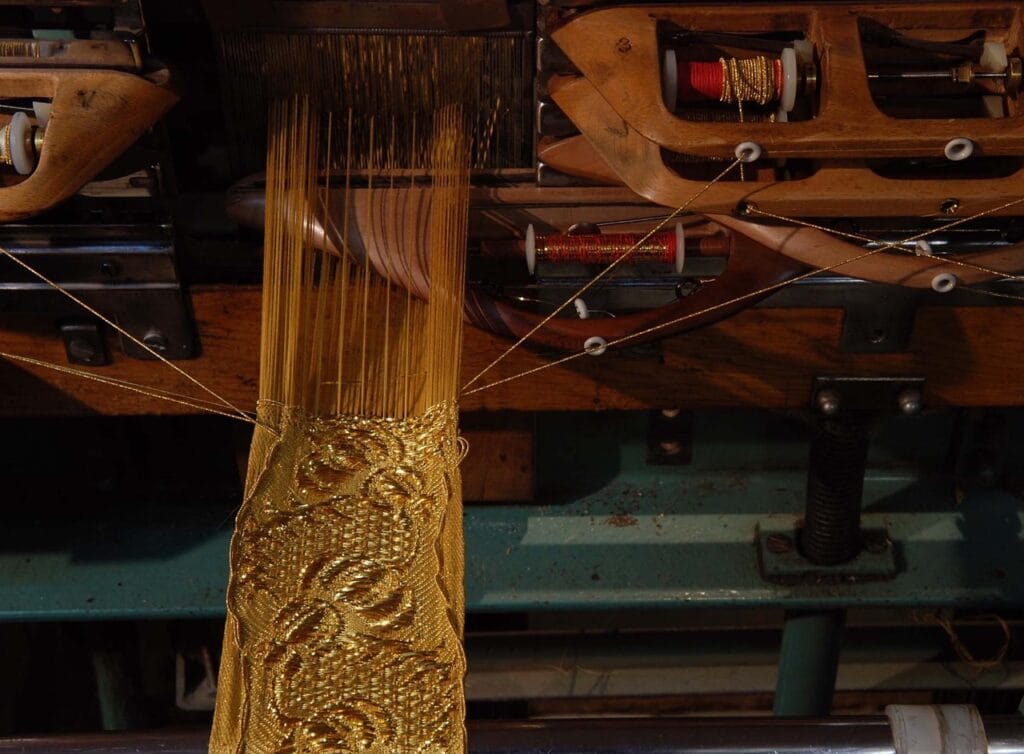
The looms that produce these trimmings are no longer manufactured. Some are over a century old. Maintaining them is itself a form of expertise, handed down from craftsperson to craftsperson in the workshops. When a machine like this breaks down beyond repair, no industrial catalogue offers a replacement. It takes an irreplaceable production capacity with it. When a house like Declercq closes, the same is true at the scale of an entire institution.
The orders are there. The cash flow is not
Here is the cruel irony: Declercq is not a business without a market. Management is clear: the orders are there. Clients who have trusted the house for decades continue to commission it for the most sensitive projects. But cash flow, weakened by years of structural strain, no longer allows the house to operate with the fluidity that craft production demands. Sourcing raw materials, paying artisans, financing the delays inherent to precision work that cannot be rushed, all of this requires available funds that the house no longer has.
Faced with this impasse, Declercq Passementiers has launched a fundraising campaign. A decision not taken lightly by a house so deeply rooted in tradition and discretion. But sometimes survival requires the humility to say that help is needed and to say it out loud, to those who understand what is at risk.
To support Declercq Passementiers and contribute to the campaign: access the fundraiser here.
Every contribution counts, not as a symbolic gesture, but as a concrete act to keep alive a production capacity that generations of craftspeople have built, and that no one can recreate from scratch.
A region, an identity, a workforce
Montreuil-aux-Lions, in the Aisne, is not a name that appears on luxury tourism maps. But it is a region that has built its identity around artisanal textile production for centuries. Declercq’s presence here is not incidental, it is part of a historical continuum that makes this corner of France one of the heartlands of French passementerie. Keeping production here means keeping local jobs, skills transmitted within a specific community, a human chain that cannot be offshored.
It is also, at its core, a question of territorial identity. Craft knowledge is not interchangeable between regions. When a workshop closes in the territory where it has historically been rooted, something is lost that goes beyond the economic. The passementerie-making culture of the Aisne, like other French regions defined by precision craft traditions, is a cultural reality as much as an industrial one.
France’s craft paradox: celebrated in speech, abandoned in practice
Declercq’s situation is not an isolated case. It is symptomatic of a deep contradiction in how France relates to its craft heritage. On one side: genuine national pride, institutional discourse about living heritage, labels like Entreprise du Patrimoine Vivant ( which Declercq holds ) ostensibly designed to identify and protect custodians of exceptional know-how. On the other: an economic reality that grinds small structures down with near-total indifference.
Energy cost increases since 2021 have hit craft workshops hard: workshops where running machines, heating spaces and maintaining equipment represent an incompressible share of overheads. Unlike industries that have rationalised, automated and compressed labour costs, craft excellence cannot sacrifice human time without sacrificing the quality that justifies its existence. A passementier who works faster is no longer a passementier. They are an industrial operator.
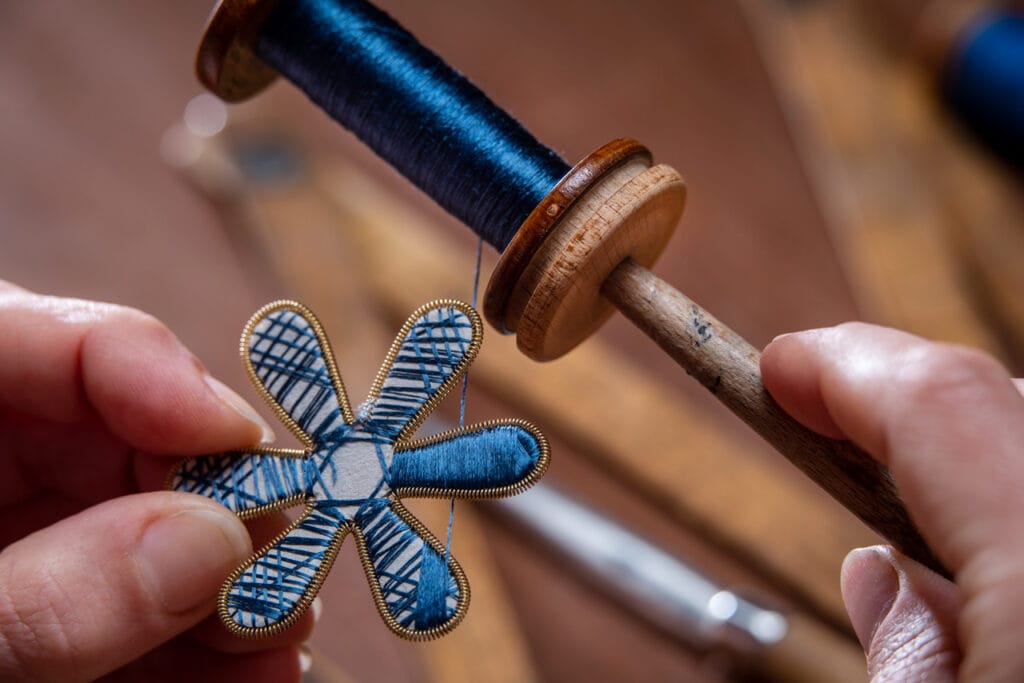
Transmission of expertise is an additional structural problem. Training a passementier takes years. Keeping them in the workshop requires salaries that small structures struggle to offer in a labour market that values manual skills differently. Recruitment is difficult, training is long, and the ageing demographic of master craftspeople has created a transmission pressure the sector has mismanaged for two decades. It is a challenge found across all workshops of excellence in France.
Then there is the industrial competition,operating in a different category, yet capturing part of the market. Trimmings produced in Asia on digital looms, at incomparably lower prices, serve a segment of clients who cannot or choose not to distinguish. The same challenge faces high-end upholstery fabrics against industrial imitation. Houses like Declercq, which cannot and will not enter that logic, find their positioning reduced to a niche, even if that niche is called Versailles.
Mechanisms do exist but they arrive too late, in piecemeal fashion, without the coherence needed to address structural difficulties accumulating over years. What is missing is a public policy that acknowledges that certain companies hold irreplaceable cultural value and that their liquidation is a collective loss, not merely a private one.
Other countries have understood this differently. Japan’s Living National Treasure designation – ningen kokuhō – formally recognises master craftspeople whose knowledge is deemed irreplaceable, with state stipends and transmission obligations attached.
Italy has built part of its global soft power on preserving its craft districts: its textile houses are the clearest example, and they have held their ground where others have not. France, meanwhile, continues to let companies like Declercq fight alone against cash flow difficulties that a few tens of thousands of euros would resolve while investing millions in the very monuments these craftspeople are the only ones qualified to furnish.
What we stand to lose
Picture an inventory of the Declercq showroom in ten years, if the house were to close. Samples scattered across auction sales. Archives that no one has the means to digitise or preserve. Looms dismantled, their setting secrets gone forever. Craftspeople redeployed, their gestures forgotten. And restoration projects, ten or twenty years from now, forced to make do with approximations where precision was once possible.
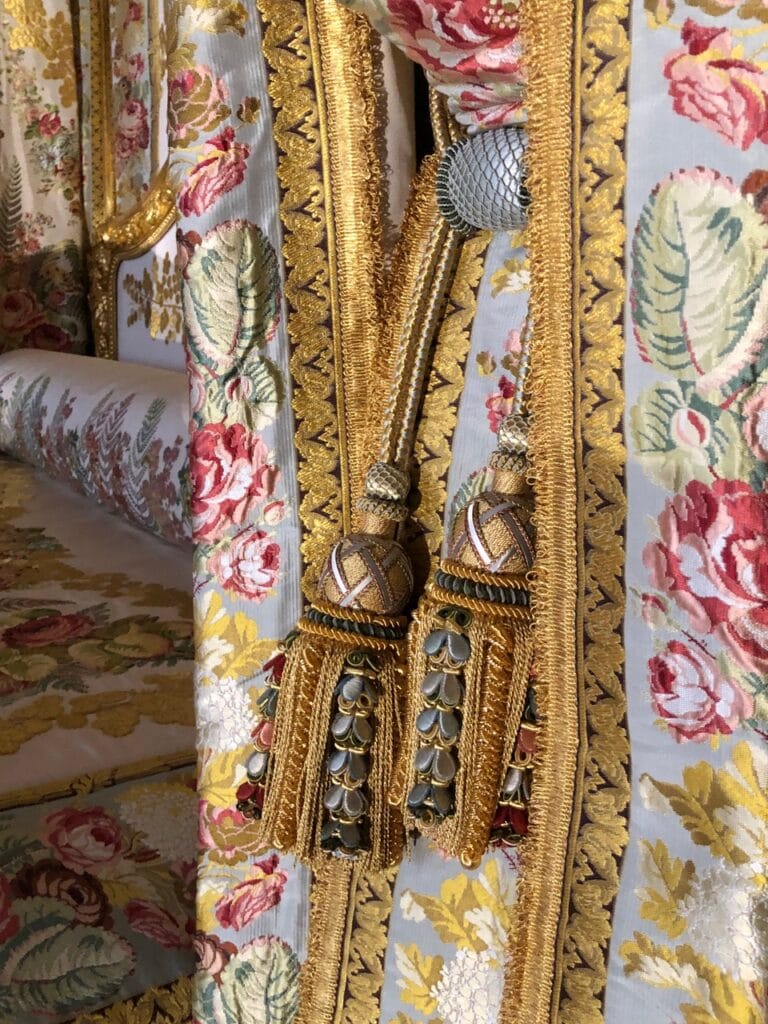
This scenario is not inevitable. The campaign Declercq has launched is a window, narrow, urgent. It rests on a simple conviction: among those passionate about design and heritage, among the network of architects, decorators and informed enthusiasts who understand what a hand-knotted silk tassel is worth, there are enough people to make a difference.
Supporting Declercq means supporting seven generations of a family who chose, every morning, to carry on. It means supporting craftspeople in the Aisne whose invisible expertise dresses the finest interiors in France. It means affirming, concretely, that exceptional craft deserves better than dying in silence in a liquidation report.
A single thread can hold an entire tapestry together. It just has to hold.
To contribute to the campaign and support Declercq Passementiers: Sauvons Declercq Passementiers.
Digital entrepreneur and craft artisan.
My work bridges craftsmanship, design history and contemporary creation, shaping a personal vision of luxury interior design.
Since 2012, I have been based in my workshop on the shores of Lake Annecy, creating bespoke interiors for architects, decorators and private clients.