


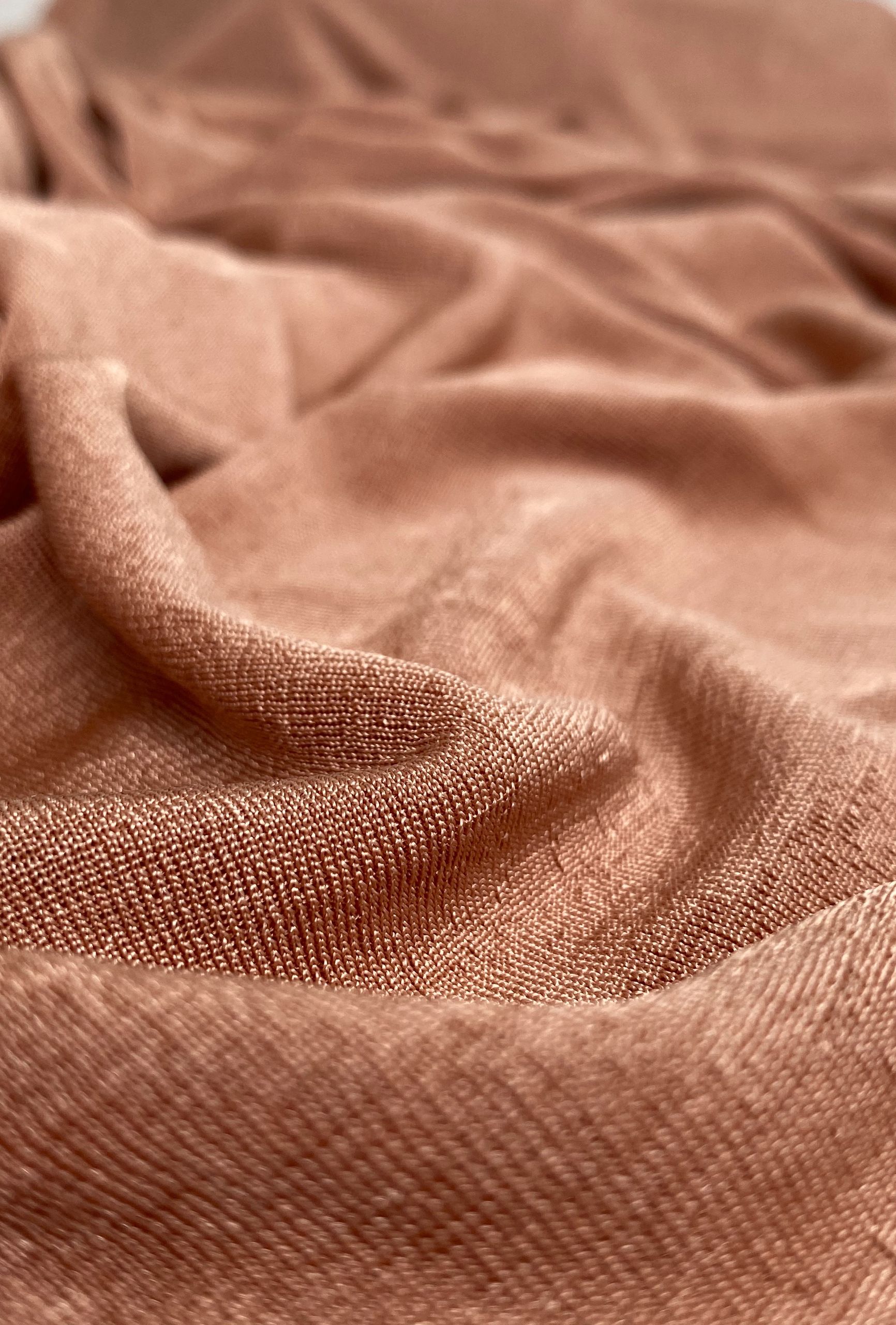
HART textile materials guide: viscose
When it first appeared at the end of the nineteenth century, it was called “artificial silk”. Viscose was invented to imitate silk at a lower cost, and it kept silk’s sheen, softness and drape. Today it is everywhere in furnishing fabrics, from luminous velvets to supple jacquards. Neither natural nor synthetic in the usual sense, it deserves to be understood before it is chosen.
This guide offers a clear, neutral reading of viscose: what it really is, how it is made, where it belongs in an interior, its limits, and what to check before choosing it for a demanding project.
Contents
What is viscose
Origin and manufacturing process
Textile classification and label codes
Look and feel
The weak point: water
Uses in interiors
How viscose ages
Durability and technical performance
Care and practical constraints
Environmental impact: the facts
Before you choose
What is viscose
Viscose belongs to the family of man-made fibres of natural origin, also called regenerated cellulose fibres. It is produced from cellulose, usually from wood, which is dissolved and then regenerated as a filament. Unlike cotton or linen, whose fibre already exists in the plant, viscose is reconstituted by an industrial process.
That in-between position explains the confusion around it: it is readily sold as “plant-based”, while in fact it involves heavy chemical processing. In furnishing, it is used alone or blended with cotton, linen, wool or polyester, mainly for sheen, softness and drape.
Origin and manufacturing process
The principle was born at the end of the nineteenth century, when chemists and manufacturers were trying to reproduce silk. The viscose process, patented in England in 1892, turns cellulose into a thick, viscous solution, hence the name, then forces it through spinnerets into a bath that regenerates it as filaments. These are then drawn, stabilised and spun.
Several fibres grew out of this idea. Classic viscose is the most common in upholstery. Modal is a stronger, more stable variant. Lyocell, often sold under a brand name, uses a different solvent recycled in an almost closed loop. Cupro, rarer, is made from cotton linter.
Textile classification and label codes
How viscose appears on a label
France: Viscose
Europe (ISO code): CV
United States: Rayon or Viscose
CV is the most common code in Europe. In the United States, rayon refers to viscose and, more broadly, to regenerated cellulose fibres. Faced with a fabric sold as “silky” or “plant-based”, the official composition remains the only reliable information.
Look and feel
Viscose is valued for its visual and tactile qualities:
– a sheen close to that of silk, especially in velvets and satins
– a soft touch and a supple hand
– a fluid drape, precious for curtains and decorative fabrics
– excellent dye uptake, giving deep, saturated colours
These qualities depend on how the fabric is built. In velvet, pile height and density matter as much as the fibre: a dense viscose velvet has nothing in common with a loose one. By comparison, cotton velvet is more matt and sturdier, and mohair velvet far more hard-wearing and durable.
The weak point: water
Viscose absorbs a lot of moisture, which helps it take dye but also weakens it: when wet, it loses much of its strength, which it regains as it dries. That explains most unpleasant surprises: water rings after spot cleaning, shrinkage, velvet pile crushed or marked after a spill.
Uses in interiors
Curtains and drapery
Thanks to its drape, viscose works well for curtains and hangings when you want an elegant fall and a luminous surface. Mechanical strength matters less than on a seat, but light and cleaning still need planning: a viscose curtain should be lined.
Decorative cushions and accessories
In low-wear uses, it brings texture and sheen. Appearance comes first, provided you accept some caution with rubbing, stains and moisture.
Seating and sofas
Viscose velvets are very common on seating. Whether they suit depends on the fabric (density, construction, abrasion, blend) and on how hard it will be used: a formal drawing room or a second home is not the same as a family sofa. For everyday use, a blend with cotton or polyester often wears better. Our guide to high-end sofas helps you choose well.
Fabric walls and headboards
These uses expose the fabric to light and ambient air for years. Viscose can work, but colour stability, especially in pale shades, and its reaction to humidity need anticipating. This is upholsterers’ work, mastered by the ateliers in our upholstery workshops directory.
How viscose ages
Viscose changes with rubbing, humidity, UV, cleaning frequency and weave quality. Watch in particular for:
– crushing of the pile where people sit and lean, in velvets
– shiny or marked patches
– sensitivity to moisture and to some cleaning methods
– colour change in very pale shades exposed to light
The key is to match the fabric to real use: a fabric that is seductive at first sight is not necessarily the one that will age best on a seat used every day.
Durability and technical performance
A fabric’s performance is not just its fibre: density, weave, yarn, finish and blend matter just as much. A viscose velvet can give very different results from one collection to another. Check:
– abrasion resistance (Martindale) against the intended use
– colour fastness to light and rubbing
– dimensional stability (distortion, shrinkage)
– cleaning instructions and tolerance to spot cleaning
To read abrasion cycles against use, see our complete guide to the Martindale rub test.
Care and practical constraints
Viscose calls for particular care, especially in velvet or on sensitive surfaces. The essentials:
– Avoid excess water and harsh cleaning
– Test any stain removal on a hidden area
– Follow the manufacturer’s instructions, often professional dry cleaning
– On velvet, lift the pile with steam held at a distance rather than rubbing
Environmental impact: the facts
Environmentally, viscose raises three questions. Where the wood comes from: cellulose from sustainably managed forests, certified FSC or PEFC, does not weigh the same as cellulose linked to deforestation. How it is made: the classic process uses carbon disulphide, a toxic solvent whose handling varies widely between plants, while lyocell recycles its solvent in an almost closed loop. How long the fabric will last: a textile replaced often cancels out the benefits of its raw material.
To judge a fabric, look at traceability (origin, process, certification) as much as lifespan. Over the long run, the longer a textile keeps its function and appearance, the more coherent the choice, the approach described in our overview of eco-design.
Before you choose a viscose fabric
– A soft touch and a fluid drape
– Deep colours, thanks to excellent dye uptake
What to check
– Performance: Martindale, fastness, density
– Real use: decorative or heavy daily use
– Care: stains, moisture, dry cleaning
When to consider viscose
– Lined curtains, drapery, cushions, moderate use
– Dense, well-built or blended fabrics suited to the expected wear
When to be particularly careful
– Everyday seating, children, pets, risk of spills
– Very pale shades exposed to strong light
– Projects where maximum longevity is the priority
Conclusion
Viscose is neither a “fake” material nor a universal solution. It is a regenerated cellulose fibre, chosen for its visual qualities, whose suitability depends on the fabric itself, the intended use and the standards of the project. In a high-end interior, the rightness of a textile is measured over time: knowing the material, reading the technical data and matching it to use remain the best criteria. To place it among other fibres, see our guide to exceptional upholstery fabrics, and to find it, the high-end upholstery fabric brands.
HART guide
Textile materials, fibre by fibre
Each fibre has its own origin, processing, way of ageing and limits in use. These guides form a reference base for understanding natural, man-made and synthetic textiles before choosing a fabric.
Alpaca/Cotton/Hemp/Linen/Mohair/Polypropylene/Raffia/Silk/Viscose/Wool
Go further
- Textile materials: the overview → Natural, man-made and synthetic fibres compared
- Exceptional upholstery fabrics → An editorial and cultural reading of high-end textiles
- Linen, wool, silk → Why natural fibres dominate luxury textiles
- Upholstery fabric brands from A to Z → Textile houses, editors and their know-how
- The Martindale rub test → Reading real performance against use
- Luxury trimmings → Braids, fringes and textile finishes
- Upholstery workshops directory → The ateliers that work noble textiles
- Textile wallcoverings → Natural or synthetic, the matter on the wall