

Le Chapitre, Eric Schmitt’s house-studio
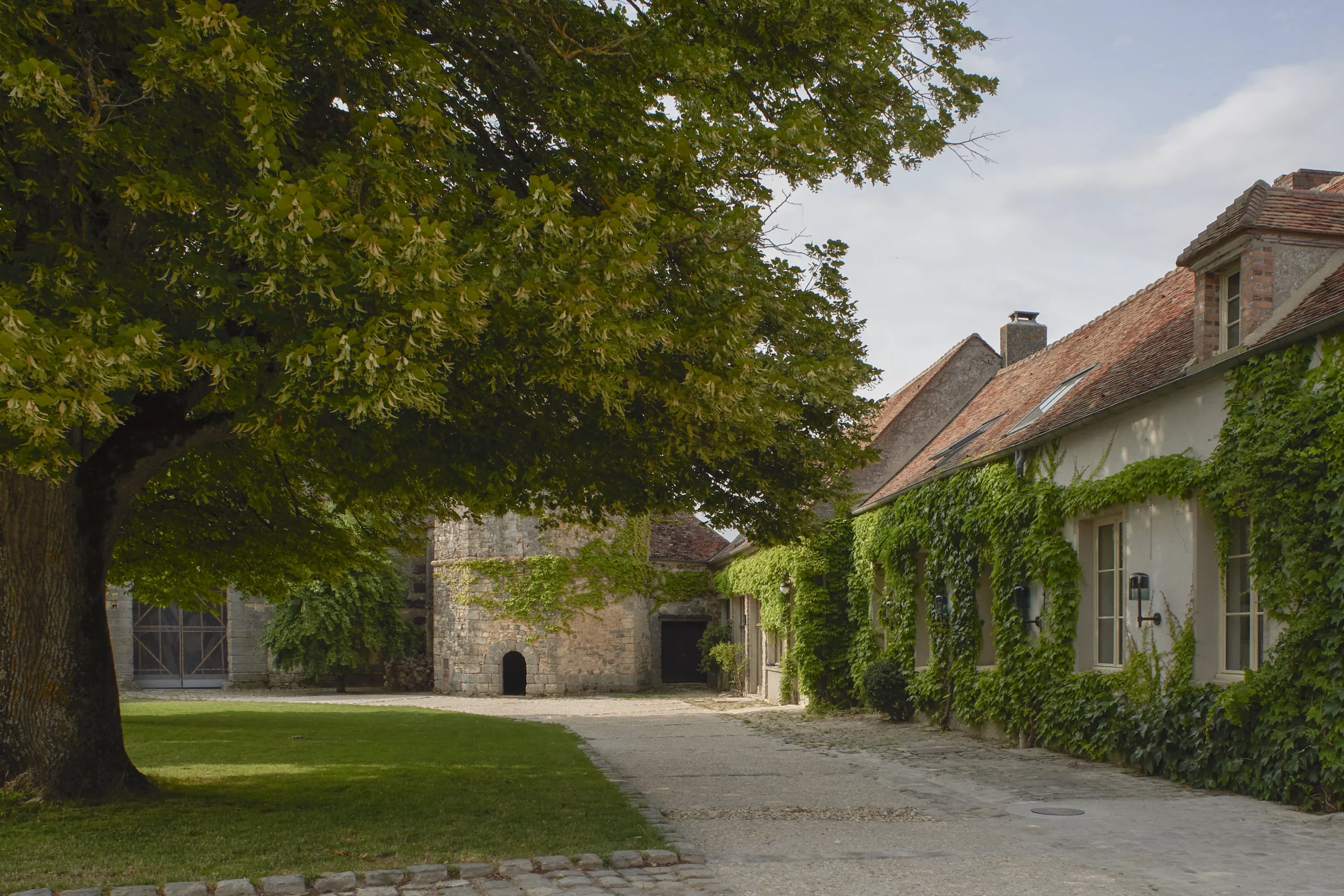
A few steps from the Fontainebleau forest, a house reveals itself without ever imposing. Named Le Chapitre, it is neither a manifesto residence nor a frozen décor but a deeply inhabited place, shaped by time, material and the gestures of everyday life. Here lives and works Eric Schmitt, alongside Sandra Babeanu.
Together they have brought into being a rare space, poised somewhere between country house, studio and intimate refuge. Behind its ancient walls, Le Chapitre reads like an open book: each room a paragraph, each object a sentence, each patina a trace of passing time.
The living room, a living memory of the house
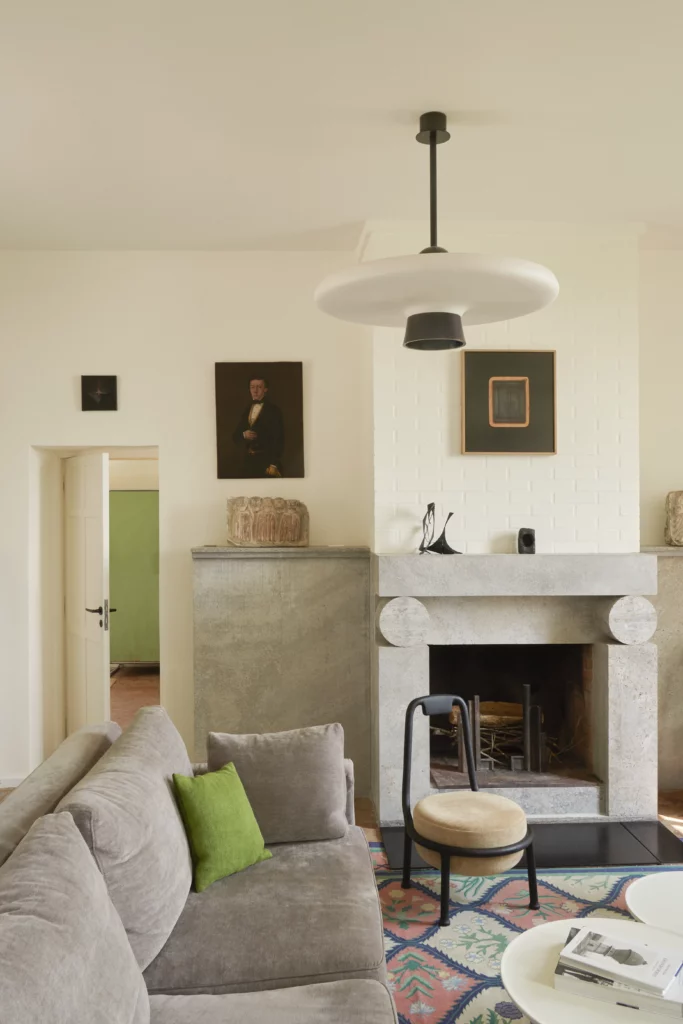
The living room sets the tone immediately. An immense 20th-century woven rug with polychromatic floral motifs covers almost the entire floor, establishing a soft and enveloping atmosphere from the first step inside. Velvet sofas in linen from Liaigre sit alongside sculptural pieces in patinated cast aluminium designed by Eric Schmitt a low coffee table and seating. The lines are as sober as they are precise.
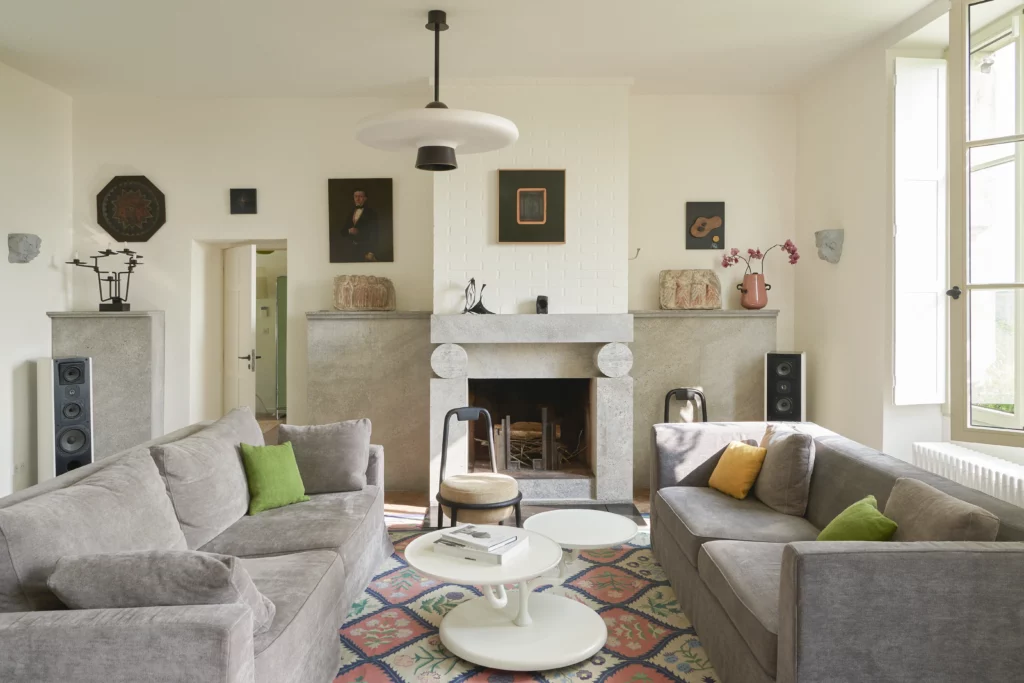
At the centre of it all, the Münchausen fireplace acts as an anchor. Originally conceived for a hotel project, it has been reinterpreted here on a domestic scale without losing any of its authority. Around it, a work by Philippe Gronon, a family portrait and a handful of carefully chosen objects compose a sensitive décor where each element seems to have found its place naturally, over time.
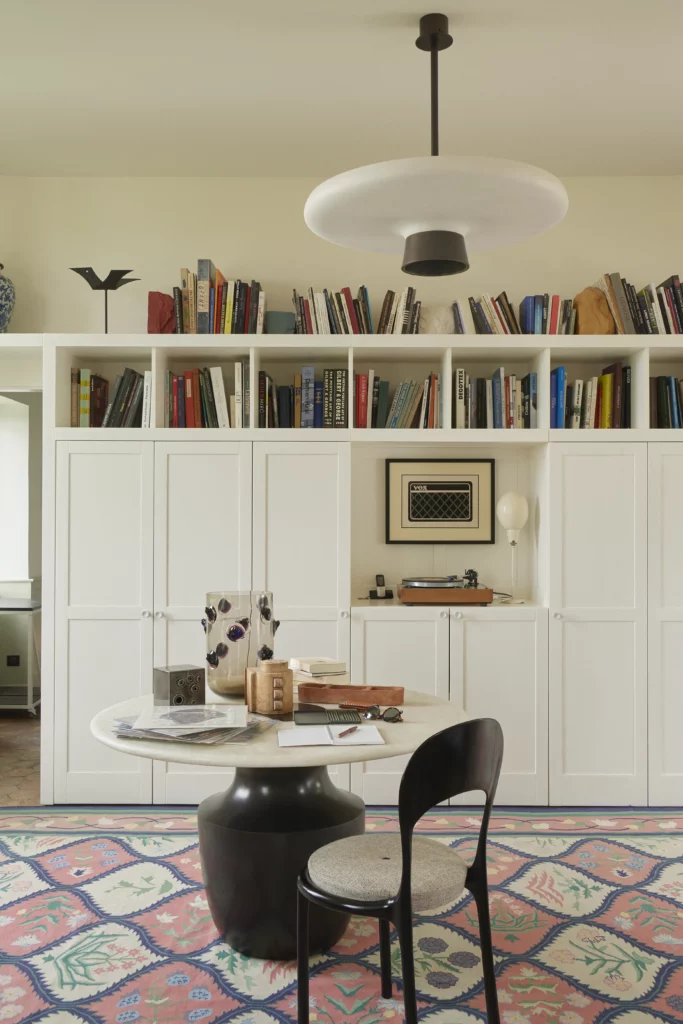
In the living room of Le Chapitre, a Jarre table in patinated bronze and marble dialogues with the Colonne console installed beneath the window, both designed by Eric Schmitt. A pigment photograph by Philippe Gronon and a painting by Charles-Henri Monvert form a free composition where art, material and use coexist with quiet ease.
A kitchen conceived as a living space
At the heart of Le Chapitre, the kitchen is anything but a functional afterthought. Designed as much for daily rituals as for shared meals, it holds the same compositional intelligence found throughout the rest of the house.
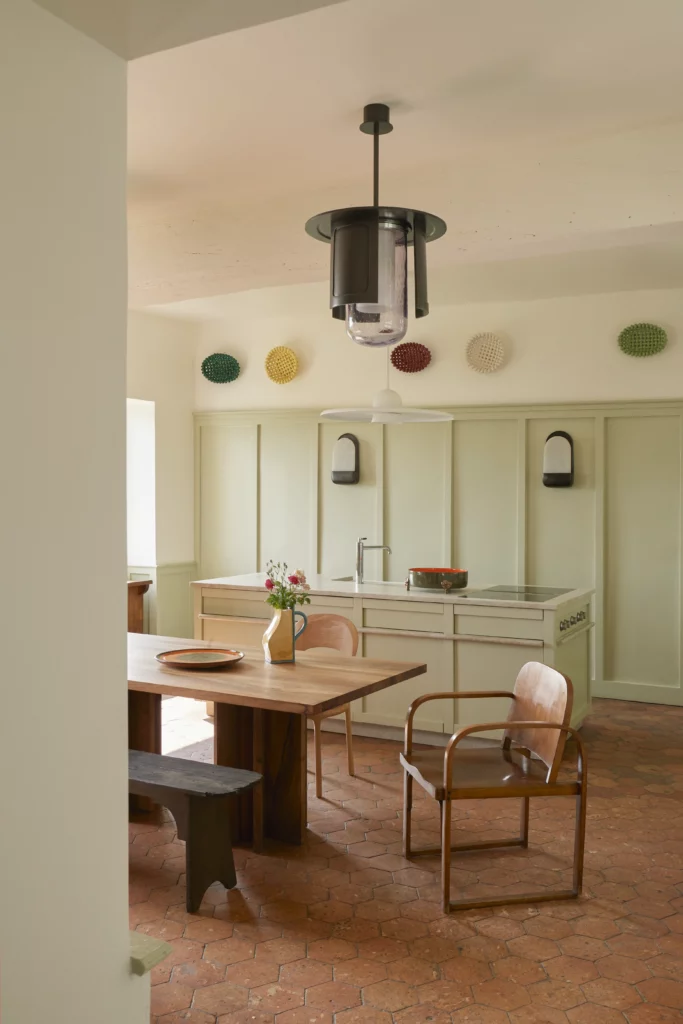
The island, crafted in lacquered wood and Taj Mahal stone, structures the room with evident clarity. Handles and plinths in matching stone extend this precise visual grammar, while generous drawers absorb the practical without cluttering the eye. Positioned to offer the finest views during meal preparation, the island becomes something of a vantage point over the life of the house.
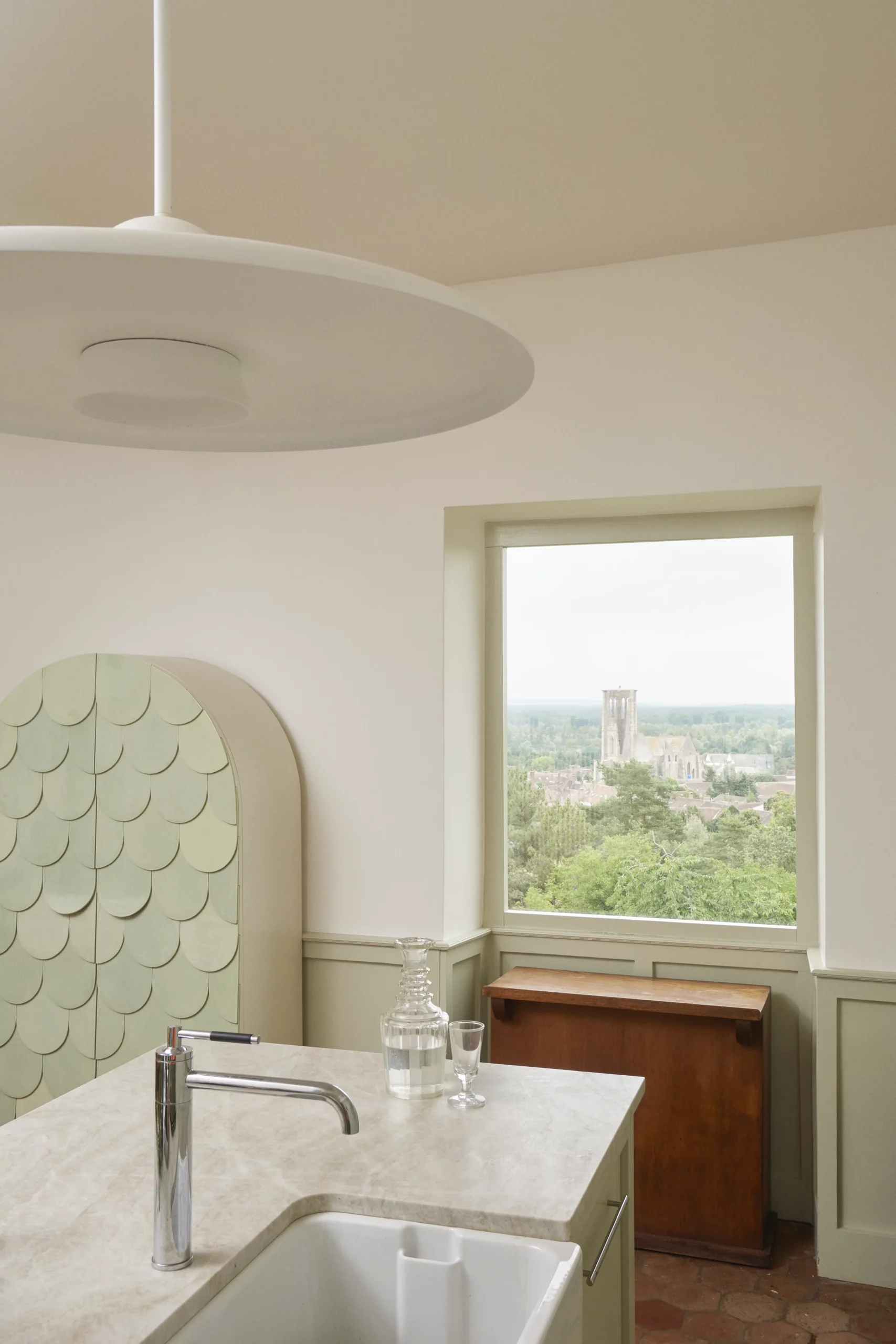
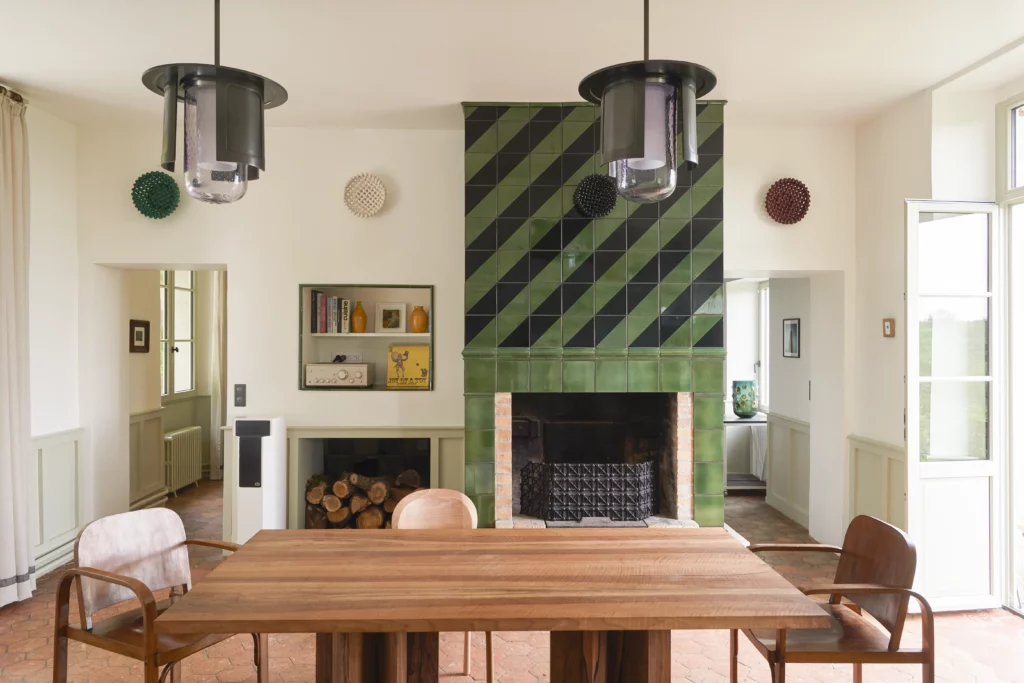
Light is never incidental here. Pâle pendants in patinated bronze and Bohemian glass, the Inlight model designed for Ralph Pucci, and bronze and alabaster wall lights give rhythm to the space without overstatement. On the walls, braided ceramics by Jérôme Massier and pieces presented by the Ibu Gallery are a quiet reminder that this kitchen is above all a lived-in place, rooted in accumulated time rather than studied perfection.
The large walnut dining table, designed to measure by Eric Schmitt, finds its companions in a bench discovered on site, a 1940s chair sourced in Prague and a beechwood seat from the studio. Nothing was planned to match. Everything does.
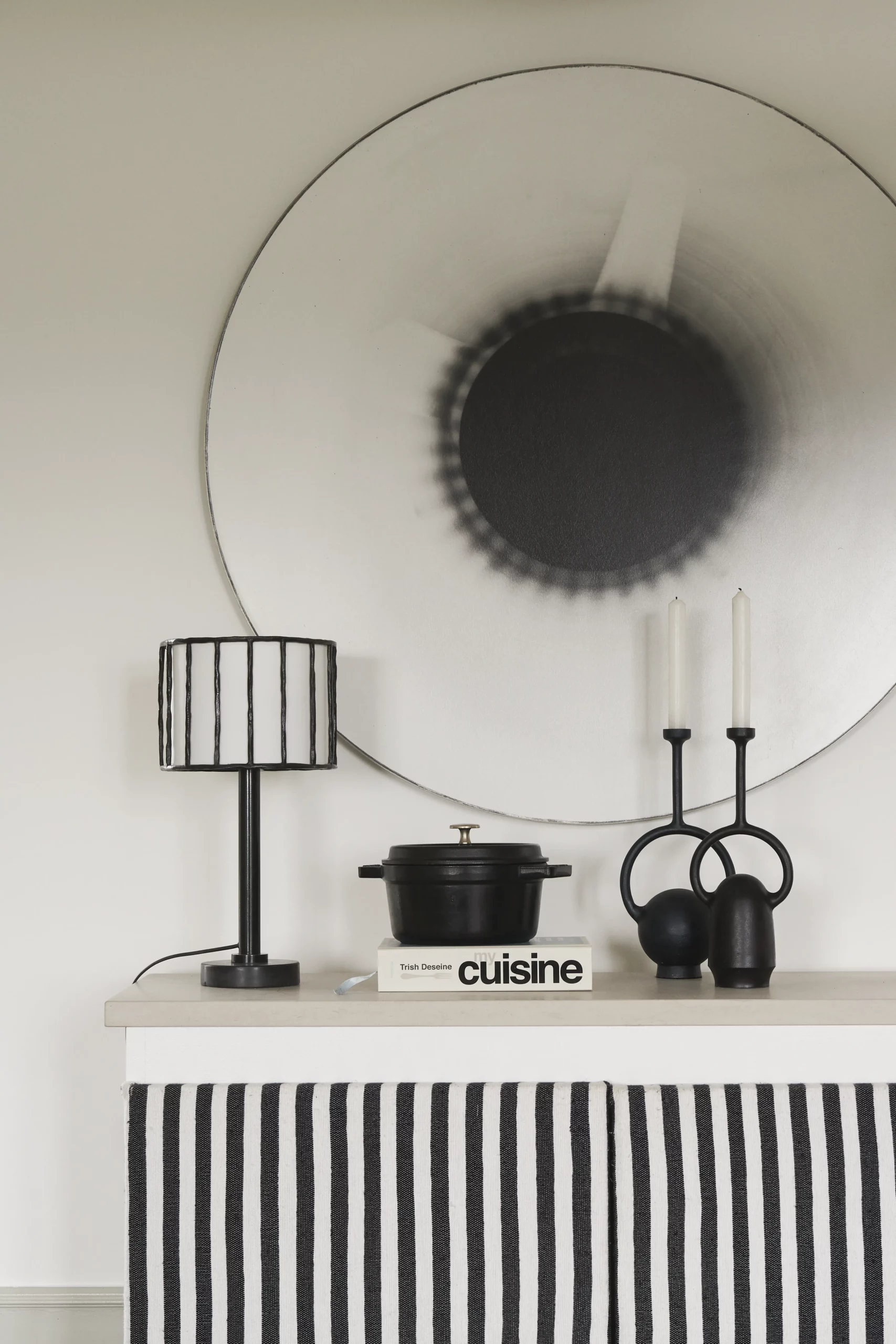
Elsewhere in the kitchen, contrast takes over. Beneath a pale worktop, a black-and-white striped curtain conceals storage with graphic ease. On the shelf above, a black cast iron Staub cocotte rests on a book beside a slender hammered brass lamp signed Eric Schmitt for Barreaux. Flanking it, the sculptural Byblos & Paros candleholders – also by Schmitt,edited by Carpenters Workshop Gallery – complete a kind of contemporary still life where line and material speak more loudly than colour.
Thresholds, circulation and breathing spaces
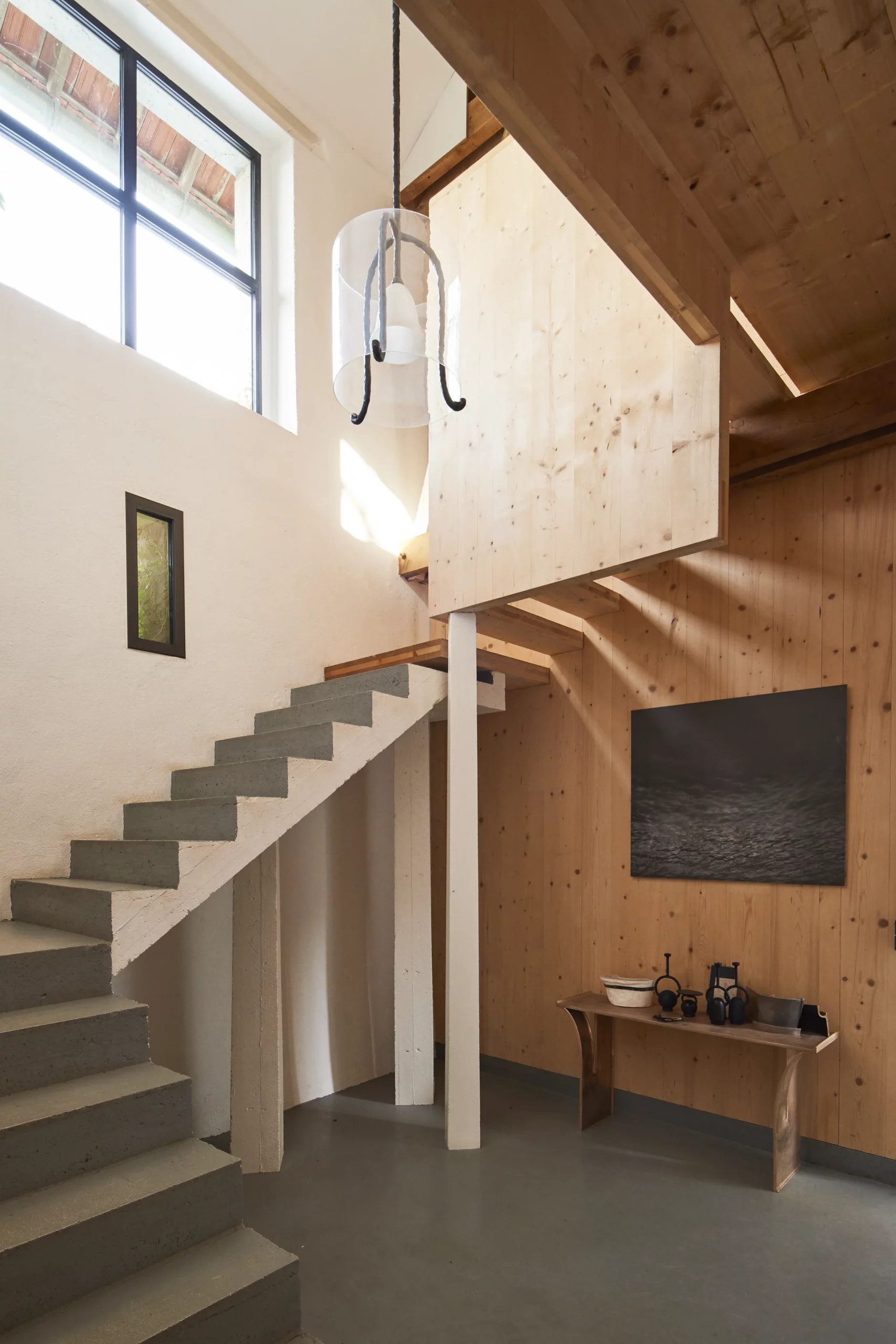
From the very entrance, Le Chapitre states its intentions plainly. The vestibule, paved with traditional terracotta tiles in place of the original parquet, immediately inscribes the house within a material continuity, in something older, more grounded. A modernist tubular steel wardrobe by Thonet Mundus, designed in the 1930s by Hermann John Hagemann, stands alongside walnut and raw wood seating conceived by Eric Schmitt. Seventy years of design history, occupying the same few square metres without the slightest tension.
A threshold conceived not as a passage, but as a first breath.
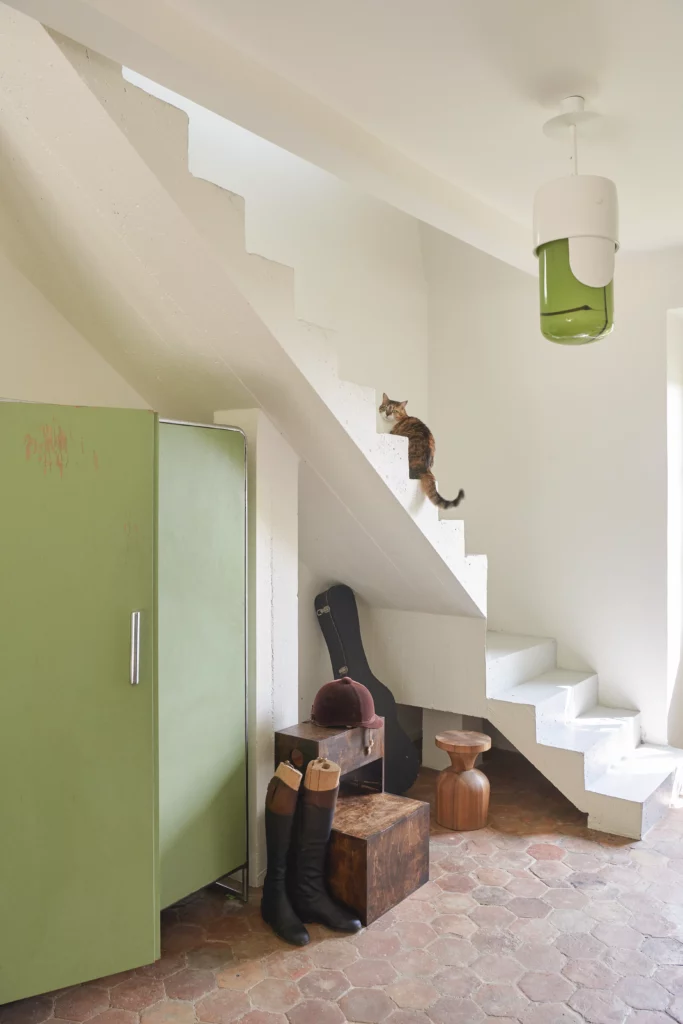
Suspended above, the Lobe lamp in lacquered aluminium and blown Bohemian glass casts a light that is soft and almost ceremonial. The concrete staircase, equally designed to measure, continues this sober and sculptural language upward, connecting the communal spaces to the more intimate rooms above. Quiet luxury at its most architectural.
The bedroom, a patinated refuge
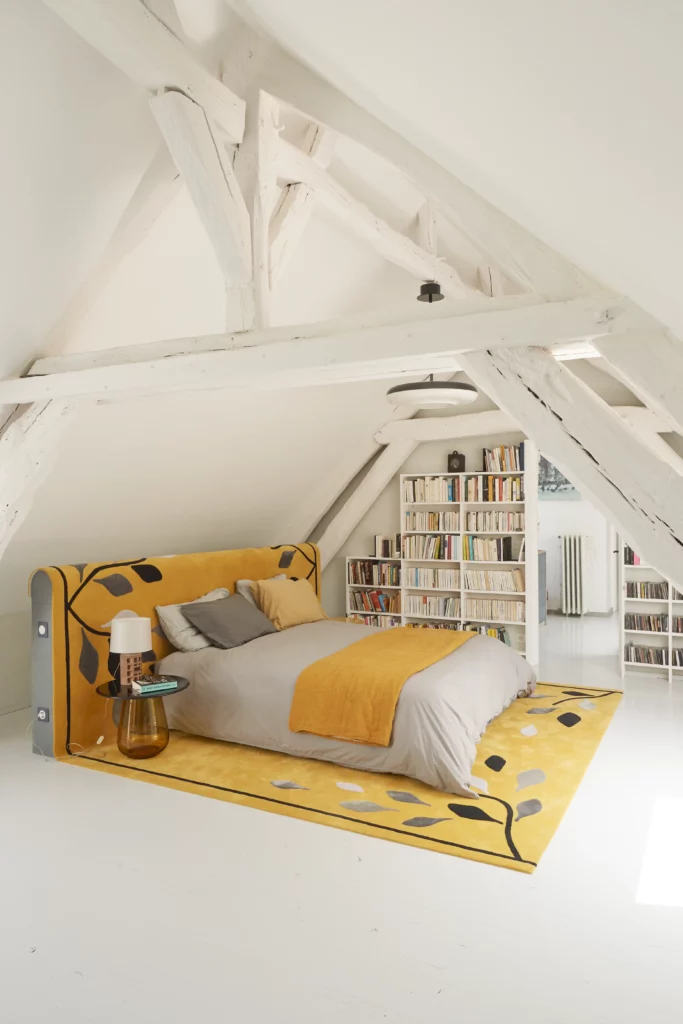
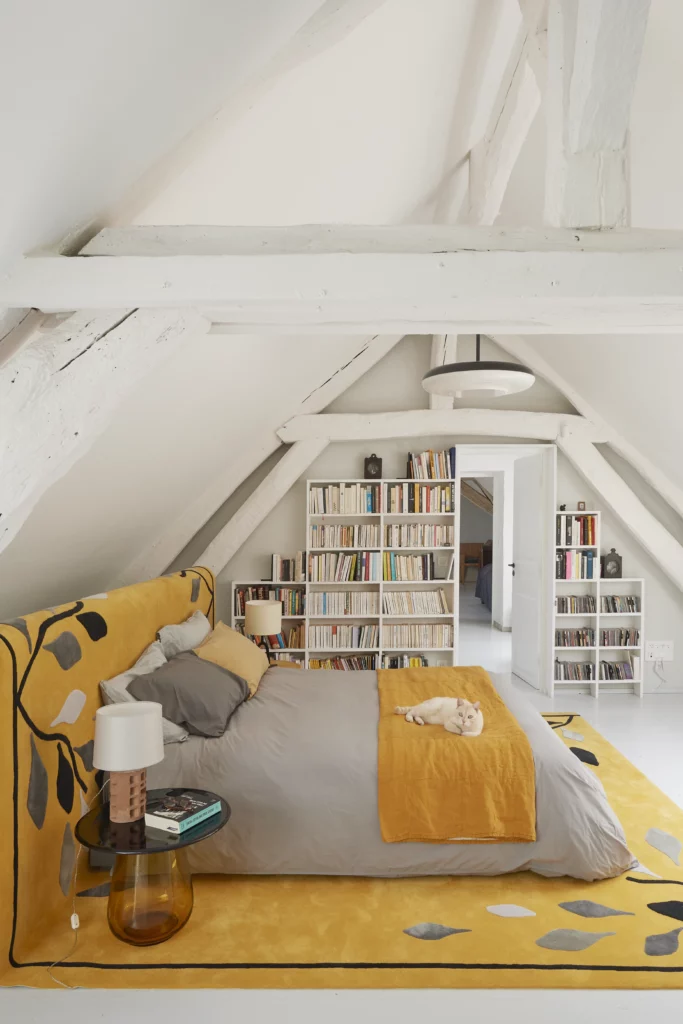
Upstairs, the atmosphere shifts. The bedroom is hushed, almost contemplative. A hand-tufted wool and silk rug designed by Eric Schmitt lies across the grey lacquered parquet, anchoring the space in an immediate tactile warmth.
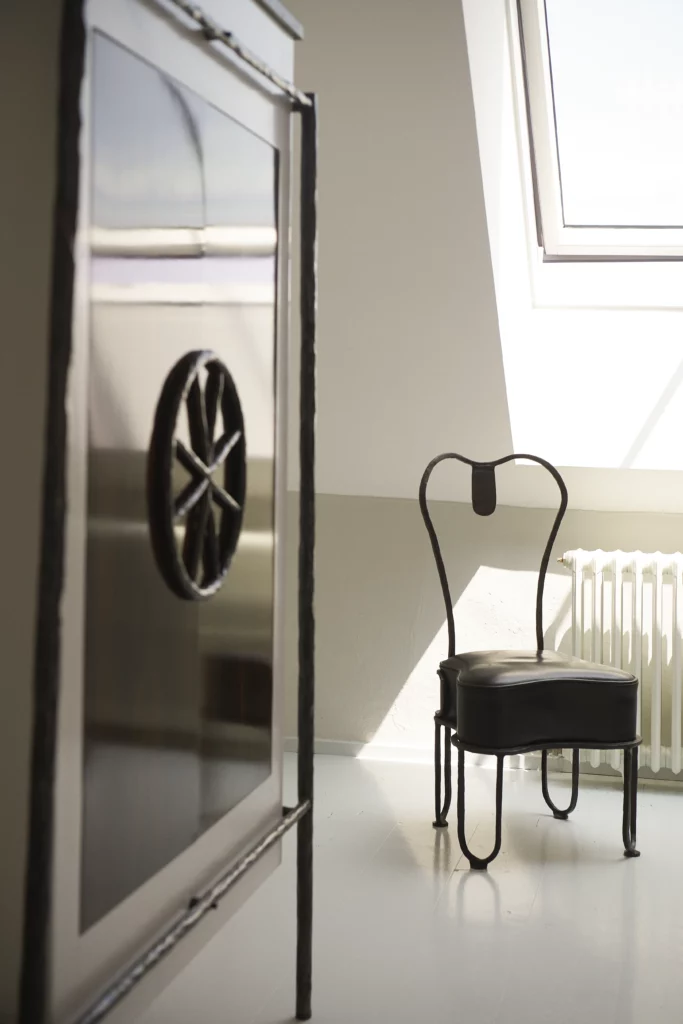
The Champignon bedside tables in Bohemian glass emit a light that feels more like a glow than illumination. Surrounding them, an ensemble of deeply personal furniture – a Macassar ebony wardrobe, prototype seating in bronze, leather and wood – gives the room the quality of something that has grown rather than been arranged.
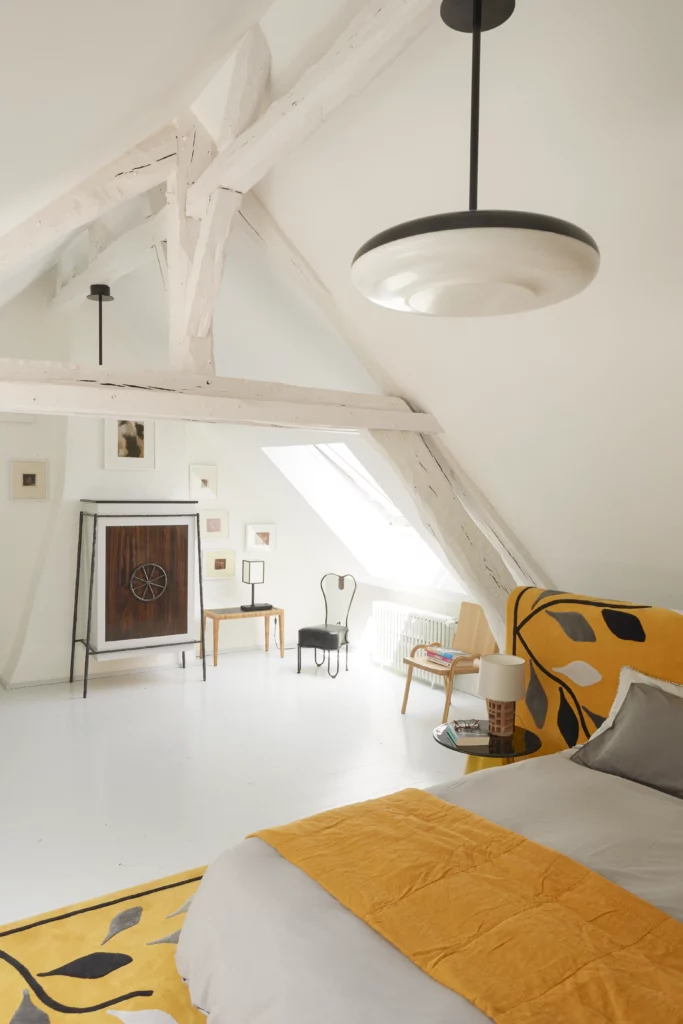
Sculptural pendants blend with terracotta and bronze lamps to draw an atmosphere that is intimate without being oppressive. On the walls, equestrian pastels by Sam Szafran hold a silent dialogue with the space. Society Limonta linen punctuated by a mustard quilted bedspread finishes the picture. This is the kind of elegance that goes unnoticed until you realise you don’t want to leave.
The bathroom, a silent luxury
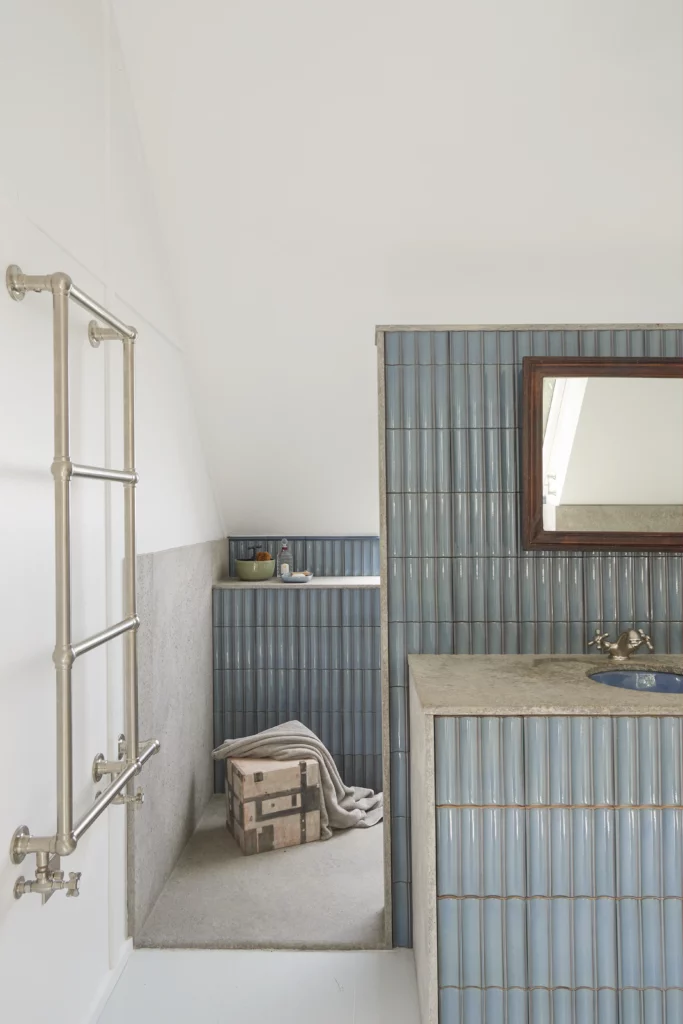
In the bathroom, material dictates everything. Pale blue ceramic tiles by Ceramica Ferres meet the grey Münchausen stone by Blanc Carrare in a décor that is mineral, almost monastic. The grey lacquered parquet underfoot extends this sensation of hushed refinement, as far as possible from any notion of display.
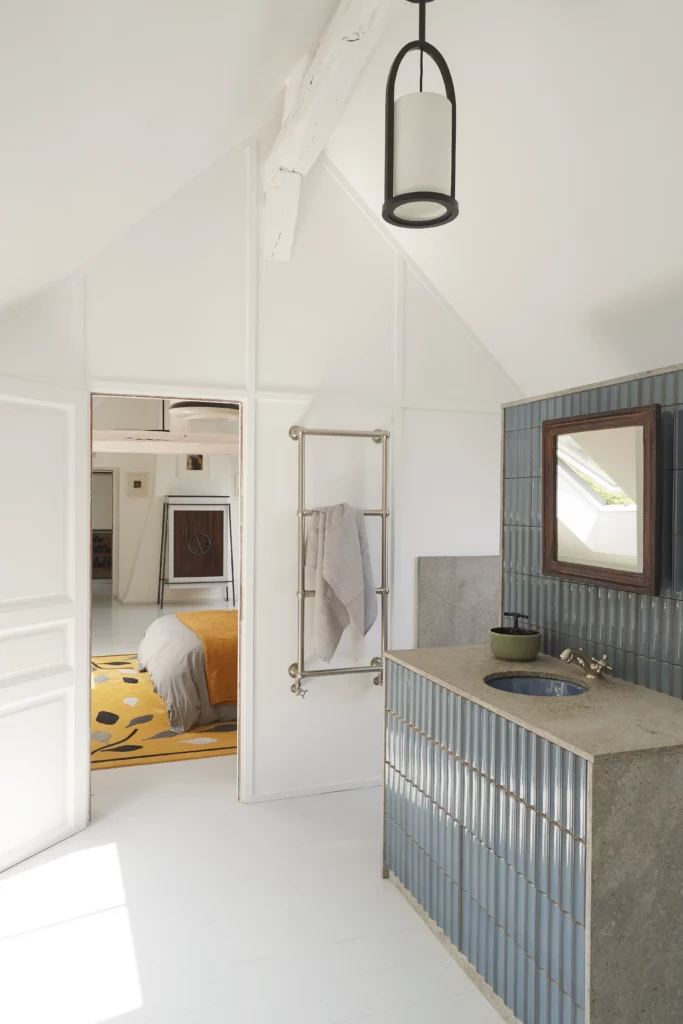
A wrought iron and opaline glass pendant designed by Eric Schmitt wraps the room in light that is soft rather than functional. An antique leather-clad mirror and a modernist ceramic stool found in Prague introduce a timeless quality, the sense that these objects arrived here by instinct rather than decision. The integrated ceramic basin, a ceramic and bronze tray, each detail confirms this as a room for withdrawal, for duration, for calm.
The courtyard, an open-air room
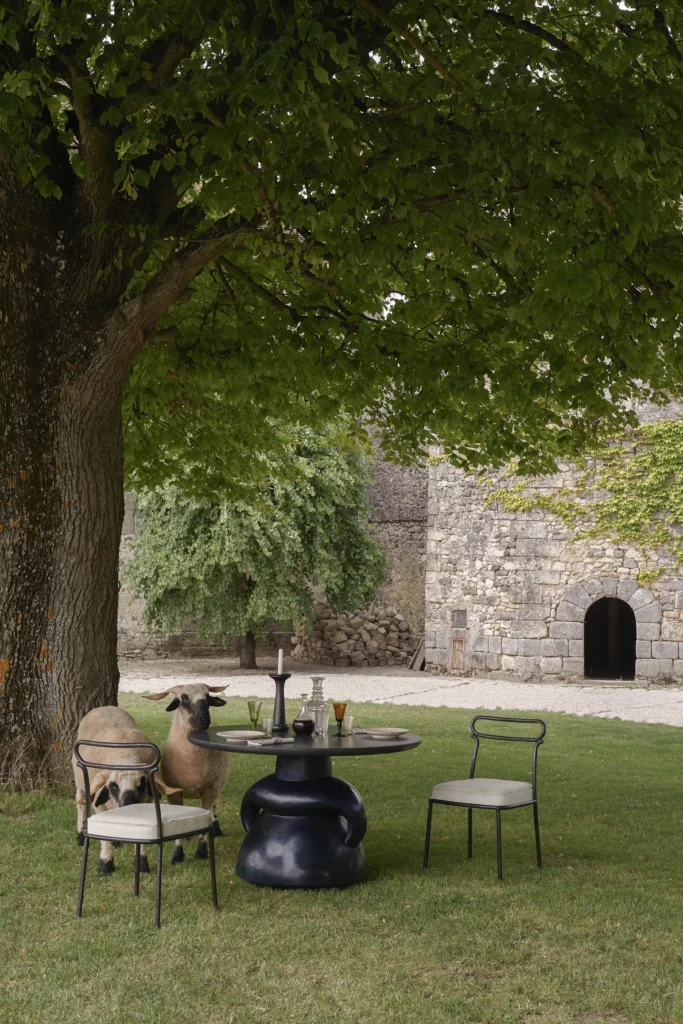
Outside, the courtyard extends the language of Le Chapitre without interruption. A Thessaly table in dark blue patinated bronze with a lava stone top, designed by Eric Schmitt for Carpenters Workshop Gallery, anchors the outdoor space. The sculptural seating in patinated bronze and leather, punctuated by candleholders from the same studio, establishes something that is simultaneously elegant and genuinely relaxed.
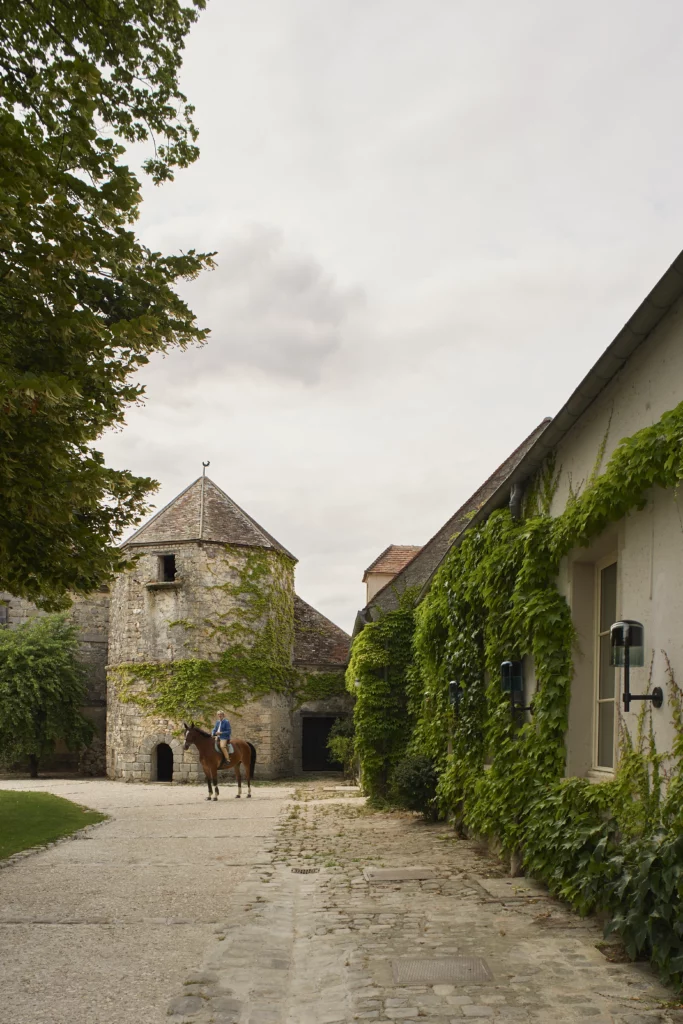
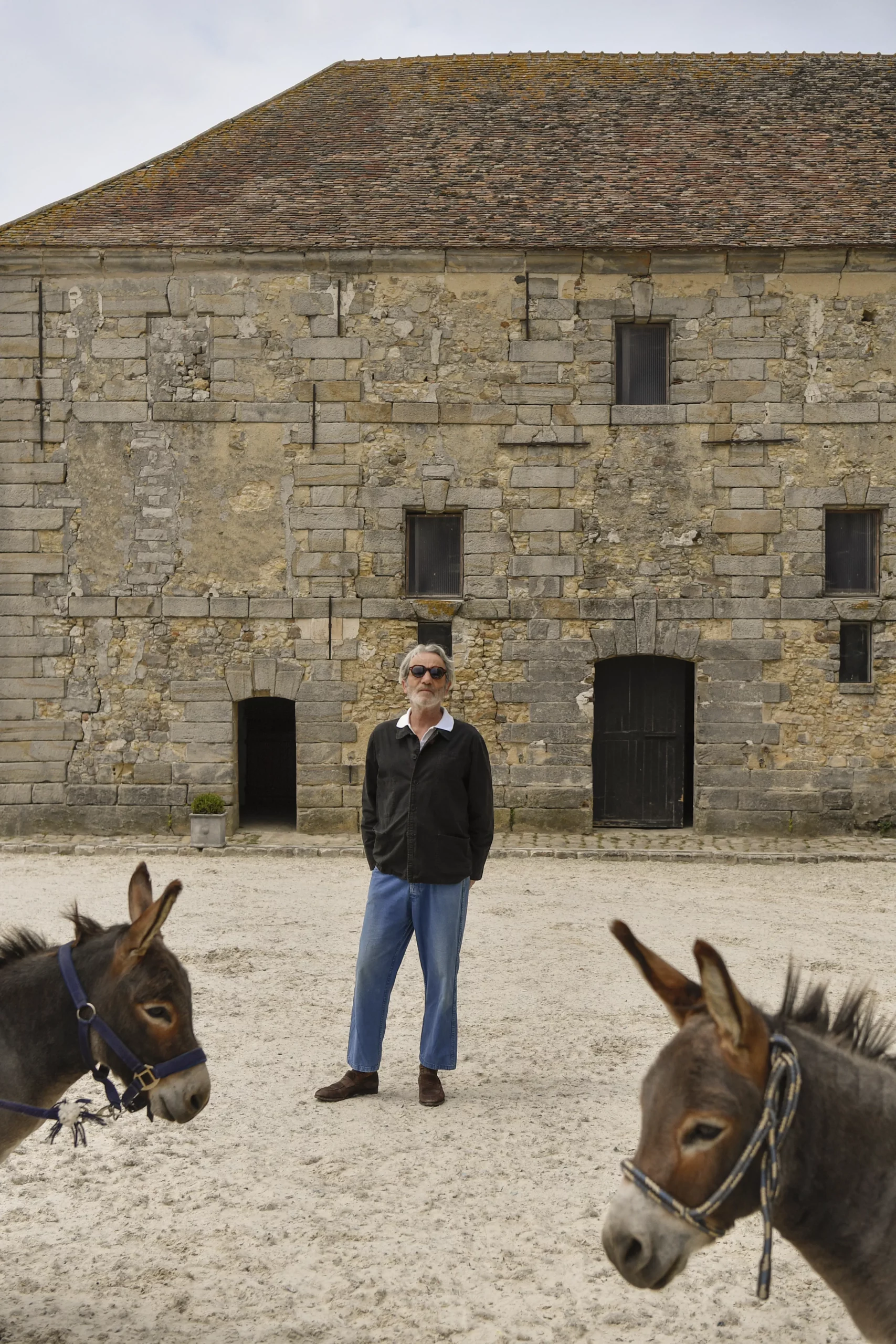
As evening falls, exterior wall lights in patinated cast aluminium and Bohemian glass extend the hours spent outside with the same gentle quality found indoors. On the table, the family’s glassware is a reminder that this space, however composed, exists to be used. The peaceful presence of Shawn and Shirley, two Valais Blacknose sheep, gives the courtyard its most singular note, somewhere between nature, architecture and the unplanned.
The studio, an extension of the house
In the study, the language becomes rawer, more essential. A large antique Romanian wood desk occupies the space with quiet authority, flanked by a traditional Alsatian chair and a 1960s brown leather working armchair. Nothing here exists for effect. Each piece was chosen for its rightness, its durability, its honesty.
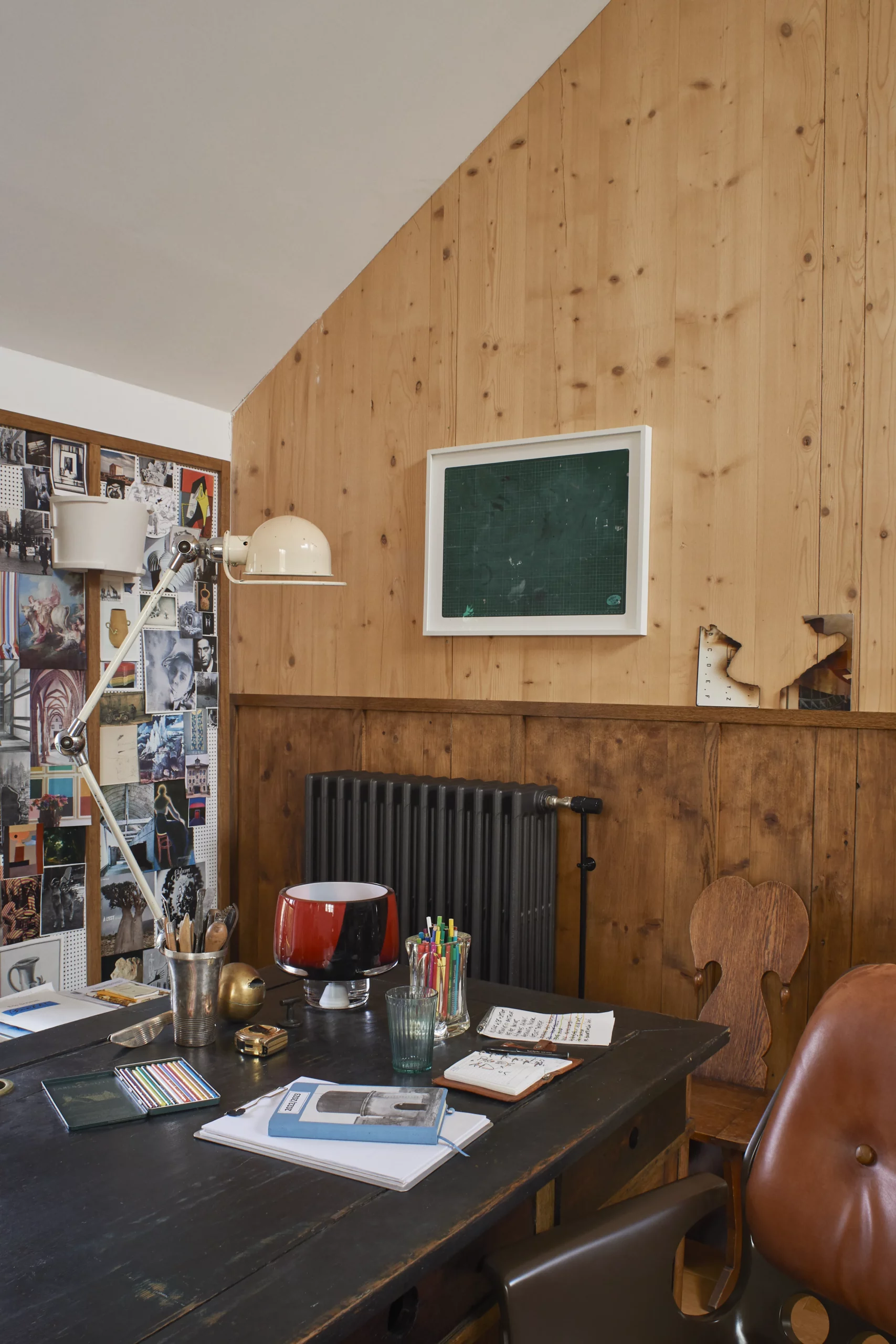
Mid-height panelling wraps the walls, structuring the volumes and lending the room a hushed, concentrated quality. The light is deliberately contrasted: a plaster wall light designed by Schmitt alongside an industrial lamp, the pairing underlining the functional nature of the space without sacrificing atmosphere. On the wall, a work by Philippe Gronon introduces a silent, almost meditative presence.
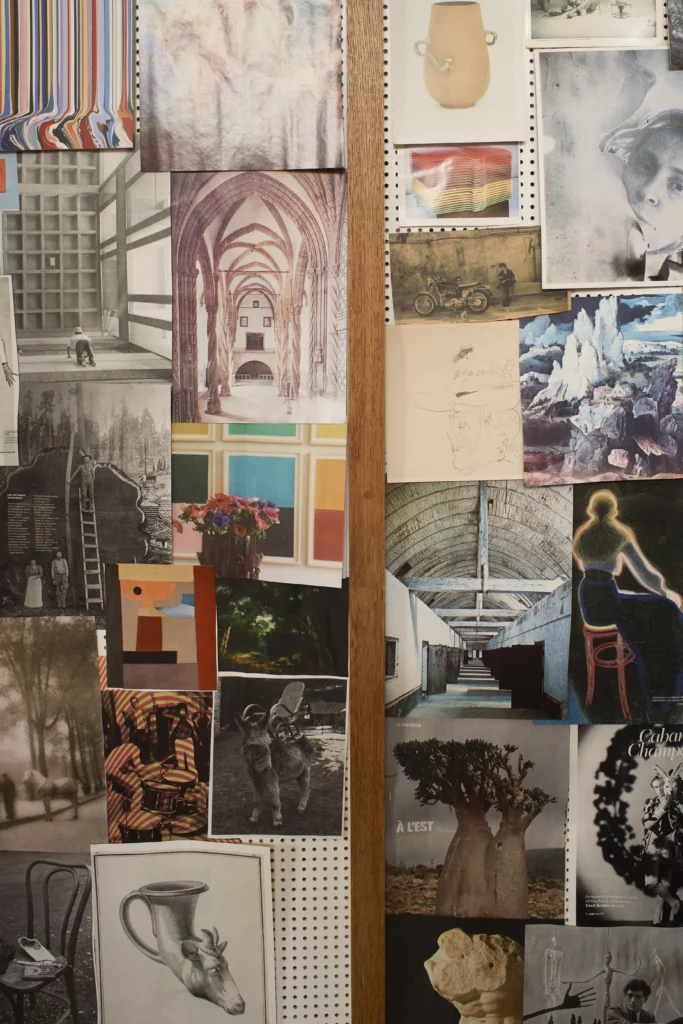
A Bohemian glass bowl on the desk, a few chosen objects on the shelves… this study is, before anything else, a personal space. One where creation, memory and the ordinary rhythms of daily life converge without ceremony.
The stable, gesture and the living
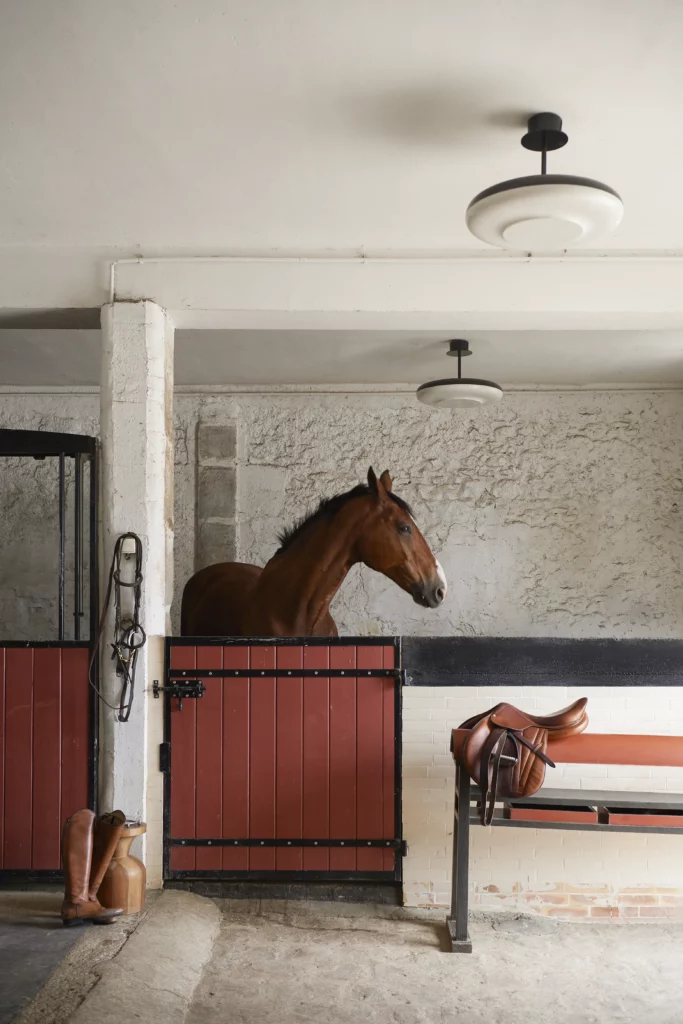
Set apart from the main house, the stable extends the universe of Le Chapitre by other means. More functional in its purpose, it is nonetheless approached with exactly the same attention to form, material and gesture. An Amazone saddle rack signed Eric Schmitt, gifted by Christian Liaigre, sits alongside a walnut stool designed by the studio. The Chapter pendants in Corian and metal cast a light that is soft, controlled, considered.
The equestrian equipment – saddle, bespoke boots – forms a composition that is simple and precise. Nothing superfluous. The presence of the horse, photographed in the neighbouring box, is the clearest reminder that this is a space of practice, of connection, of craft and movement.
A house that reads itself through time
Le Chapitre is neither a showcase nor a demonstrative manifesto. It is a house that accepts wear, transformation, the unexpected.
More than a place, it is a way of inhabiting the world, with attention, with patience, and with that rare elegance that is born when material is left free to tell its own story.

Architecte d’intérieur et chef de projet indépendant, j’allie expertise technique et sensibilité esthétique. Des travaux de structure aux finitions, j’ai développé une connaissance approfondie des matériaux, que je partage à travers l’écriture pour transmettre ma passion du design et de l’architecture