

Marcel Breuer: from the Wassily chair to Modern Democratic Design
Dessau, 1925. A young carpentry master at the Bauhaus rides his new Adler bicycle through town and keeps looking down at the handlebars. If a factory could bend steel tube that lightly and that strongly, why not a chair? Within months, Marcel Breuer (1902-1981) had built one of the first pieces of furniture in bent tubular steel, the chair the world now knows as the Wassily. He was twenty-three.
For anyone who loves interiors, Breuer matters twice over. His tubular steel chairs, the Wassily and the Cesca above all, invented a new family of furniture and remain in production almost a century later. And the same man went on to become one of the great architects of the post-war years, from the Whitney Museum in New York to the UNESCO headquarters in Paris and the ski resort of Flaine in the French Alps. Few designers have moved so convincingly from the armchair to the building.
From Pécs to the Bauhaus
Marcel Lajos Breuer was born on 21 May 1902 in Pécs, in southern Hungary. At eighteen he left for Vienna to study art, stayed only a few weeks, and in 1920 joined the Bauhaus in Weimar, the school founded the year before by Walter Gropius. He entered the carpentry workshop, where his talent quickly stood out.
His early pieces, such as the slatted wooden armchair of 1922, show the influence of the Dutch De Stijl movement and Gerrit Rietveld: planes and lines assembled like a composition, with the sitter almost an afterthought. When the school moved to Dessau in 1925, Gropius appointed him head of the furniture workshop. He was one of the first former students to become a Bauhaus master, alongside teachers such as Wassily Kandinsky, Paul Klee and László Moholy-Nagy.

The bicycle and the tube: the Wassily chair (1925-1926)
The chair first known as model B3 takes the bulky club chair of the nineteenth century and reduces it to a drawing in space. A frame of bent, nickel-plated and later chromed steel tube carries taut bands of fabric, then leather, for the seat, back and arms. The early versions used Eisengarn, a waxed cotton canvas woven at the Bauhaus; leather came later. The frame was bolted rather than welded, so the chair could be taken apart and shipped flat, a very industrial idea for 1925.
Kandinsky admired the piece, and Breuer made one for the painter’s house in Dessau. The name came much later: when the Italian manufacturer Dino Gavina reissued the chair in the early 1960s, he called it “Wassily” in tribute to the painter. Before Gavina, it had been produced by Standard-Möbel, a small Berlin firm Breuer co-founded, then by Thonet. Since Knoll took over Gavina in 1968, Knoll has been its authorised maker.

The Wassily sums up the Bauhaus ambition: to reconcile art and industry and make modern furniture from industrial materials. Tubular steel, until then reserved for bicycles and machines, becomes a material for the home. To understand why designers fell for it, our guide to metal in design traces the story of steel, chrome and brass in furniture.
The Cesca and the battle of the cantilever (1928)
In 1928 Breuer designed the side chair B32 and its armchair version B64. The frame is a single bent tube with no back legs: the seat is held in cantilever, which gives the sitter a slight, comfortable spring. The seat and back are framed in beech with woven cane, a deliberate meeting of industrial steel and traditional craft. Gavina later named it “Cesca”, after Breuer’s daughter Francesca.
Breuer was not alone with the idea. The Dutch architect Mart Stam showed a cantilevered chair in 1926, and Ludwig Mies van der Rohe presented his own, the MR10, at the Weissenhof exhibition in Stuttgart in 1927. The question of who invented the cantilever chair ended up in the German courts, which recognised Stam’s artistic claim to the principle. Breuer’s version nevertheless became the most widely produced and the most copied of all, from school canteens to the world’s best dining rooms.

The chair is still made by two authorised houses: Thonet, under the names S 32 and S 64, and Knoll, as the Cesca. Both versions are originals; only the name changes.
Nesting tables and the Laccio
The same logic gave rise to small tables designed to live with the new chairs. The B9 nesting tables, a set of four in tubular steel with lacquered tops that slide into one another, are still produced by Thonet. The Laccio table, designed in 1925 to accompany the Wassily, is produced by Knoll in a small and a large size that can be combined. Rigorous rectangles, thin steel, flat tops: these pieces read almost as architectural drawings in three dimensions, and they show Breuer already thinking of furniture as a system rather than a set of isolated objects.

Berlin, London and the turn to plywood
In 1928, the year Gropius stepped down as director of the Bauhaus, Breuer left too and opened an architecture practice in Berlin. Commissions were scarce, and with the rise of Nazism he left Germany in the early 1930s, spending time in Budapest before settling in London in 1935. There he joined Jack Pritchard’s firm Isokon, the company behind the famous modernist flats in Hampstead, and went into partnership with the architect F. R. S. Yorke.
In England, steel gave way to wood. The Long Chair of 1935-1936 adapts an aluminium lounge chair he had designed a few years earlier: a frame of laminated birch carries a seat of moulded plywood, whose natural flex provides the comfort that springs used to give. Still produced by Isokon Plus, it anticipates by a decade the moulded plywood experiments of Charles and Ray Eames, and it sits close to the warm, curved modernism of Alvar Aalto. Our guide to wood in design explains how plywood changed furniture.

America: the architect of granite and concrete
In 1937 Gropius, now at Harvard, invited Breuer to join him in Cambridge, Massachusetts. The two taught together and designed houses in partnership until 1941; among their students were future leaders of American architecture. Breuer then opened his own office, in New York from 1946, and architecture became his main work for the rest of his life.
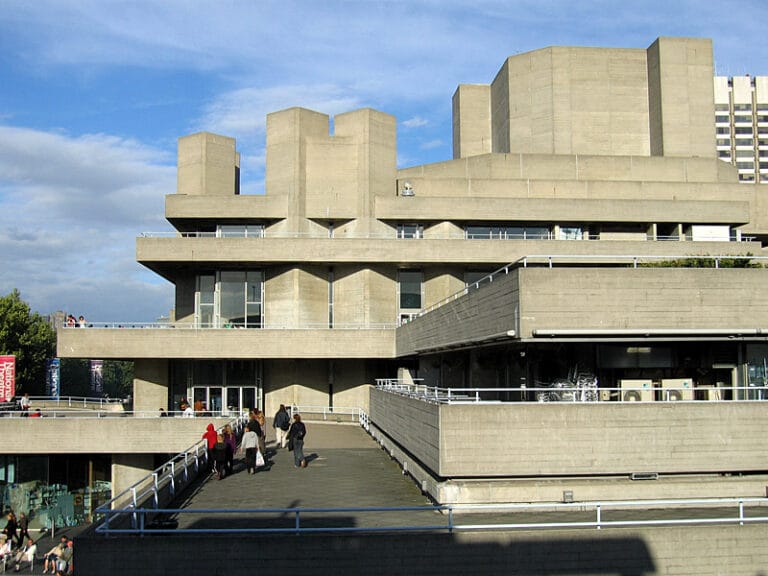
His buildings speak the language of brutalism in its most refined form: raw concrete and granite, strong sculptural volumes, deep-set windows and careful attention to texture. The UNESCO headquarters in Paris (1952-1958), designed with Bernard Zehrfuss and the engineer Pier Luigi Nervi, gave him an international stage. Then came Saint John’s Abbey Church in Collegeville, Minnesota, the IBM research centre at La Gaude near Nice, and from the 1960s the ski resort of Flaine in Haute-Savoie, where his concrete buildings still face Mont Blanc.
His best-known building is the Whitney Museum of American Art on Madison Avenue (1963-1966), an inverted ziggurat clad in dark granite and pierced by trapezoidal windows. Each floor juts out further over the street than the one below: the cantilever of the Cesca, at the scale of a building. After the Whitney moved downtown, the building housed the Met Breuer, then the Frick Collection during its renovation, and it is now Sotheby’s New York headquarters.

Breuer pieces still made today
Knoll produces the Wassily, the Cesca and the Laccio table. Thonet produces the cantilever chairs S 32 and S 64, the B9 nesting tables and other tubular steel models. Isokon Plus produces the Long Chair. These are the authorised versions. Indicatively, a new Wassily costs several thousand euros depending on leather and finish, while a Cesca or S 32 chair costs between several hundred and around 1,500 euros depending on version.
On the vintage market, Gavina pieces from the 1960s and early Thonet chairs are the most sought after. To tell an original from a copy, look at the details: the authorised makers mark their pieces (Knoll and Breuer’s signature on recent Wassily and Cesca chairs, labels or stamps on Thonet and Gavina pieces), the welds and joints are clean, the chrome is thick and even, and the proportions are exact. A cheap cantilever chair with thin, wobbly tube or a Wassily with stitched rather than tensioned straps is almost certainly a reproduction. Our guide to high-end design furniture lists the editors behind the great classics.

Legacy: from the spoon to the city
A century on, Breuer’s legacy is everywhere. The cantilever chair in bent tube became one of the most produced chair types in the world, and the Wassily is in the collections of the great design museums, including MoMA in New York. His conviction that good design could be made industrially, for the many, runs through the whole of mid-century modern design, and his students carried it into American architecture.
His buildings, long dismissed as harsh, have been reappraised over the past twenty years: the Whitney building’s successive lives show how much it has become a landmark. Like Le Corbusier, Breuer embodies the designer-architect who works at every scale, from a chair to a city. Few have kept such coherence across the two.
To meet the other great names of design, explore our glossary of design icons, and for his buildings and those of his contemporaries, our Architecture section.
Frequently asked questions
Why is the Wassily chair called Wassily?
Breuer designed it in 1925-1926 as model B3, and the painter Wassily Kandinsky, a fellow Bauhaus master, had one in his house in Dessau. The name “Wassily” was only given in the early 1960s by the Italian manufacturer Dino Gavina when he reissued the chair.
Did Marcel Breuer invent the cantilever chair?
Not alone. Mart Stam showed a cantilevered chair in 1926 and Mies van der Rohe presented the MR10 in 1927; the German courts later recognised Stam’s claim to the principle. Breuer’s B32 of 1928, known as the Cesca or S 32, became the most widely produced version.
Who makes original Marcel Breuer furniture today?
Knoll produces the Wassily, the Cesca and the Laccio table; Thonet produces the S 32 and S 64 chairs and the B9 nesting tables; Isokon Plus produces the Long Chair. Pieces from these makers carry their marks, which distinguish them from the many reproductions.
Resources
Five ways into the world of HART
- 01 Spaces Spaces & materials Interiors, atmospheres and materials that give a place its identity.
- 02 Creators Designers & creators Architects, designers and artists whose vision changed the way we live.
- 03 Craftsmanship Artisans & fine crafts Upholsterers, cabinetmakers, metalworkers, ceramicists: the workshops and the hands behind true excellence.
- 04 Furniture Furniture & interiors Iconic sofas, seating and lighting, read through form, use and comfort.
- 05 Heritage Design history From Gothic to global design, the styles that shaped the art of living.
Digital entrepreneur and craft artisan.
My work bridges craftsmanship, design history and contemporary creation, shaping a personal vision of luxury interior design.
Since 2012, I have been based in my workshop on the shores of Lake Annecy, creating bespoke interiors for architects, decorators and private clients.