

Obumex: The Belgian signature of exceptional kitchen design
After the flashy years of high-tech kitchens and the wave of Nordic minimalism, a quieter idea of luxury has taken hold, built on restraint and exceptional craftsmanship. This is exactly where Obumex stands. The Belgian house does not really fit any category: part cabinetmaker, part interior designer, it treats the kitchen as a piece of architecture you live in.
Eli Ostyn founded the company in Staden, in West Flanders, in 1960. It started out making school furniture before turning to kitchens. Three generations later, his grandson Thomas Ostyn runs a workshop of more than a hundred people that produces around two hundred bespoke kitchens a year, nearly half of them for clients abroad. Along the way, Obumex has worked with some of the most respected names in architecture, from John Pawson to Joseph Dirand.
From school furniture to luxury kitchens
Obumex grew up in the Belgium of the 1960s, when the kitchen was ceasing to be a functional back room and becoming the social heart of the home. Eli’s son Geert Ostyn took over in the 1980s and widened the scope from kitchens to complete interiors, which is still the company’s model today.
The turning point came in 1996. At Interieur, the Kortrijk design biennial, Obumex presented its first serially produced kitchen, designed by the British architect John Pawson, a leading figure of minimalism. A workshop known for one-off commissions was suddenly offering a kitchen signed by an architect, without giving up bespoke work. That double model still defines the house.
The Obumex style: wood, stone and restraint
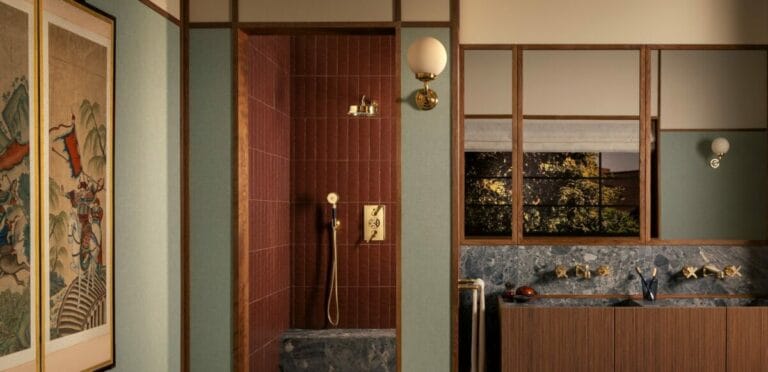
An Obumex kitchen is recognisable by its geometric purity, its strong horizontal lines and its carefully sculpted volumes. Central islands, often monumental, organise the room much as a sculpture would. The palette stays deliberately restrained: blond or smoked oak, deep walnut, marble with graphic veining. Natural tones dominate and let light and texture do the work.
There are no cheap laminates here. Solid wood comes first: oak, walnut and wenge, worked with traditional cabinetmaking skills and then paired with contemporary materials. Marble and natural stone take pride of place, and their natural variations make every kitchen a one-off. For a closer look at these surfaces, our guide to noble kitchen materials and our wood and design guide go further.

The architects behind Obumex kitchens
John Pawson drew a system of independent elements that can stand against a wall or freely in the room. That modularity gives real freedom in planning the space, and the design has aged remarkably well: it still looks contemporary three decades later.
Joseph Dirand designed for Obumex a kitchen in London’s Notting Hill organised around a monumental marble island. The proportions are generous, almost cinematic, and the effect is unmistakably Parisian in its elegance.
Bruno Moinard looks back to French Art Deco, with a kitchen where brushed copper, smoked wood and patinated brass play off one another under indirect lighting.
Gilles & Boissier blur the line between kitchen and living room, bringing precious woods, marble and metal together in a single, fluid space.
Nicolas Schuybroek, invited by Thomas Ostyn, took the most radical route: a kitchen clad entirely in pewter. The metal patinates with use, so the kitchen slowly changes over the years.
How Obumex changed the high-end kitchen
By bringing leading architects into a field they had long ignored, Obumex helped turn the kitchen into a statement piece. Its vocabulary of monumental islands, continuous surfaces and fully integrated appliances now runs through the whole luxury market, from Italian houses such as Boffi to English makers like Smallbone of Devizes.
What spread was less a look than an idea: the kitchen as a complete living space, where cooking, eating, working and entertaining overlap without hierarchy. It is also a matter of ergonomics, which Obumex treats with the same care as materials.

How to buy an Obumex kitchen
Obumex does not publish a price list. Each kitchen is designed and quoted for its project, made in the Staden workshops and installed by the company’s own teams, which places it firmly at the top of the market. Projects start with a visit to one of the showrooms, in Staden, Knokke, Ghent or Paris, on the rue de Lille.
The second-hand market is almost non-existent. Because every kitchen is built for a specific room, few ever change hands; those that do surface occasionally in design sales, valued as designer pieces rather than as kitchen units.
Luxury through discretion
Obumex embodies a contemporary craftsmanship that refuses shortcuts. Between a Belgian family tradition and collaborations with the international avant-garde, the house has chosen discretion over display, very much in the spirit of quiet luxury. It speaks to clients who look for authenticity and know that real luxury lies in what lasts. Its kitchens are designed to serve for fifty years, and they prove that innovation and tradition, artistic ambition and daily use, can live in the same room.

To compare Obumex with the other great names, read our selection of the greatest European luxury kitchen brands and our complete guide, Luxury in the kitchen: the ultimate guide to high-end kitchens.
Frequently asked questions
Where are Obumex kitchens made?
In Staden, in West Flanders, Belgium, where the family company was founded in 1960 and still has its headquarters, workshops and main showroom.
Which architects have designed kitchens for Obumex?
John Pawson designed its first serially produced kitchen in 1996. Joseph Dirand, Bruno Moinard, Gilles & Boissier and Nicolas Schuybroek have since followed.
How much does an Obumex kitchen cost?
Obumex does not publish prices: every kitchen is bespoke and quoted on the project. It sits at the very top of the luxury kitchen market.
Resources
Five ways into the world of HART
- 01 Spaces Spaces & materials Interiors, atmospheres and materials that give a place its identity.
- 02 Creators Designers & creators Architects, designers and artists whose vision changed the way we live.
- 03 Craftsmanship Artisans & fine crafts Upholsterers, cabinetmakers, metalworkers, ceramicists: the workshops and the hands behind true excellence.
- 04 Furniture Furniture & interiors Iconic sofas, seating and lighting, read through form, use and comfort.
- 05 Heritage Design history From Gothic to global design, the styles that shaped the art of living.

Digital entrepreneur and craft artisan.
My work bridges craftsmanship, design history and contemporary creation, shaping a personal vision of luxury interior design.
Since 2012, I have been based in my workshop on the shores of Lake Annecy, creating bespoke interiors for architects, decorators and private clients.