

The UP Chair by Gaetano Pesce:
The UP Chair by Gaetano Pesce: When a Seat Becomes a Revolution
If you’ve ever come across it, it’s impossible to forget. But beyond its spectacular feminine form, the UP chair represents an unprecedented innovation in many ways.
You know my obsession with all kinds of armchairs… After recently encountering “La Donna” again at the B&B Italia showroom in London (South Kensington), I thought it fully deserved its place in the pantheon of design icons at Hart Design Selection. Why? Three excellent reasons: an unprecedented technological feat, a feminist manifesto, and a unique and timeless sculptural aesthetic. But let’s start at the beginning…
1969, Milan: A Scandalous Presentation
Milan, spring 1969. At the Furniture Fair, before the astonished eyes of visitors, an unprecedented spectacle unfolds: dozens of hermetically sealed flat packages open simultaneously. As if by magic, sculptural forms slowly emerge, inflate, come to life.
This isn’t a simple product exhibition: it’s a live performance. Hundreds of vacuum-packed chairs deploy upon contact with air before a mesmerized audience. The forms emerge, inflate, come to life under stunned gazes. The first living installation in design history had just been born, transforming a simple commercial presentation into a true artistic happening.
The UP chairs by Gaetano Pesce provoke a real shock. This theatrical staging is far from gratuitous: it perfectly embodies the spirit of revolt that animates radical Italian design at the time. That day, design shifted into a new era.
Genesis of an Innovation: When Chemistry Meets Radical Design
To understand this revolution, we must go back to the early 1960s. The chemist Bayer develops a revolutionary polyurethane foam with infinite possibilities. The Italian publisher C&B Italia (future B&B Italia) immediately seizes on this innovation.
The context is crucial. In 1968, all of Europe is swept by protest movements. In the design world, creators like Andrea Branzi, Alessandro Mendini, and Gaetano Pesce join the movement of Radical Design and Italian anti-design rallying to a provocative slogan: “No to functional design!” They must react against official design and its proponents of pure functionality.
It’s in this climate of excitement that in 1964, the meeting between Pesce and Cesare Cassina gives birth to a bold concept: create furniture entirely in high-density polyurethane foam, cover them with stretch jersey, then vacuum-pack them between vinyl sheets.
The genius of the idea? Once unwrapped, these chairs come back to life, inflate, and regain their original volume. The name “UP” evokes this spectacular experience. The seat volume reduces to one-tenth thanks to vacuum compression. Once released, it slowly deploys as air penetrates the foam cells.
What could have been just a practical transport solution becomes a poetic, almost magical experience. Purchasing a piece of furniture transforms into a fascinating ritual.
The UP Series: Seven Sculptures, One Icon
The UP series comprises seven distinct models, each with its unique sculptural personality. From UP1 to UP7, these expanded polyurethane chairs explore different organic and anthropomorphic forms, perfectly embodying the spirit of the 70s.
But one duo will forever mark design history: the UP5 accompanied by its UP6 ottoman, quickly nicknamed “La Mamma,” “Big Mama,” or “Donna.”
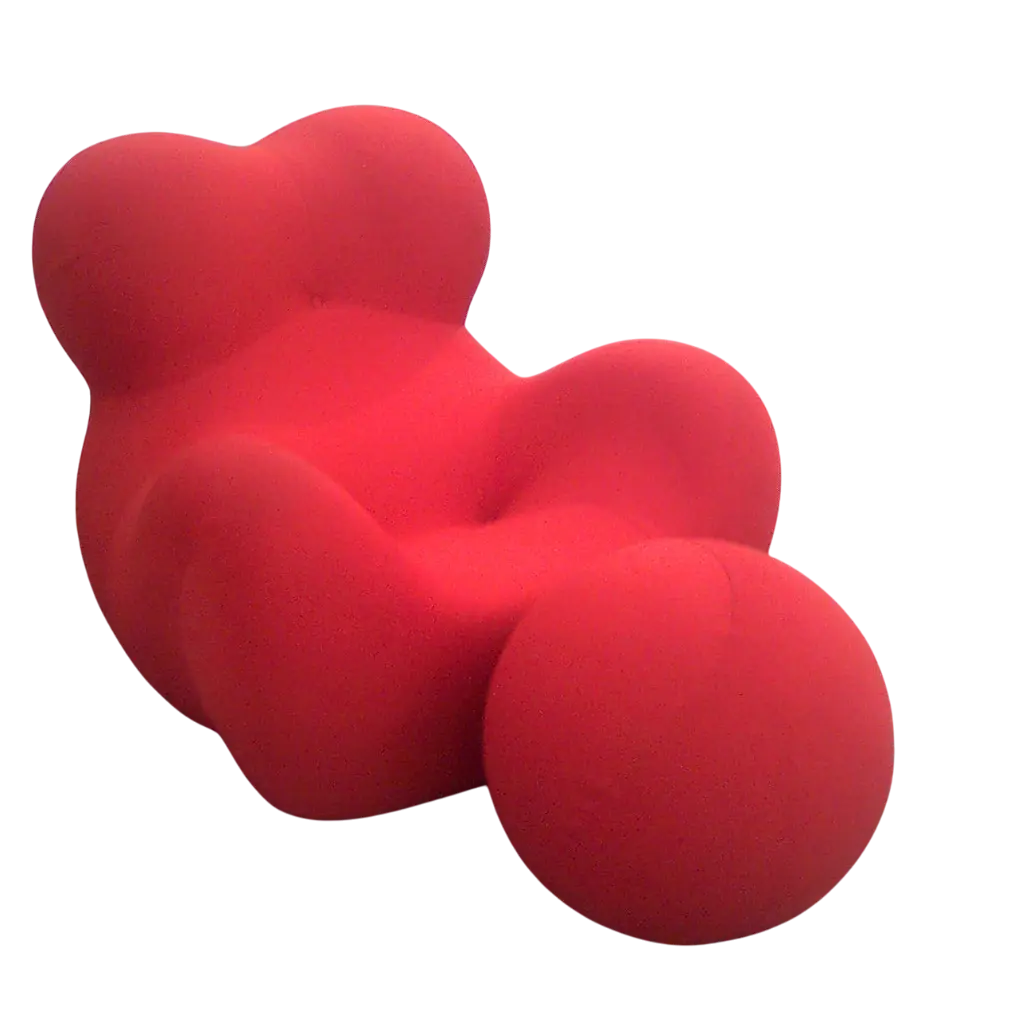
The forms are explicit, even provocative. The UP5 chair unambiguously evokes prehistoric fertility goddesses, with its generous curves, maternal volumes, its welcoming belly appearance. But the element that transforms this comfortable sculpture into a political manifesto is the UP6 ottoman: a sphere connected to the chair like a ball and chain on a prisoner’s foot.
Pesce leaves no room for ambiguity. This creation expresses his vision of women’s condition in the late 1960s. Woman, always sedentary, remains despite herself a prisoner of herself and her social role. These generous forms held back by a ball and chain refer to the universal image of oppression, of captivity disguised as domestic comfort.
The designer fully assumes his provocation. He speaks of this “Mamma chair, with these enormous breasts and this big ass,” claiming that the object no longer has to simply be the expression of itself. Design becomes language, furniture becomes discourse. Comfort transforms into a political manifesto.
Why La Donna Remains an Icon: The Triple Symbol
More than half a century after its creation, the UP5_6 chair remains one of the absolute icons of international design. Why such longevity? Because it embodies a triple symbol that crosses decades without aging.
1. Technological Symbol
In 1969, the vacuum packaging process represents an unprecedented industrial feat. The mastery of expanded polyurethane, compression to one-tenth of the volume, then the spectacular rebirth of the form upon contact with air mark a radical break with traditional furniture manufacturing methods.
This innovation transforms transport into poetic performance and democratizes access to a monumental object. Even today, the cold-molded Bayfit foam testifies to B&B Italia’s technological excellence and the sustainability of avant-garde solutions.
2. Feminist Symbol
Few design objects have dared to carry such an explicit political discourse. The generous curves evoking fertility goddesses, the ottoman-ball connected by a chain, the metaphor of woman imprisoned by herself and patriarchal structures… Pesce leaves no ambiguity.
In 1969, at the heart of women’s liberation movements, “La Mamma” becomes a three-dimensional manifesto, a comfortable cry of protest. Far from dating, this militant dimension resonates with renewed acuity in contemporary debates on women’s rights and gender equality.
3. Aesthetic Symbol
The UP5_6 transcends passing trends to establish itself as a timeless functional sculpture. Its anthropomorphic organic forms, its chromatic boldness, its sculptural presence make it much more than a seat. It’s a work of art that dialogues with space, provokes the gaze, arouses emotion.
From MoMA to Centre Pompidou, from the Metropolitan Museum to the Louvre’s Museum of Decorative Arts, “Donna” sits in the permanent collections of the greatest museums. From bourgeois interiors to contemporary lofts, it asserts its visual power with unalterable expressive force.
Market Value and Pricing: Should You Invest in a UP?
In the contemporary design market, the UP5_6 chair occupies a unique place. The new version, still published by B&B Italia since the 2000 reissue, constitutes a substantial but justified investment. Prices vary according to finishes and special editions offered by official retailers.
On the secondary market, reissues from the UP 2000 series generally trade between €3,800 and €5,000 for a set in good condition. A reasonable investment for a design icon that retains its value over time.
⚠️ Professional upholsterer’s advice: Beware of vintage models (1969-1973)! I’ll tell you frankly: after more than 50 years, the polyurethane foam is dead, completely collapsed, unrecoverable. These vintage pieces can certainly reach high auction prices (often beyond €4,000) due to their historical value and rarity, but they will systematically require complete restoration – foam AND fabric.
You’re ultimately paying the price of a new piece for a chair that requires expensive work. Better to invest in a UP 2000 reissue in perfect condition! That’s the advice I give to all my clients.
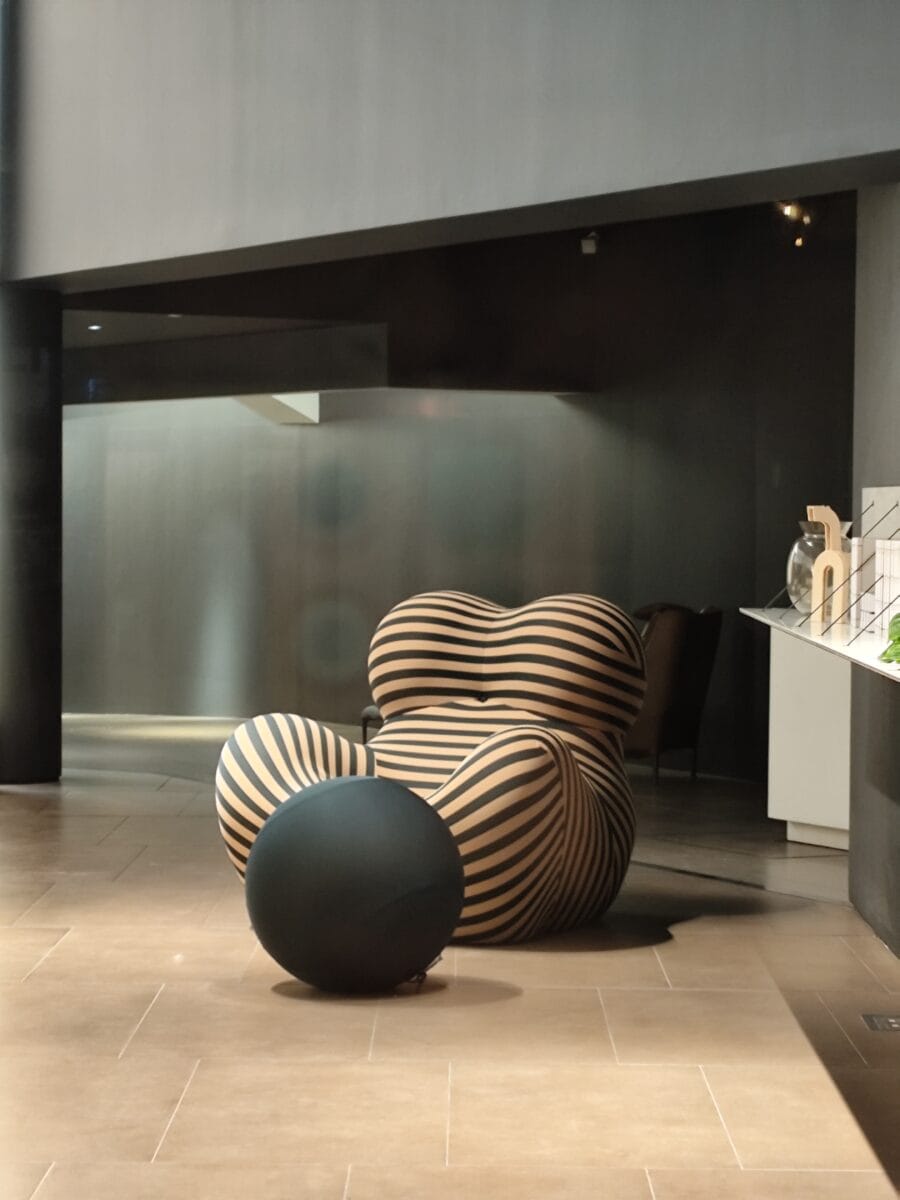
Special editions generate particular interest from collectors. The silver version created for the 40th anniversary, numbered and limited to a few hundred copies, stands out for its high value. Striped colors, particularly the highly sought-after red and white version, or the fiftieth anniversary beige and petrol green edition, also benefit from premium valuation.
The international market testifies to the universality of this design icon: on specialized platforms like 1stDibs, Pamono, or Whoppah, prices fluctuate between $3,000 and $8,500 depending on condition, provenance, and authenticity. Versions restored or reupholstered in contemporary fabrics should be considered with caution because the technique used (expanded foam) makes it very difficult to recreate anew. Often the new fabric is placed on the original foam, so the longevity of second-hand pieces is limited.
Durability and Maintenance: How Long Will Your UP Last?
Let’s be concrete. The polyurethane foam of a well-maintained UP5_6 chair retains its qualities for 10 to 15 years of regular use. This duration can extend up to 20 years for less stressed pieces or those benefiting from optimal maintenance.
Versions reissued since 2000 use Bayfit foam – cold-molded flexible polyurethane of high density. This high-end foam offers superior durability to standard upholstery foams. Unlike cheap foams that irreversibly sag after 5 to 8 years, Bayfit maintains its cellular structure and bounce capacity longer.
Signs of aging appear gradually: slight loss of elasticity after about ten years, appearance of persistent impressions on the most used seating areas, moderate sagging of volumes. The stretch jersey fabric with jute backing may show signs of wear (discoloration, shininess, small abrasions) even before the foam is structurally compromised.
A Legacy That Defies Time
This exceptional convergence between technical innovation, political commitment, and formal excellence explains the phenomenal longevity of this chair. Neither the death of Gaetano Pesce in April 2024 in New York, nor the evolution of production techniques, nor societal transformations have altered its relevance.
On the contrary: each new generation rediscovers with fascination this concentrate of provocation, comfort, and beauty. It’s with this same spirit of protest that bold designers like Ettore Sottsass with the Memphis Group or Philippe Starck would take over subsequently, perpetuating the spirit of radical Italian design.
Gaetano Pesce achieved this tour de force: creating an object that refuses to age, that still questions, that still moves. A chair that is never just a chair, but an act of resistance, a celebration of women, and an accessible sculptural masterpiece.
Beautiful, disturbing, unforgettable: “La Mamma” remains the most brilliant testimony that a piece of furniture can carry a message, tell a story, and even – why not – change the world of design.
Digital entrepreneur and craft artisan.
My work bridges craftsmanship, design history and contemporary creation, shaping a personal vision of luxury interior design.
Since 2012, I have been based in my workshop on the shores of Lake Annecy, creating bespoke interiors for architects, decorators and private clients.