

Luxury and high-end bathroom guide: the greatest brands
The bathroom is the most technical room in the house, and the one where luxury is judged by touch. Water, steam and limescale test every material every day; a tap is handled thousands of times a year; the wrong stone stains within a week. Here, high-end has nothing to do with gilding: it is the meeting of rigorous planning, materials that live happily with water, and objects whose quality you feel in your hand.
This guide brings together the great houses, the rules of planning, materials, tapware, lighting and wellbeing equipment, to compose a bathroom that will still look right in twenty years.
The great houses
Each house has its own language. In Italy, Boffi sets the standard for architectural minimalism, Agape and Antonio Lupi sculpt baths and basins as stand-alone pieces, Falper builds bespoke furniture and Salvatori treats stone as a design material. In Germany, Dornbracht is the reference for precision tapware, and Duravit brought designer ceramics to a wider public, notably with Philippe Starck. In Switzerland, Laufen pushes ceramics to unprecedented thinness. France has THG Paris and Volevatch, masters of decorative tapware; England has Lefroy Brooks for Edwardian heritage and Samuel Heath for brass fittings. In Italy again, Gessi and Fantini give tapware a sculptural dimension.
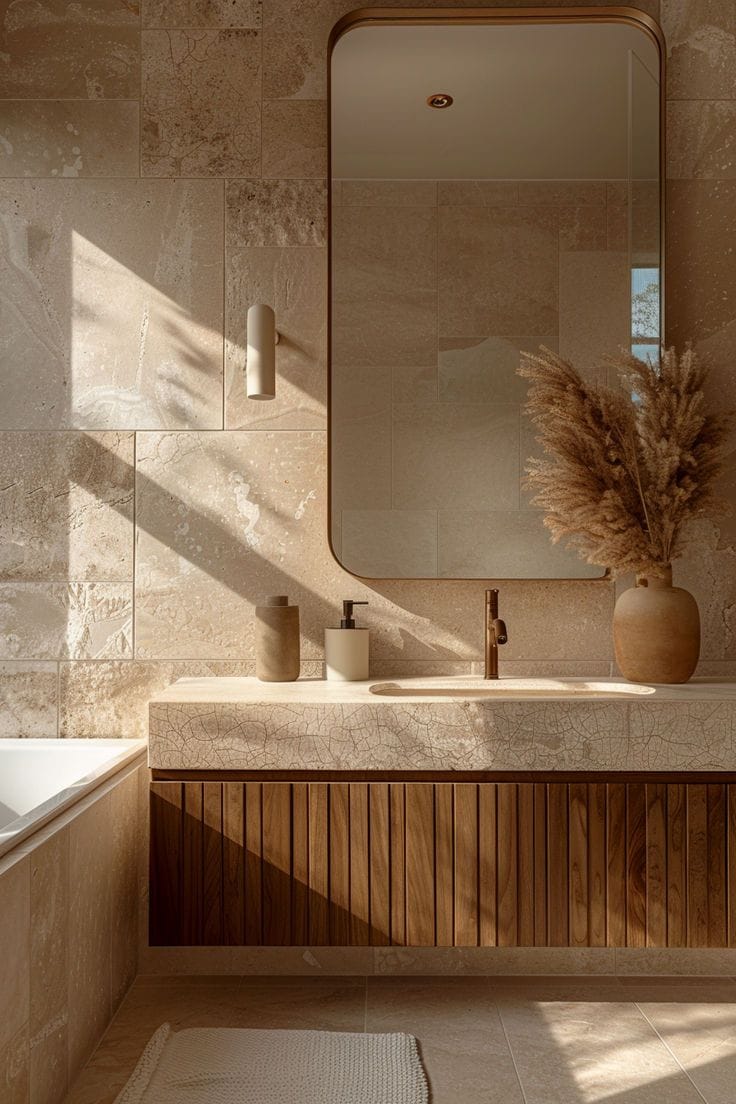
- The greatest luxury bathroom brands: our detailed selection.
- Boffi: from kitchen to bathroom, Italian minimalism.
Plan before you choose
A beautiful bathroom is decided before the objects are chosen. The plan comes first: where water arrives and leaves, where the soil stack runs, what fall the shower needs. A level-access shower requires a recess in the slab or an ultra-flat tray, and a steady fall to a drain or a linear channel; it is decided at the structural stage, not when choosing tiles.
Then waterproofing: under tiles or plaster, it is the tanking membrane that protects the house, not the grout. Electrics follow safety zones around the bath and shower, set by local wiring regulations; they decide where sockets, lights and towel warmers can go. Finally ventilation: quiet, efficient extraction is the best protection for materials, paint and wallpaper.
Furniture is drawn like cabinetmaking: basin height around 85 to 90 cm (34 to 35 in), storage depth designed for what you actually store, niches built into the shower rather than added shelves. A good joiner, like those in our craftspeople guide, makes all the difference.
Materials
Each material has its own temperament with water. The right choice depends on where it goes: floor, shower wall, vanity top or decorative wall.
- Natural stoneMarble, limestone, travertine, onyx: unique and alive, but porous and sensitive to acids. Choose a honed finish for floors, and an impregnating sealer.Vanity tops, walls, floors
- PorcelainAlmost impervious, maintenance-free, available in very large formats and convincing stone looks. The rational choice for wet zones.Showers, floors, wall cladding
- PlastersMoroccan tadelakt with lime and black soap, microcement, lime: seamless and sensual, but demanding to apply and to maintain.Walls, niches, showers
- WoodTeak, iroko, oiled oak: unmatched warmth and touch, provided the species suits and it is regularly oiled.Furniture, duckboards, tops
Marble remains every bathroom’s dream, but it has to be understood: it is a crystallised limestone, etched by vinegar, limescale removers and some cosmetics; a mirror polish is slippery underfoot and marks quickly. Keep Calacatta and Carrara for tops and walls, and choose a denser stone or a quartzite for floors. Everything is explained in our stone and marble guide.
Mineral composites (Corian, Cristalplant and similar) allow seamless moulded basins and baths in a soft matt white. Handmade ceramics, zellige or hand-glazed tiles, bring the vibration of the hand. For wood, species and their behaviour in humidity are covered in our wood guide.
Tapware and finishes
The tap is the most touched object in the bathroom: this is where you feel high-end. A solid brass body, a ceramic cartridge that turns with even resistance, a flow that does not hiss, a handle that falls naturally under the hand. In the shower, a thermostatic valve is essential: it holds the temperature when someone opens another tap. Concealed tapware frees walls and tops, but requires a well-installed, accessible concealed body.
Finishes tell the style: timeless polished chrome, softer brushed nickel, graphic matt black, brass, bronze, gold. PVD finishes, vacuum-deposited, resist scratches and limescale far better than conventional plated finishes. Unlacquered brass is a living finish that patinates over time: a connoisseur’s choice, to be embraced. Metals and their patinas are covered in our metal guide.
Bath and shower
The freestanding bath has become the signature object of the luxury bathroom: enamelled cast iron for thermal inertia and classic style, mineral composite for sculpted forms, solid stone or wood for exceptional pieces. It needs space around it, a floor that can carry its weight when full, and a floor-mounted supply or a freestanding mixer.
The shower is lived every day. A level-access shower closed by a fixed panel of low-iron glass, a rain head completed by a hand shower to rinse without wetting your hair, a niche, a bench if space allows. A steam room fits into a well-designed shower: steam generator, sloped ceiling so condensation does not drip, complete sealing. A sauna needs its own room or cabin.
Light
Three layers of light are enough: soft general lighting, mirror lighting that lights the face from the front without shadow, and ambient lighting for the bath. At the mirror, choose a source with a high colour rendering index, at least 90, and a warm to neutral temperature, around 2,700 to 3,000 K. Fittings must meet the ingress protection rating required in each zone. Our lighting guide and our article on LED innovations go further.
Textiles and wallpaper
A bathroom does not have to be all stone. Wallpaper belongs there away from water splashes, provided you choose a suitable backing and read its pictograms: scrubbable or vinyl, with good ventilation. See our high-end wallpaper guide.
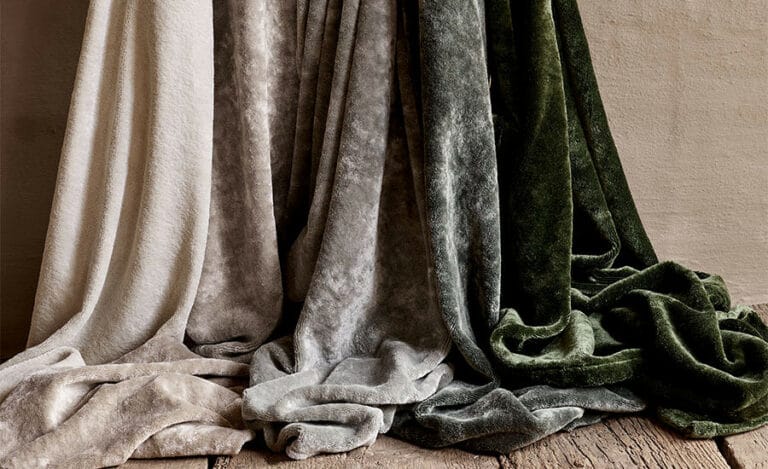
Textiles soften everything: a linen Roman blind or curtains, an upholstered bench, a padded stool. Choose fibres that tolerate humidity and wash well; in very damp rooms, solution-dyed outdoor fabrics offer the look of linen without fearing water. Our upholstery fabrics guide helps you choose. Fabric walling, on the other hand, belongs in the dressing room or the adjoining bedroom.
Wellbeing and technology
The best technology is the kind you forget: underfloor heating that dries the room, a towel warmer, a demisting mirror, a Japanese shower toilet, a shower that remembers your temperature. Home automation runs light, heating and music through scenarios; it should stay simple to use and repairable. On water, a softener protects tapware, glass and stone from limescale in hard-water areas, and flow-regulated mixers save water without sacrificing comfort. The ritual is completed by a well-chosen home fragrance.
Styles and inspiration
Three main directions. Mineral minimalism, inherited from minimalism and extended by quiet luxury: one stone, one wood, concealed tapware. British classicism, inspired by the Victorian style: clawfoot bath, metro tiles, swan-neck taps. And the garden bathroom, nourished by biophilic architecture: daylight, plants, a view, raw materials. For current trends, see our confidential trends.
Frequently asked questions
Can marble be used in a shower?
Yes, provided the waterproofing beneath is perfect, the stone is sealed and it is cleaned with neutral soap. Choose a honed finish underfoot and accept that the stone will live.
Thermostatic or mixer?
Thermostatic for the shower, without hesitation: the temperature stays stable. A mixer is enough for the basin.
Which tapware finish lasts longest?
Chrome and PVD finishes. Unlacquered brass patinates on purpose; coloured plated finishes are more fragile against limescale and cleaning products.
Can wallpaper go in a bathroom?
Yes, away from direct splashes, with a scrubbable or vinyl backing, a suitable adhesive and effective ventilation.
Latest articles on bathrooms

Luxury and high-end bathroom guide: the greatest brands
Read nextThe high-end kitchen guide · Materials and finishes · Exceptional craftspeople · The HART glossary
Explore
HART in five chapters
Places, creators, craftsmanship, furniture and history: everything that makes an exceptional interior.

Digital entrepreneur and craft artisan.
My work bridges craftsmanship, design history and contemporary creation, shaping a personal vision of luxury interior design.
Since 2012, I have been based in my workshop on the shores of Lake Annecy, creating bespoke interiors for architects, decorators and private clients.