

The Renaissance Style (1495-1600)
The Renaissance stands in continuity with the Gothic style while laying the foundations for the great French classical styles of the 17th century, notably the Louis XIII style.
What’s Renaissance style?
The Renaissance style marks a decisive break with medieval aesthetics. Around 1400 in Italy, artists and thinkers rediscovered Greco-Roman Antiquity. This fascination with classical forms, perspective, measure, and harmony radically transformed architecture, furniture, and interior decoration.
Between 1400 and 1600, the Renaissance spread from Florence throughout Europe. Italy, France, Spain, England, the Netherlands: each region adapted classical principles to its own genius. The style evolved from the Florentine Quattrocento to refined Mannerism, creating an extraordinary diversity of expressions.
Why does this style matter today? Because it established the foundations of modern Western design. The Renaissance invented the notion of the architect-creator, theorized ideal proportions, and developed an ornamental vocabulary that spans centuries. Its principles of symmetry, balance, and harmony remain at the heart of contemporary classical design.
Historical & Cultural Context
The Renaissance was born in the Italian city-states of the 15th century. Florence, Venice, and Rome competed in wealth and power. The Medici in Florence and the popes in Rome became history’s greatest patrons. Their patronage allowed artists to devote themselves entirely to their art.
Humanism revolutionized European thought. Scholars rediscovered ancient texts: Vitruvius for architecture, Pliny for the arts, Cicero for eloquence. This rediscovery accompanied a new vision of humanity: no longer sinners before God, but creatures capable of greatness and beauty.
Scientific discoveries transformed the representation of the world. Linear perspective, theorized by Brunelleschi and codified by Alberti, allowed three-dimensional space to be represented on a flat surface. Anatomy advanced through dissections. The printing press disseminated knowledge on an unprecedented scale.
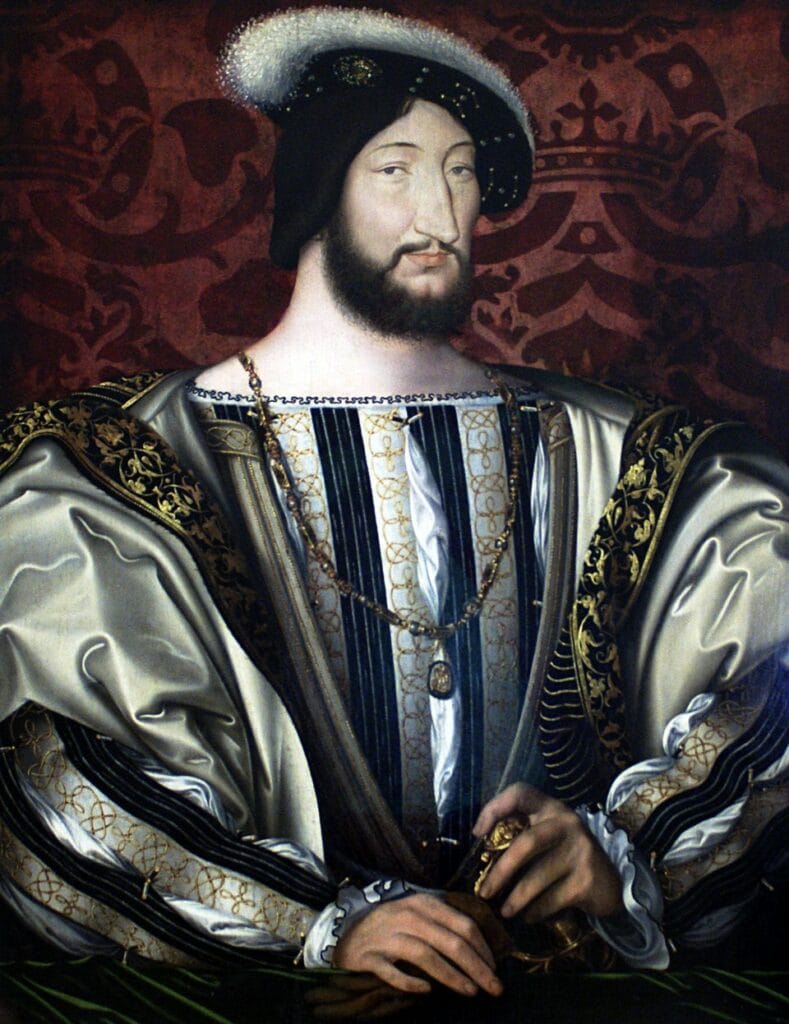
The Italian Wars (1494-1559) paradoxically spread the Renaissance style. French kings, fascinated by Italian refinement, imported artists and craftsmen. Francis I brought Leonardo da Vinci, commissioned Château de Chambord, and transformed Fontainebleau. The French Renaissance was born from this encounter between Gothic tradition and Italian contributions.
The Renaissance style thus expressed a society in profound transformation: urban, commercial, cultured, and confident in human capabilities. Art was no longer solely in service of the sacred but also celebrated earthly beauty, knowledge, and princely power.
Aesthetic Characteristics
The Renaissance is immediately recognizable by its antique-inspired architectural vocabulary. Columns (Doric, Ionic, Corinthian), pilasters, pediments, entablatures structure façades and interiors. These elements are not applied arbitrarily but follow precise mathematical proportions inherited from Vitruvius.
Symmetry dominates spatial organization. Plans become regular, centered, balanced. In interiors, this symmetry is expressed through aligned openings, regular furniture arrangement, and balanced decoration. Gone is Gothic asymmetry: enter geometric harmony.
Ornamentation draws from the antique repertoire but also from stylized nature. Grotesques (fantastic motifs inspired by discovered Roman decorations), rinceaux (vegetal scrollwork), putti (chubby cherubs), garlands, medallions, cartouches enrich surfaces and furniture. Delicate arabesques replace Gothic tracery.
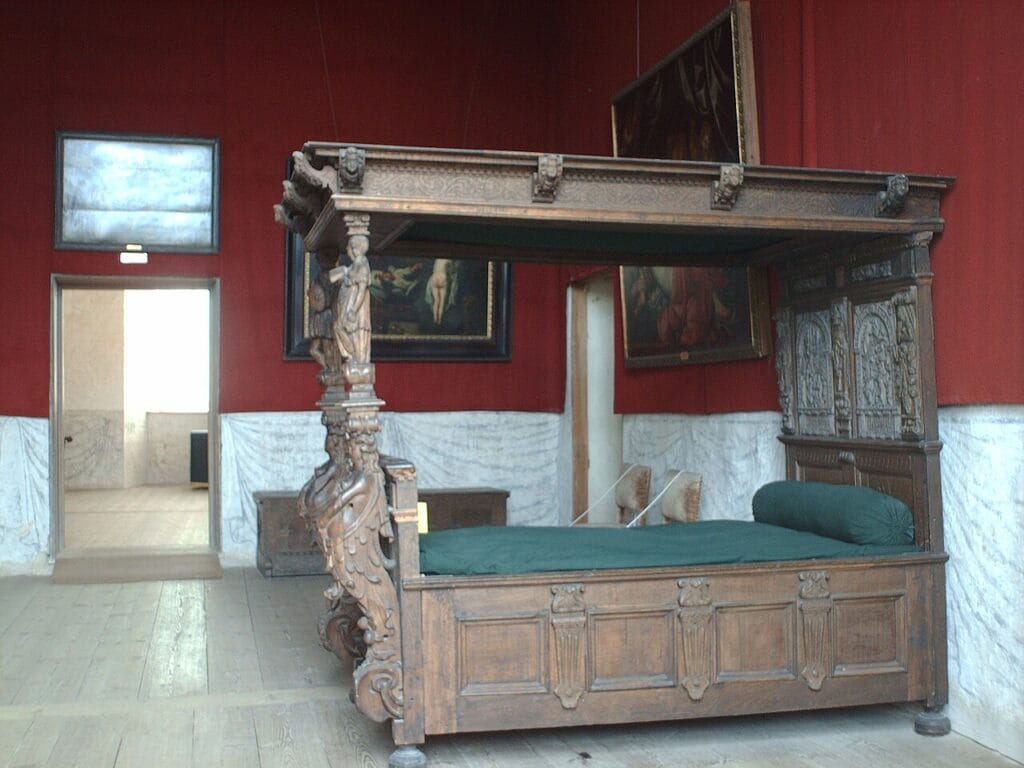
Noble materials assert prestige. Marble for floors and columns, stucco for ceilings, precious woods (walnut, carved oak) for paneling and furniture. Frescoes cover walls and ceilings, creating spectacular architectural illusions. Marquetry achieved remarkable technical sophistication.
Color evolved toward greater richness. Gothic interiors favored dark tones; the Renaissance introduced deep reds, brilliant golds, intense blues, emerald greens. Textiles (velvet, damask, brocade) displayed unprecedented sumptuousness.
Major Phases of the Renaissance
Italian Quattrocento (1400-1500)
The Florentine Quattrocento laid theoretical and practical foundations. Brunelleschi revolutionized architecture with the dome of Santa Maria del Fiore. Alberti theorized ideal proportions in his treatise De re aedificatoria. Florentine palaces – Palazzo Medici, Palazzo Strozzi – established the Renaissance urban palace model.
In interiors, sobriety still dominated. Walls were often bare or adorned with frescoes. Furniture remained relatively simple but gained sculptural sophistication. Cassoni (marriage chests) became supports for extraordinary narrative paintings.
Cinquecento and High Renaissance (1500-1530)
The apex of the style. Bramante, Michelangelo, Raphael brought architecture and decoration to classical perfection. The Vatican Rooms decorated by Raphael defined the Renaissance beauty ideal. Villas multiplied around Rome and Venice, combining architecture and gardens in total harmony.
Interiors gained richness. Carved and gilded coffered ceilings became luxury signatures. Stucco enabled sophisticated relief decorations. Furniture enriched with geometric marquetry (certosina) and elaborate carvings.
Mannerism (1530-1600)
The late Renaissance complexified and refined classical vocabulary. Proportions lengthened, forms became more sophisticated, sometimes more tormented. Palladio in Venice theorized rigorous classicism that would influence architecture for centuries.
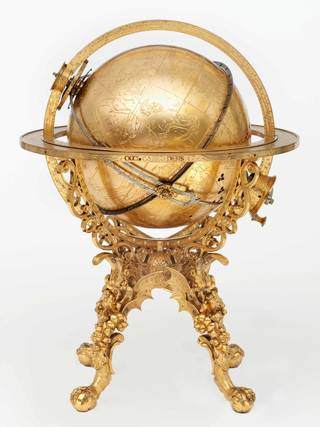
Mannerist interiors multiplied decorative effects: trompe-l’oeil, feigned perspectives, elaborate grotesques. Furniture integrated caryatids, terms, mascarons. This sophistication heralded the Baroque to come.
French Renaissance (1495-1600)
In France, the Renaissance blended with local traditions after 1495 (Charles VIII’s Italian campaigns). The early French Renaissance (1495-1525) timidly combined Italian elements with Gothic structures. The classical Renaissance (1525-1570) under Francis I and Henry II asserted the style: Loire châteaux, Fontainebleau, the Louvre.
French furniture developed its own identity: monumental dressoirs, carved armoires, chests with architectural panels. Walnut became the favored wood, carved with medallions, caryatids, arabesques. The Fontainebleau School created a unique decorative style, blending stucco, frescoes, and woodwork.
Creators & Key Figures
Filippo Brunelleschi
Florentine architect (1377-1446), Brunelleschi revolutionized architecture with the dome of Santa Maria del Fiore. He rediscovered and applied the principles of linear perspective. His churches, San Lorenzo, Santo Spirito, established Renaissance architectural vocabulary: columns, round arches, harmonious proportions.
Leon Battista Alberti
Humanist and architect (1404-1472), Alberti theorized the Renaissance in his treatises. De re aedificatoria codified architectural proportions. De pictura explained perspective. His works—Palazzo Rucellai, Sant’Andrea in Mantua—rigorously applied these principles. He embodied the Renaissance universal man ideal.
Donato Bramante
Architect (1444-1514), Bramante brought the Renaissance to classical maturity. His Tempietto in Rome represents perfection in centralized architecture. Commissioned by Pope Julius II to rebuild St. Peter’s Basilica, he conceived a Greek cross plan that would influence all religious architecture.
Michelangelo
Sculptor, painter, architect (1475-1564), Michelangelo transcended all arts. His Sistine Chapel frescoes defined the Renaissance beauty ideal. As architect, he completed St. Peter’s with its majestic dome. His dramatic genius heralded the Baroque while remaining profoundly classical.
Andrea Palladio
Venetian architect (1508-1580), Palladio systematized Renaissance classicism. His Venetian villas – Villa Rotonda, Villa Barbaro– established the aristocratic country house model. His treatise I Quattro Libri dell’Architettura (1570) became the bible of classical architecture, influencing Europe and America for centuries.
François I
King of France (1515-1547), François I imported the Renaissance to France. He brought Leonardo da Vinci, commissioned Chambord, and transformed Fontainebleau into an artistic center. His patronage established the French Renaissance as an original synthesis between Gothic tradition and Italian contributions.
Architecture & Interior Decoration
Florentine Palaces
The Palazzo Medici-Riccardi (Michelozzo, 1444) established the Renaissance urban palace model. Façade with graduated rustication (rough on ground floor, smooth on upper floors), arcaded interior courtyard, loggia for receptions. Inside, the Chapel of the Magi by Benozzo Gozzoli illustrates Quattrocento decorative splendor.
Interiors combined structural austerity and localized richness. Walls often bare or painted with frescoes, painted exposed beam ceilings, carved monumental fireplaces. Furniture remained sober but quality: carved chests, massive tables, credenzas, benches (cassapanca).
Vatican Rooms
The Stanze decorated by Raphael (1508-1524) represent the apex of Renaissance decoration. The School of Athens synthesizes the humanist ideal: ancient philosophers gathered in perfect classical architecture. The grotesques of adjacent loggias established ornamental vocabulary copied throughout Europe.
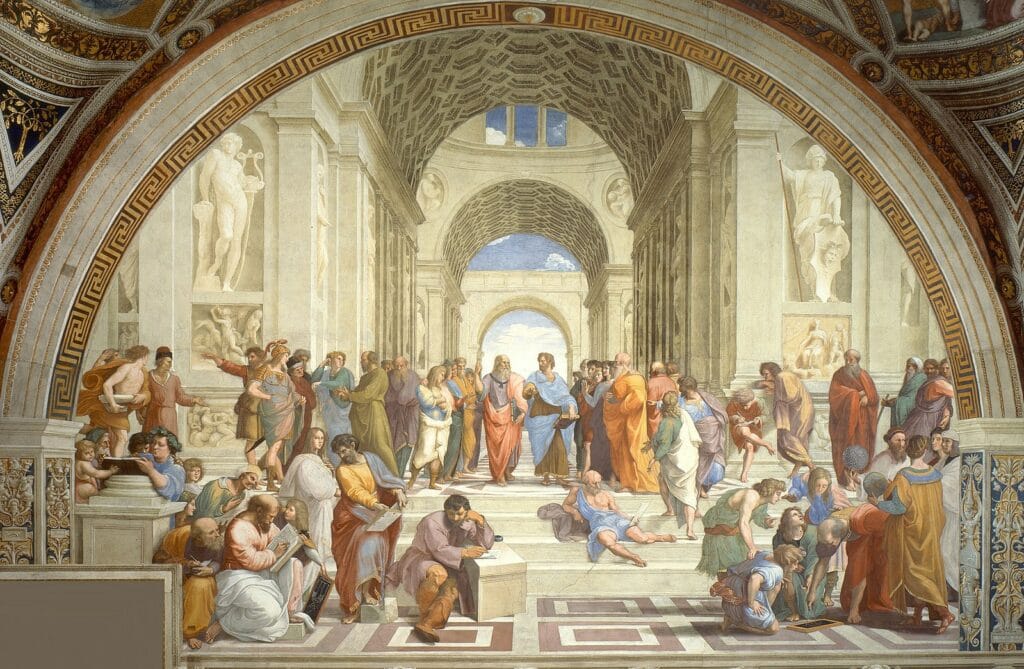
These interiors demonstrate total integration between architecture, painting, and sculpture. Frescoes create spatial illusions, stucco adds relief and gilding, marble marquetry pavements (opus sectile) complete the decorative symphony.
Loire Châteaux
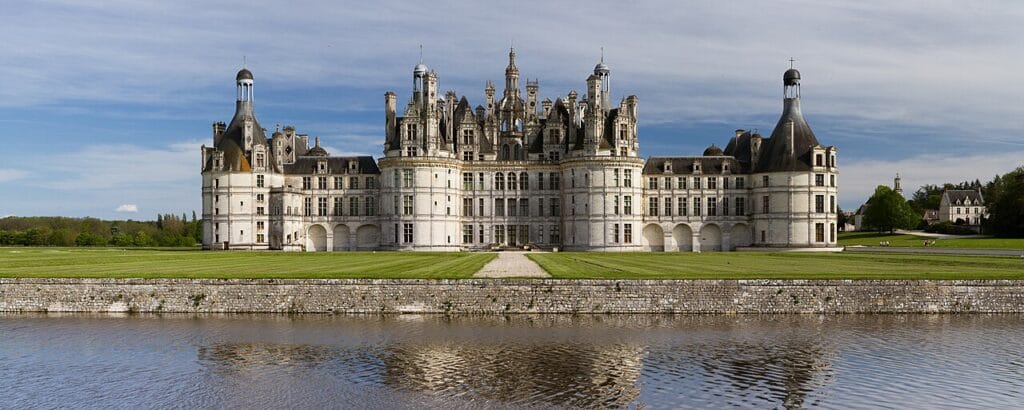
Chambord (begun 1519) illustrates the French Renaissance. Its centralized plan, double-helix staircase (attributed to Leonardo), ornate chimneys and dormers fuse Italian rationality with French fantasy. The interiors, though stripped today, contained tapestries, hangings, sumptuous furniture.
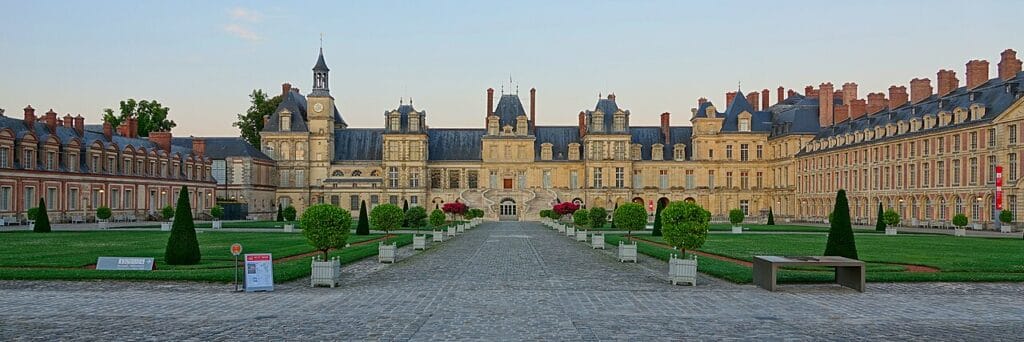
Fontainebleau, Francis I’s favorite residence, developed a unique decorative style. The School of Fontainebleau combined Italian stucco and French paintings in elegant, erotic compositions. Galleries adorned with frescoes, stucco, and woodwork established the model for grand royal apartments.
Palladian Villas
Palladio’s Villa Rotonda (1567) embodies classical perfection. Centered and symmetrical plan, four identical pedimented porticos, central dome. The interiors, decorated with frescoes by Veronese and others, integrate architecture and painting. Each room obeys precise mathematical proportions, creating spatial musical harmony.
These villas established the elegant country residence model: noble architecture, refined decoration, geometric garden, harmonious landscape integration. They would influence European and American domestic architecture for four centuries.
Furniture & Decorative Arts
Cassone (Marriage Chest)
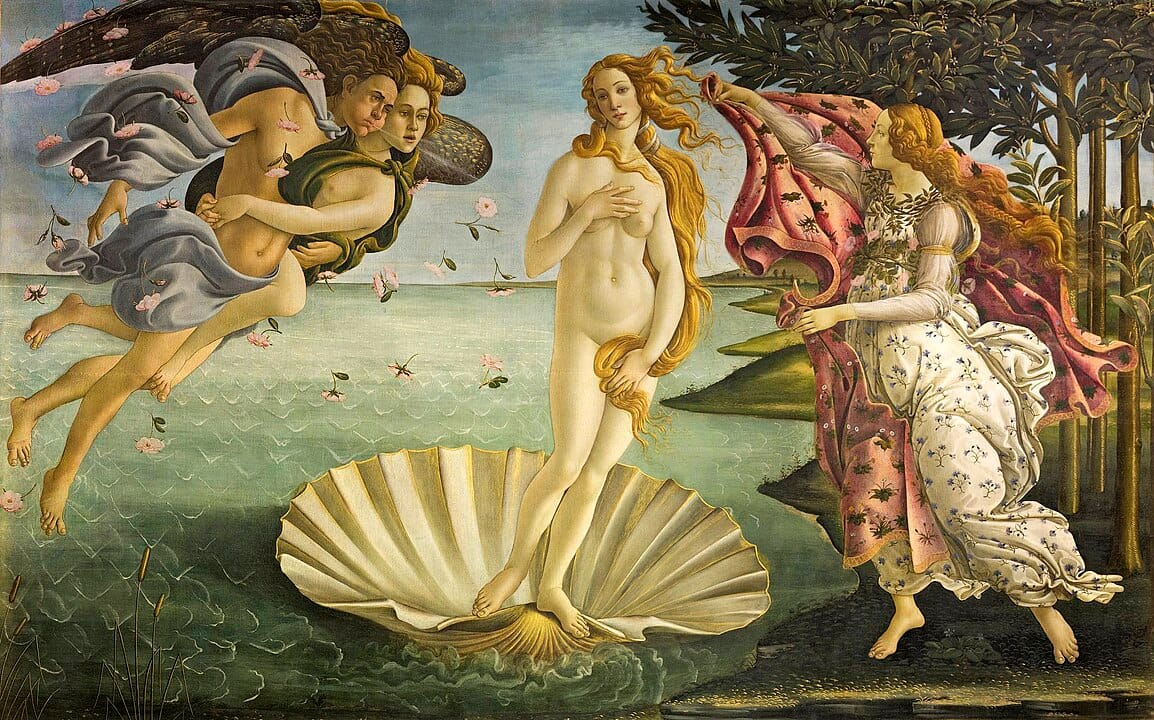
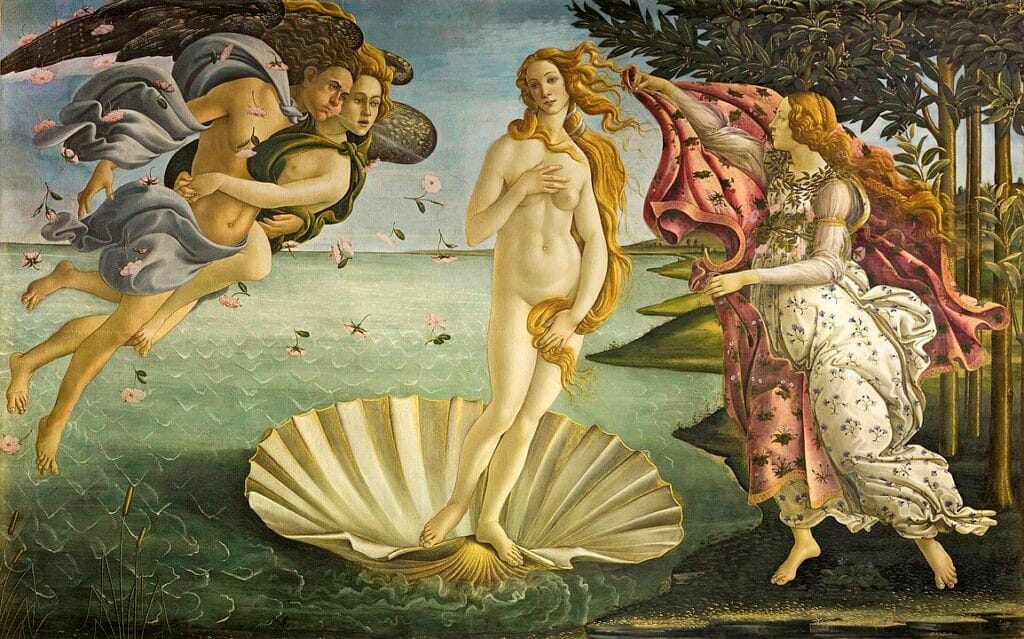
The cassone dominated Italian Renaissance furniture. These monumental chests, commissioned for aristocratic weddings, became supports for narrative paintings. Botticelli, Uccello painted mythological or historical scenes on their façades. Carved, gilded, decorated with pastiglia (gilded stucco reliefs), they embodied domestic luxury.
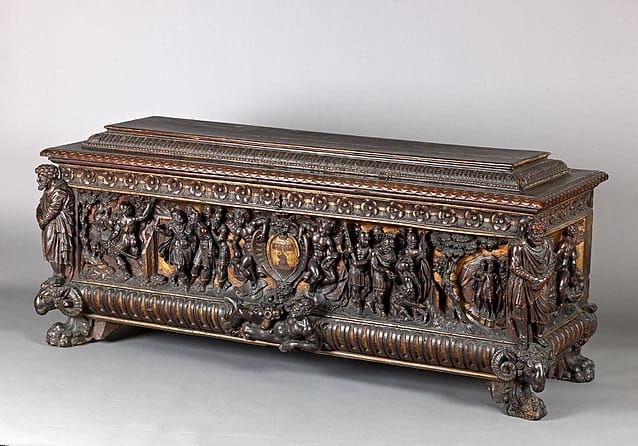
The cassone evolved in the 16th century toward more architectural sculpture: pilasters, caryatids, mascarons, grotesques. Some examples, mounted on feet, heralded future credenzas and buffets.
Cabinet
The Renaissance cabinet (studiolo) constituted the art furniture par excellence. These furniture pieces with drawers and secret compartments, designed to preserve precious objects and documents, competed in sophistication. Perspective marquetry (intarsia), hardstone veneers (pietre dure), ivory inlays, gilt bronzes: all decorative arts combined.
Ducal studioli, like Federico da Montefeltro’s in Urbino, featured stunning trompe-l’oeil marquetry: musical instruments, books, scholarly objects appearing to rest on shelves, creating perfect depth illusion.
French Furniture
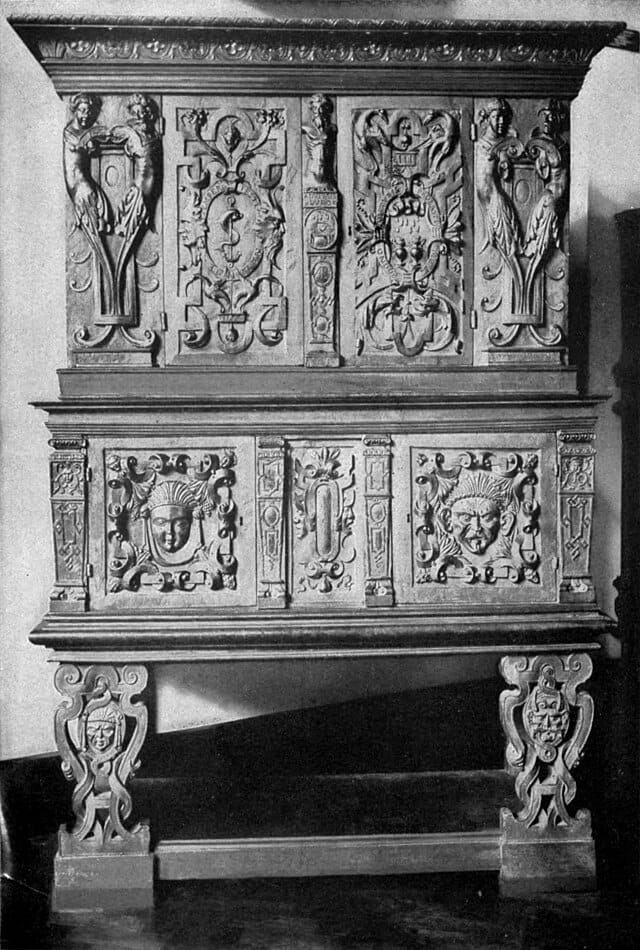
The French Renaissance developed monumental furniture in carved walnut. Dressoirs (buffets) with two superimposed bodies, adorned with columns, caryatids, pediments, transposed architecture into furniture. Armoires gained height and sculptural sophistication.
Seating evolved: caquetoires (chairs with tall, narrow backs) for ladies in voluminous dresses, armchairs with carved armrests. Furniture remained rarer and more precious than today, owning multiple seats testified to wealth.
Textiles & Tapestries
Textiles transformed Renaissance interiors. Monumental tapestries covered entire walls: the Hunts of Maximilian, the Acts of the Apostles after Raphael represented considerable investments. Velvet, damask, brocade adorned beds, windows, seats.
Beds became decorative monuments: carved canopies, sumptuous curtains, embroidered coverlets. In Italian palaces, the canopy bed (letto a baldacchino) dominated the state bedroom, a reception room as much as sleeping chamber.
Ceramics & Glassware
Italian maiolica reached its Renaissance apex. Urbino, Faenza, Deruta produced ceramics with istoriati (narrative) decoration inspired by engravings. These pieces adorned credenzas and dressoirs, signaling wealth and culture.
Venetian glassware achieved extraordinary sophistication. Murano glass – crystalline, colored, filigree- equipped aristocratic tables. Venetian mirrors, extraordinarily costly, became symbols of ultimate luxury.
Legacy & Reinterpretations
The Renaissance established the foundations of Western classicism. Its architectural vocabulary (orders, proportions, symmetry) remained the reference for four centuries. 18th-century Neoclassicism consciously returned to Renaissance sources. 19th-century Beaux-Arts perpetuated this heritage.
Palladian architecture enjoyed extraordinary fortune. In England, Inigo Jones then 18th-century Palladianism dominated aristocratic architecture. In the United States, Thomas Jefferson adopted Palladio as model, from Monticello to the University of Virginia.
The 20th century dialogued differently with the Renaissance. Modernism rejected ornament but retained fascination with proportion and geometry. Le Corbusier studied Palladian villas. Louis Kahn meditated on Renaissance harmony. Postmodernism explicitly cited Renaissance forms.
In contemporary interior design, the Renaissance continues to inspire. Classical elements like moldings, cornices, pilasters, pediments, adorn traditional and neoclassical interiors. Renaissance proportions guide interior designers seeking harmony and balance.
Current Market & Pricing
Authentic Furniture
Authentic Renaissance furniture commands extraordinary prices. A 15th-century cassone decorated by a known master can exceed €500,000. Marquetry cabinets sell for €50,000 to €300,000 depending on quality and provenance.
French Renaissance furniture (dressoirs, armoires) reach €20,000 to €150,000. Expert authentication is essential: 19th-century neo-Renaissance reproductions abound. Authentic seating remains extremely rare, a period armchair can be worth €30,000 to €100,000.
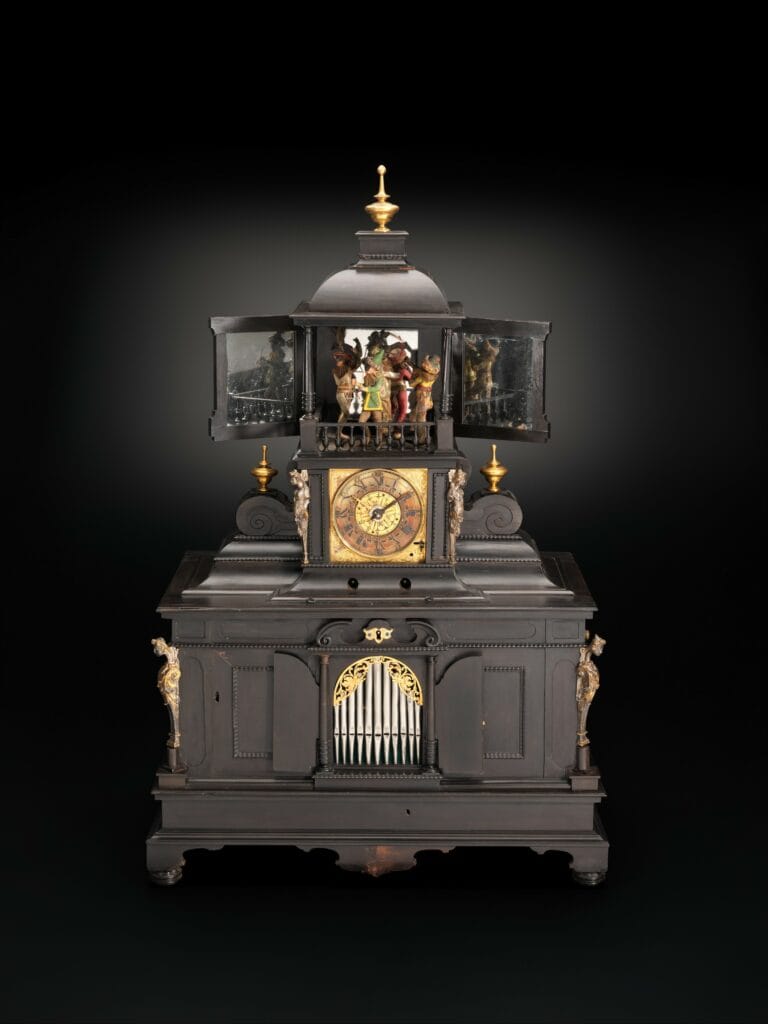
Decorative Arts
16th-century istoriati maiolica reach €10,000 to €200,000 depending on pictorial quality and provenance. Renaissance bronzes (statuettes, plaques, objects) sell for €5,000 to €500,000.
Textiles as tapestries, velvet, embroideries rarely survive in good condition. A 16th-century tapestry in acceptable condition can be worth €30,000 to €300,000. Fragments, more accessible, start at €3,000.
Neo-Renaissance Style
19th-century neo-Renaissance furniture offers accessible alternatives. A neo-Renaissance carved walnut dressoir ranges from €2,000 to €15,000. A monumental desk can reach €8,000 to €30,000. Neo-Renaissance seating: €500 to €3,000 per piece.
Architectural elements like doors, fireplaces, paneling from demolished residences always find buyers. A Renaissance stone fireplace: €5,000 to €50,000. Complete paneling: €20,000 to €200,000.
Conclusion
The Renaissance represents a unique moment when art, science, and philosophy converged to create a harmonious vision of the world. For two centuries, architects, artists, and craftsmen pursued an ideal of beauty based on measure, proportion, and harmony.
This quest produced architectural and decorative masterpieces of extraordinary sophistication. Renaissance palaces and villas, with their perfect proportions, integrated decoration, and sumptuous furniture, established a model of aristocratic elegance spanning centuries.
After the Renaissance, the Baroque would amplify and dramatize its vocabulary. But fundamental principles – classical orders, symmetry, harmonious proportions – remained the basis of Western design until 20th-century Modernism. And even today, when contemporary architecture seeks beauty and balance, it still dialogues with the Renaissance.
For the Renaissance still speaks to us. It reminds us that beauty emerges from order and measure. That art can simultaneously express grandeur and intimacy. That design, when aiming for perfect harmony between function and form, achieves timelessness. Renaissance interiors,with their subtle balance between richness and restraint, perfect integration of arts, celebration of earthly beauty remain models of civilized elegance.

Digital entrepreneur and craft artisan.
My work bridges craftsmanship, design history and contemporary creation, shaping a personal vision of luxury interior design.
Since 2012, I have been based in my workshop on the shores of Lake Annecy, creating bespoke interiors for architects, decorators and private clients.