


Fine cabinetmaking: history, workshops and leading makers
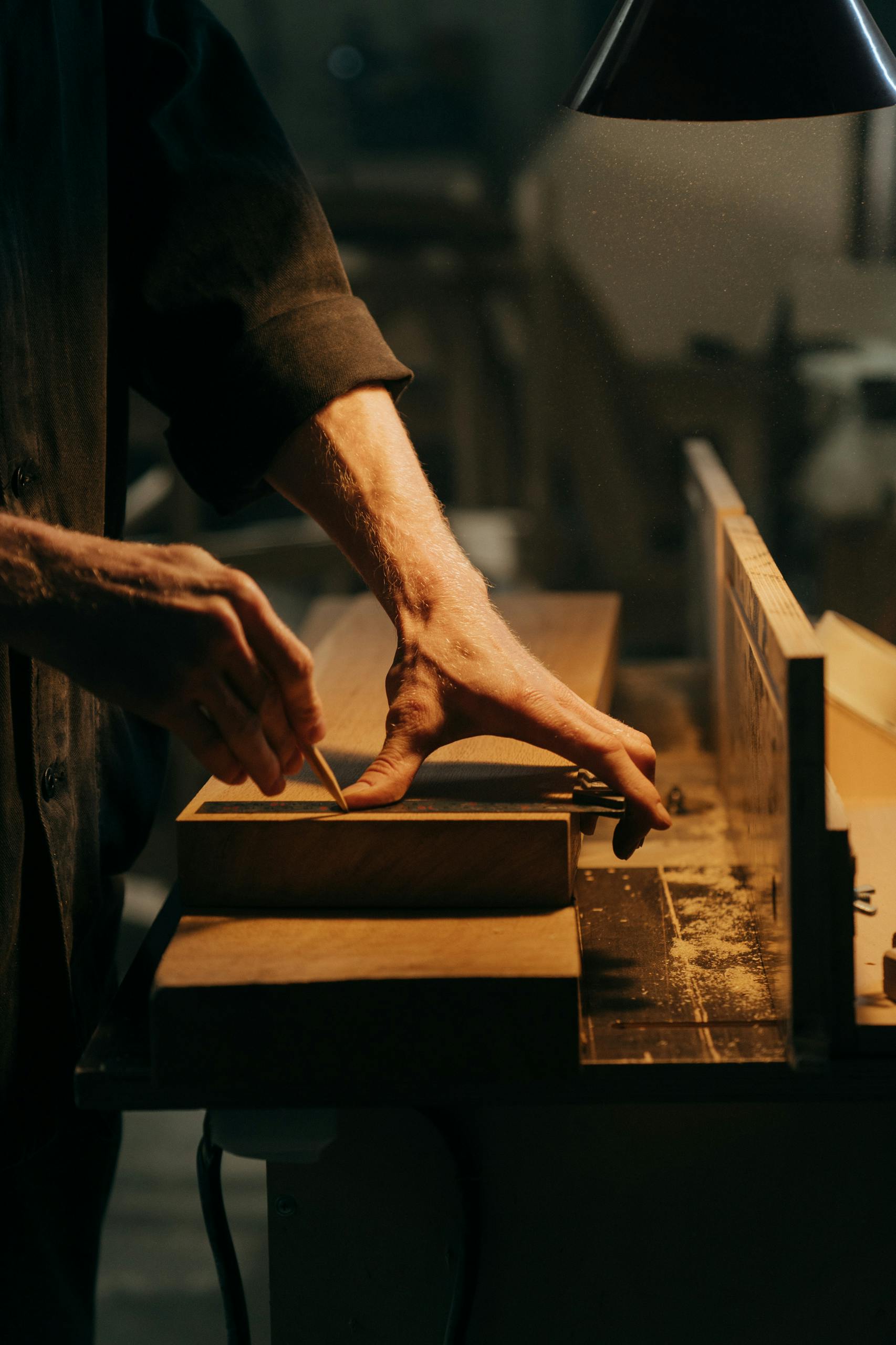
The French word for cabinetmaker, ébéniste, comes from ébène, the dense black ebony that European craftsmen discovered in the sixteenth century and reserved for their most precious pieces. Four centuries on, the cabinetmaker is still the one who turns furniture into art: veneer, marquetry, carving and finish, every gesture shapes the beauty and the life of the piece.
Contents
What is fine cabinetmaking?
From Boulle to Ruhlmann: a French story
How do you become a cabinetmaker?
Leading workshops and makers
Choosing a cabinetmaker
Where to see and buy the work
Cabinetmaking today
Frequently asked questions
What is fine cabinetmaking?
Fine cabinetmaking is the art of designing and making refined furniture, in solid or veneered wood, often enriched with marquetry, inlay or carving. Where the joiner makes what belongs to the building, doors, panelling, staircases and fitted interiors (see our guide to fine joinery and bespoke fitted interiors), the cabinetmaker makes furniture, piece by piece.
Veneer is the cabinetmaker’s territory: thin leaves of precious wood laid over a carcass, allowing patterns, grain matching and marquetry impossible in solid timber. So is the finish, from French polish to wax, which gives wood its depth.
From Boulle to Ruhlmann: a French story
At the court of Louis XIV, André-Charles Boulle gave his name to a marquetry of tortoiseshell and brass that spread across Europe. In the eighteenth century Paris became the capital of furniture: under Louis XV and Louis XVI, Oeben, Riesener and their peers made the most admired commodes and secretaires in the world. Guild masters struck their estampille, a stamp punched into the wood that still allows a piece to be attributed today.
The Faubourg Saint-Antoine in Paris long remained the heart of the trade. In the twentieth century, Émile-Jacques Ruhlmann took cabinetmaking to a peak of luxury with Art Deco: shagreen, ivory, macassar ebony and proportions of absolute elegance.
How do you become a cabinetmaker?
In France, the classic path starts with a vocational CAP in cabinetmaking, often followed by a craft diploma (BMA) focused on marquetry, veneering and restoration. A design-led degree, the DNMADe in wood, offers a more conceptual route. The Compagnons du Devoir, the French guild whose Tour de France sends apprentices from workshop to workshop, remain a unique school of rigour, and the title of Meilleur Ouvrier de France crowns the masters.
Reference schools include the École Boulle in Paris, founded in 1886, the Compagnons du Devoir, the Royal Danish Academy in Copenhagen, heir to Kaare Klint, and in the United States the North Bennet Street School in Boston and the furniture programme at the Rochester Institute of Technology. In Britain, John Makepeace trained a whole generation of furniture makers at Parnham, in Dorset.
Leading workshops and makers
This selection brings together traditional workshops and makers who work wood as cabinetmakers. It will grow as we meet more of them.
France
Moissonnier (Bourg-en-Bresse): fine cabinetmaking since 1885, known for period furniture in bold colours. Taillardat (Paris): period furniture and seating for great houses and luxury hotels. Jallu Ébénisterie: exceptional furniture and fittings for luxury houses and private residences. Atelier Lison de Caunes (Paris): the reference for straw marquetry, a precious technique brought back into fashion. On the contemporary side, HART has profiled Adrien des Rues, a Lyon cabinetmaker for whom wood becomes a language, and the Exo collection by Grégoire de Lafforest.
United Kingdom
John Makepeace, pioneer of sculptural wooden furniture and founder of the Parnham school; Sebastian Cox (Kent), working local timber from sustainably managed woodland; Gareth Neal (London), combining digital cutting and hand finishing; Linley, for marquetry and bespoke furniture.
Belgium and the Netherlands
Kaspar Hamacher (Belgium): monumental benches and tables carved from trunks, often charred; Michaël Verheyden (Belgium): objects and furniture in wood and leather of great restraint; Maarten Baas (Netherlands): the Smoke series, classic furniture burnt and then lacquered, now an icon of collectible design.
Italy
Riva 1920 (Cantù): solid wood in the Brianza tradition; Martino Gamper, an Italian designer based in London, known for 100 Chairs in 100 Days, a hundred chairs reassembled from discarded ones.
Scandinavia
PP Møbler (Denmark): Hans J. Wegner’s chairs made by hand, in one of the most demanding workshops in the world; Carl Hansen & Søn, maker of the Wishbone Chair and other Danish wooden classics.
Germany and Austria
e15 (Frankfurt): solid oak and walnut in minimal lines; Nils Holger Moormann (Bavaria): clever, demountable furniture; Team 7 (Austria): oiled solid wood, from forest to workshop.
United States and Canada
Nakashima Woodworkers (New Hope, Pennsylvania), where Mira Nakashima continues her father George’s work and his live-edge tables; Wendy Maruyama (California), a leading figure of American studio furniture; Brent Comber (Vancouver), for sculptural pieces in reclaimed wood.
Choosing a cabinetmaker
For a bespoke piece, ask to see the workshop and recent work, drawings and a sample of wood and finish. The price depends on the species, the complexity of the joinery, the veneer and marquetry, and the finishing time: expect anything from a few thousand euros for a chair to several tens of thousands for a cabinet or library, and several months of lead time. A deposit on order is normal; full payment before work begins is not.
To choose your woods, our guide to wood in design covers species, origins and behaviour.
Where to see and buy the work
Collectible design galleries: Galerie Kreo and Galerie Negropontes in Paris, Carpenters Workshop Gallery, Friedman Benda in New York, Nilufar in Milan. To go further, our selection of confidential houses of collectible design.
Fairs: Révélations, the fine crafts biennial at the Grand Palais; PAD in Paris and London; Design Miami; Maison&Objet; Milan Design Week; and the Artisans d’Excellence fair.
Museums: the Musée Nissim de Camondo and the Musée des Arts Décoratifs in Paris for the eighteenth century, the Wallace Collection and the V&A in London, the Musée du Compagnonnage in Tours, and for contemporary design the Vitra Design Museum and the Cooper Hewitt in New York.
Further reading: Roubo’s L’Art du menuisier, whose volume on cabinetmaking remains a bible; Pierre Kjellberg’s dictionary of eighteenth-century French cabinetmakers and joiners; George Nakashima’s The Soul of a Tree.
Cabinetmaking today
Responsible wood. Local or certified timber, reclaimed wood, natural oil and wax finishes: the finest workshops have made traceability a point of pride. Precious tropical woods, several of them protected, are now used with documented origin or as veneer.
Hand and machine. Digital cutting and 3D modelling serve prototyping and complex forms, but choosing the wood, veneering and finishing remain the cabinetmaker’s gestures. Repairable, demountable furniture made to last reconnects with the spirit of the craft.
To discover the other fine crafts, from joinery to upholstery, see our guide to luxury craftspeople and fine crafts.
Frequently asked questions
What is the difference between a cabinetmaker and a joiner?
A joiner makes what is tied to the building: doors, staircases, panelling, fitted interiors. A cabinetmaker makes furniture, often veneered, inlaid or carved, and finishes it.
What is an estampille?
It is the cabinetmaker’s name stamp, struck into the wood of a piece of furniture. Compulsory for Parisian masters in the eighteenth century, it allows a piece to be attributed today and weighs heavily in its value.
How much does a bespoke piece from a cabinetmaker cost?
It depends on the species, the complexity and the finish: from a few thousand euros for a chair to several tens of thousands for a cabinet or library. Always ask for a detailed quote and a finish sample.
Resources
Five ways into the world of HART
- 01 Spaces Spaces & materials Interiors, atmospheres and materials that give a place its identity.
- 02 Creators Designers & creators Architects, designers and artists whose vision changed the way we live.
- 03 Craftsmanship Artisans & fine crafts Upholsterers, cabinetmakers, metalworkers, ceramicists: the workshops and the hands behind true excellence.
- 04 Furniture Furniture & interiors Iconic sofas, seating and lighting, read through form, use and comfort.
- 05 Heritage Design history From Gothic to global design, the styles that shaped the art of living.