

Verner Panton and the Concept of Total Design
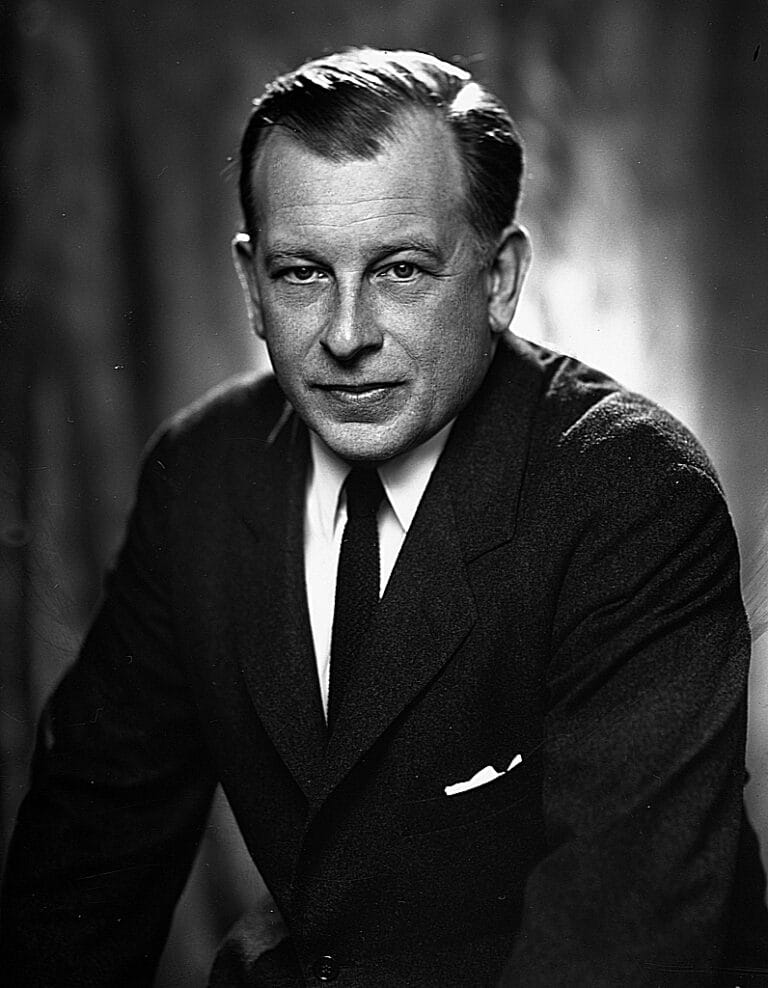
In the history of twentieth-century design, only a handful of iconic designers truly changed the way we think about domestic space. Verner Panton was one of them. Born in Denmark in 1926, he reshaped the experience of interiors by turning away from Scandinavian restraint and embracing colour, curvature, and bold expression. Where others chose discretion, he chose presence. Where many designed furniture, he imagined entire worlds. His work tells the story of a visionary who transformed design into a total, immersive experience.
A Danish Designer Beyond Convention
Born in Denmark in 1926, Verner Panton belonged to a generation of Scandinavian designers deeply shaped by modernist functionalism. Yet he quickly sensed its limitations. After studying at the Royal Danish Academy of Fine Arts in Copenhagen and briefly working in the studio of Arne Jacobsen, he soon chose a radically different path.
While Nordic design celebrated restraint and the moral virtue of the well-made object, Panton embraced colour, movement and expressive form. He rejected the idea that furniture should quietly fade into the background. For him, design was not simply about producing objects. It was about shaping perception, influencing mood and transforming the way a space is experienced.
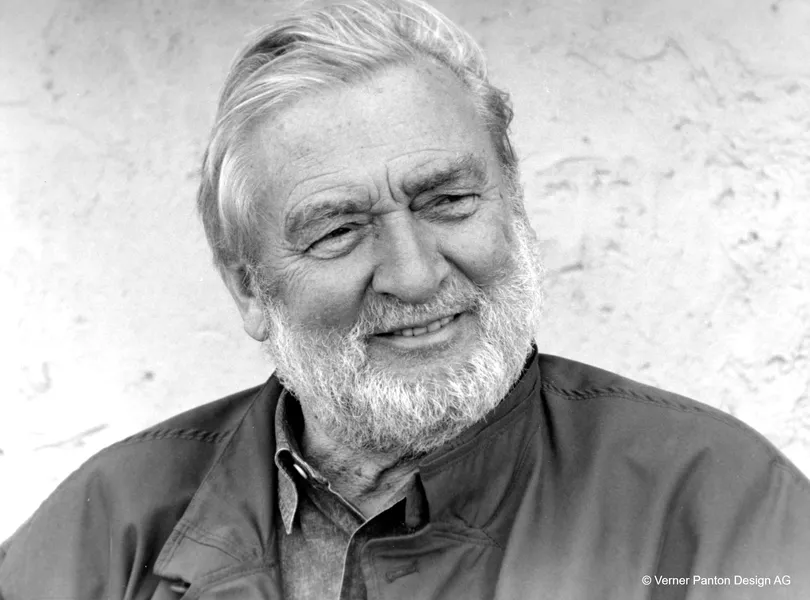
Verner Panton was not just a furniture designer. He was a creator of atmospheres.
Why His Work Still Matters
Verner Panton occupies a central place in design history, not simply because he designed an iconic chair, but because he fundamentally expanded the role of design.
He was among the first designers to treat colour as a primary language rather than mere decoration. He also championed the use of polymer materials as a field of experimentation and freedom at a time when such materials were often dismissed as inferior.
Most importantly, he understood interiors as immersive environments. For Panton, an interior was not simply an arrangement of objects but a spatial experience capable of surrounding the body and activating the senses.

At a time when modernism favoured neutrality and rational clarity, Panton introduced emotion, intensity and provocation. He was not interested in reassuring people. He wanted to awaken them.
His thinking deeply influenced Italian Radical Design, contemporary scenography, experiential retail environments and many immersive interiors today. Panton did not merely anticipate our era; he helped define it.
Emotion Before Function
For Verner Panton, design is never neutral. It affects the psyche, shapes behaviour and transforms how we feel within a space.
Comfort, in his view, was never purely ergonomic. A space should stimulate and envelop. It might even unsettle. Colour became a psychological tool capable of transforming the atmosphere of a room.
Furniture ceased to be discreet and became expressive, almost theatrical. Through this approach, Panton challenged conventional notions of good taste and the polite bourgeois interior. His work represented a cultural position and a declaration of freedom, perfectly embodying the liberated spirit of the 1960s.
He was not searching for neutral timelessness. He was searching for expression and non-conformity.
Designing Space as a Whole
The Concept of the Total Environment
At the heart of Panton’s thinking lies a simple conviction: a space cannot be conceived in fragments.
Floor, walls, ceiling, furniture, lighting and colour must interact continuously. Design becomes a spatial continuum without rigid hierarchies.
Panton created monochrome interiors that feel like landscapes, environments one steps into as if entering another dimension.

His Visiona installations in the late 1960s for Bayer illustrate this philosophy perfectly. Presented during the Cologne Furniture Fair, these environments were not conventional showrooms but immersive spatial experiences.
Visitors did not simply observe the design. They moved through it. They inhabited it. They experienced it.
Iconic Creations
The Panton Chair remains his most recognizable creation. As the first single-piece moulded polyurethane chair produced industrially, it represented a radical breakthrough in furniture design.
With no visible rear legs and no apparent structure, its fluid silhouette appears to defy gravity. Developed with Vitra and released in 1967, the chair perfectly captured Panton’s ambition to explore the potential of polymer materials and create a sensual, industrially produced object.

The story of the Panton Chair actually began several years earlier. As early as 1959, Panton started exploring the idea of a single-piece cantilever chair moulded from synthetic materials. Numerous prototypes followed throughout the early 1960s before the design could finally be produced industrially. When Vitra introduced the chair in 1967, it was the result of nearly a decade of experimentation and technological development.
The Living Tower stands somewhere between sculpture and architecture, proposing a playful and unconventional way of inhabiting furniture.
The Cone Chair and Heart Cone Chair transformed seating into bold geometric statements that punctuate space.
The Flowerpot lamp, born within the countercultural atmosphere of the late 1960s, became an emblem of optimism and freedom, celebrating colour and accessibility.
Visiona 2, created for Bayer during the Cologne Furniture Fair, remains one of the most radical interior environments ever designed. Red, orange, purple, violet and blue combine into a chromatic landscape where architecture and furniture dissolve into a continuous sensory world.
A Living Legacy
Verner Panton does not belong to the past. In today’s renewed interest in maximalism and immersive environments, his work feels strikingly contemporary.
He reminds us that design does not need to be polite or discreet. An interior can be an adventure. Colour can be a manifesto. Space can be emotional.
Panton did not simply design furniture. He created worlds and those worlds continue to inspire and challenge us today.
Acknowledgement
HART Design Selection thanks Verner Panton Design AG for their support and for providing access to archival material related to the work of Verner Panton.
Digital entrepreneur and craft artisan.
My work bridges craftsmanship, design history and contemporary creation, shaping a personal vision of luxury interior design.
Since 2012, I have been based in my workshop on the shores of Lake Annecy, creating bespoke interiors for architects, decorators and private clients.