

Understanding the Louis XIV Style
Between the constructive rigor of Louis XIII style and the decorative softening of Regency style, Louis XIV style (1643–1715) imposes a monumental classicism in service of power.
Louis XIV style (1643–1715) marks the spectacular affirmation of a decorative art conceived as an instrument of power. Under the reign of the Sun King, decoration ceases to be merely functional or artisanal: it becomes a political language, codified, hierarchized, designed to impress, order, and dominate. Architecture, furniture, and decorative arts organize themselves around a central principle: staged grandeur.
In this guide, we decode how to recognize Louis XIV (forms, legs, backs, stretchers, motifs), its key creators (Le Brun, Le Vau, Hardouin-Mansart, Le Nôtre, Boulle) and what truly distinguishes it from Louis XIII, often misunderstood and confused.
What is Louis XIV Style?
Born in the rigorous continuity of Louis XIII style, Louis XIV style amplifies every element – proportions, symmetry, ornamental richness – to achieve unprecedented monumentality. Versailles is its absolute expression: a total decoration where space, furniture and ornament serve the sovereign’s glory and permanently establish French classicism as a European reference.
Louis XIV style embodies the apogee of French absolute monarchy. Between 1643 and 1715, under the reign of the Sun King, a style of unprecedented magnificence unfolds, expressing royal omnipotence and France’s grandeur.
This style develops in two distinct phases. The early Louis XIV (1643-1680) still retains baroque influence and decorative fantasy. The grand Louis XIV style (1680-1715), after the installation at Versailles in 1682, achieves perfect classical majesty, characterized by rigorous symmetry, monumentality and extraordinary richness.
Why does this style matter today? Because it represents the culmination of French classicism. Louis XIV creates a complete and coherent decorative language that establishes itself as a European reference. Its ornamental vocabulary – gilding, marble, mirrors, solar symbols – durably influences aristocratic art of living. This style embodies the very notion of grand luxury and court art.
- Architectured structure: massive, rectilinear furniture, impression of stability and power.
- Straight and powerful legs, often connected by an X or H stretcher, sometimes carved.
- Legs turned in “os de mouton” (swollen and rhythmic baluster), emblematic of seats and tables.
- High and straight backs, slightly inclined at the end of the reign, affirming posture and authority.
- Rectilinear armrests, firm, extending the structure rather than the curve.
- Noble woods: oak and walnut dominate, with precious veneers for ceremonial furniture.
- Symmetrical and ordered decoration, inherited from classical architecture.
- Royal decorative repertoire: acanthus leaves, palmettes, laurels, trophies, mascarons.
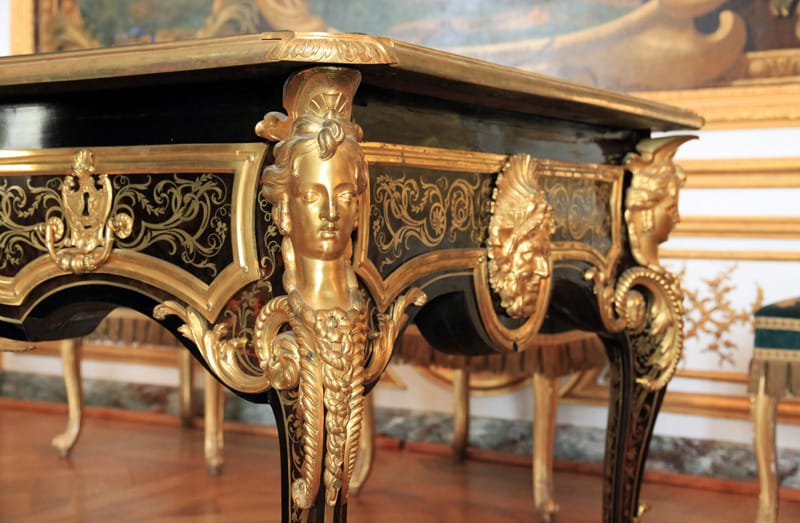
- Gilt bronzes and elaborate marquetry (Boulle) for prestige furniture.
- Representative function: furniture is a sign of rank before being a comfort object.
Historical & Cultural Context
Louis XIV ascends to the throne in 1643 at age five. His mother Anne of Austria and Cardinal Mazarin ensure the regency until 1661. The Fronde (1648-1653) profoundly marks the young king: he will always distrust the Parisian nobility.
Upon Mazarin’s death in 1661, Louis XIV decides to govern alone. He affirms absolute monarchy: “L’État, c’est moi” (I am the State). He surrounds himself with competent ministers – Colbert for finances, Louvois for war, Le Tellier – who methodically organize French grandeur.
Colbert plays a crucial role in elaborating Louis XIV style. Controller General of Finances and Superintendent of the King’s Buildings, he organizes artistic production like a state industry. He creates or reorganizes the Royal Manufactories: Gobelins (tapestries, furniture, bronzes), Savonnerie (carpets), Saint-Gobain (mirrors). These institutions guarantee exceptional quality and independence from foreign imports.
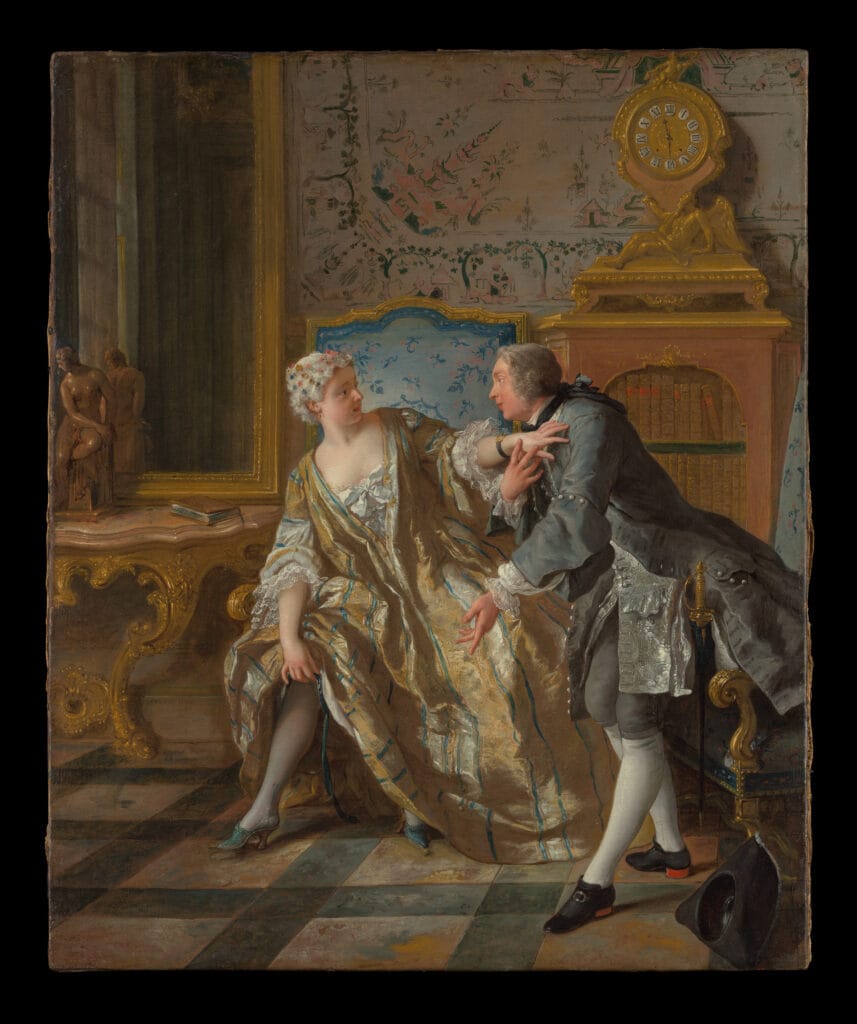
The Royal Academy of Painting and Sculpture (1648), the Academy of Architecture (1671), the Academy of Music (1669) codify the arts under royal control. This cultural centralization makes Paris the European artistic capital, supplanting Rome.
The transfer of the court to Versailles in 1682 marks the system’s apogee. The king transforms a hunting lodge into a monumental palace where he gathers and monitors French nobility. Versailles becomes a permanent theater of royal power, a propaganda and etiquette machine where every gesture, every decoration glorifies the Sun King.
Aesthetic Characteristics
Louis XIV style is immediately recognizable by its monumental majesty. Proportions become grandiose, imposing, sometimes overwhelming. Architectural scale dominates, even in domestic furniture. Everything expresses power and permanence.
Symmetry reaches absolute rigor. Plans, facades, decorations organize themselves along perfectly balanced axes. This implacable geometry translates the royal order imposed on the world’s chaos. Le Nôtre’s gardens at Versailles embody this domination of nature through human geometry.
Baroque is an artistic movement born in Italy at the end of the 16th century, well before the reign of Louis XIV. It relies on movement, theatricality and the search for strong emotional impact.
When Louis XIV comes to power, baroque is already widely diffused throughout Europe. In France, it is neither copied nor rejected, but transformed: exuberance is contained by rules of composition, symmetry and hierarchy inherited from classicism.
Louis XIV style is therefore not pure baroque, but a controlled and monumental version, designed to serve the representation of power and inscribe art in service of the State.
Ornamentation obsessionally celebrates the king. The sun – Louis XIV’s emblem – radiates everywhere: mascarons, cartouches, pediments. The eagle, the lion, the Gallic rooster symbolize power and courage. Military trophies recall military victories. Interlaced L’s crowned mark royal property.
Precious materials affirm royal wealth. Polychrome marbles (red from Languedoc, green from Campan, black from Belgium) cover floors, columns, fireplaces.
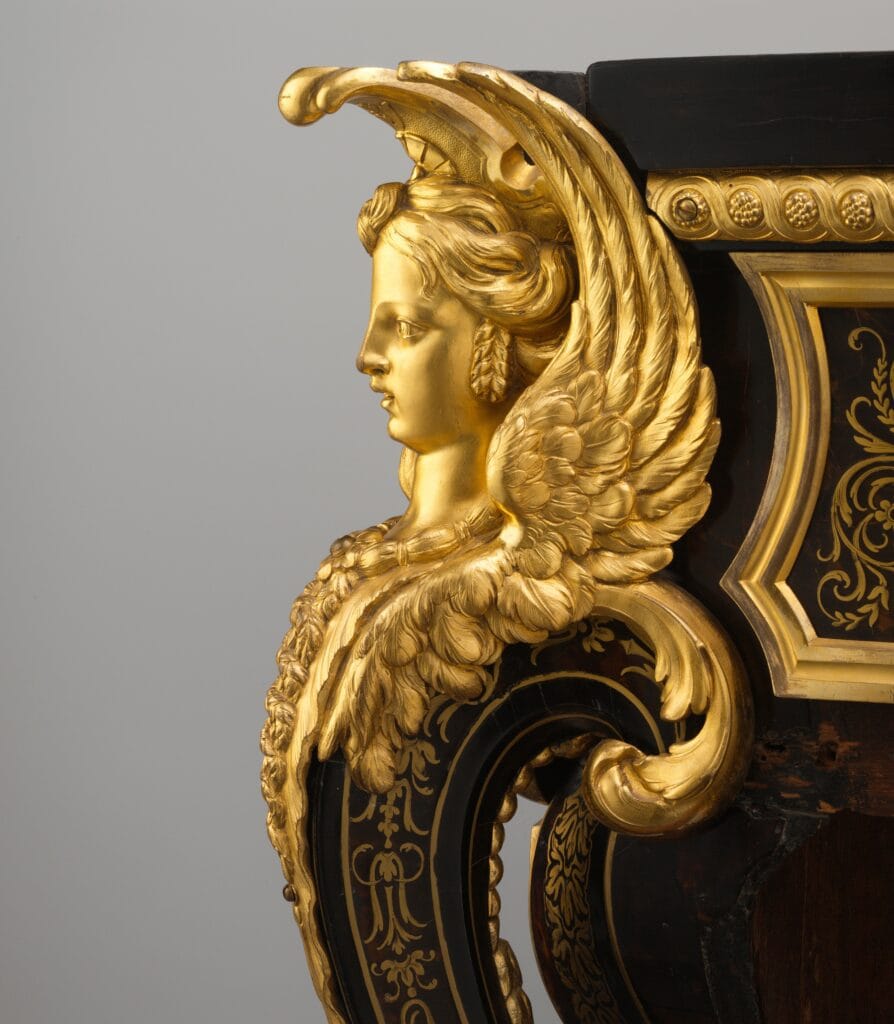
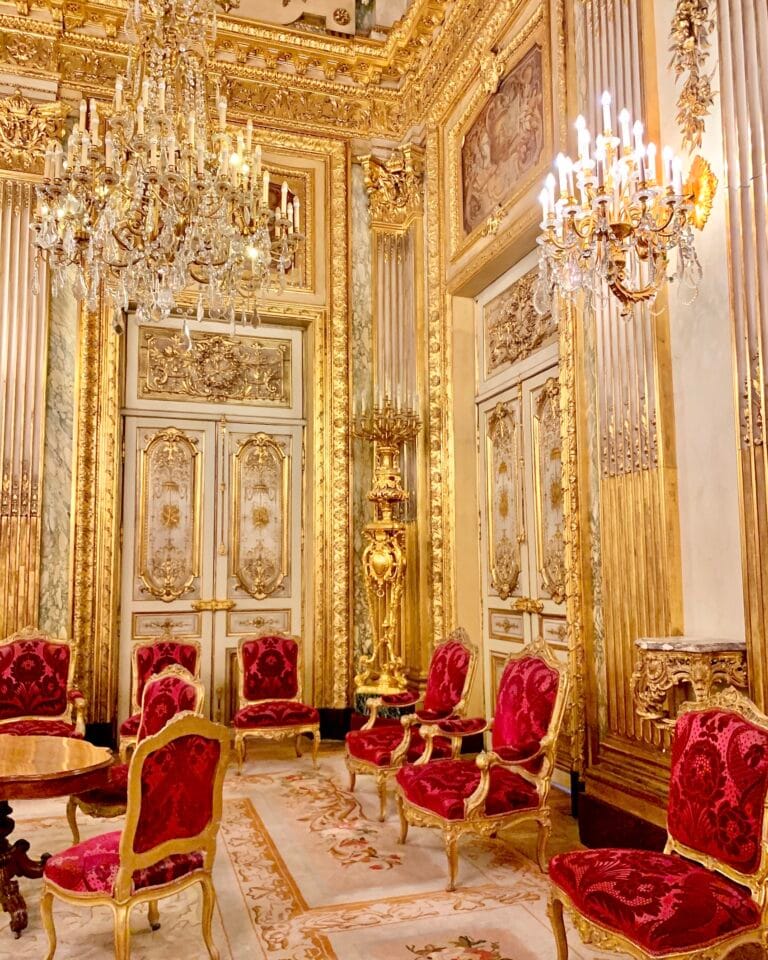
Metal is also omnipresent, with gilt bronzes – chiseled, polished, mercury-gilded – reaching unequaled quality. Mirrors, still very expensive, multiply light and space. Gold – gold leaf on wood, mercury gilding on bronze – shines everywhere.
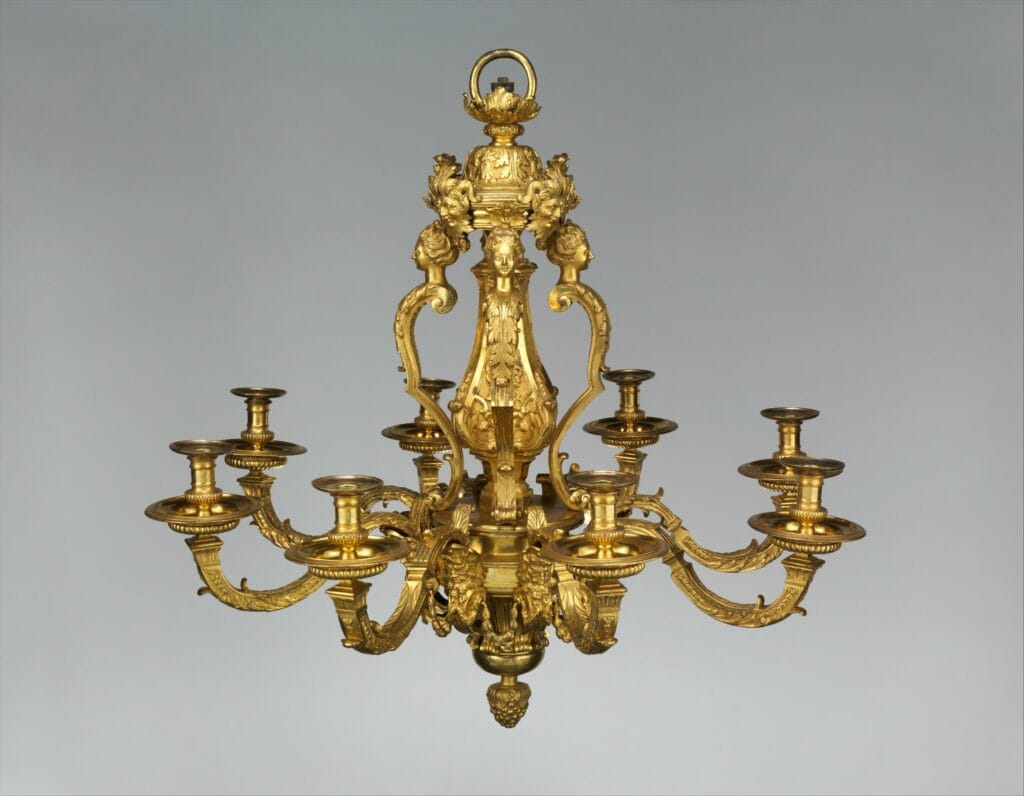
Furniture adopts architectural forms. Sheath legs (pillars narrowing toward the bottom), columns, pediments, entablatures transpose monumental architecture to domestic scale. Inverted console legs, carved with foliage and scrolls, become the style’s signature.
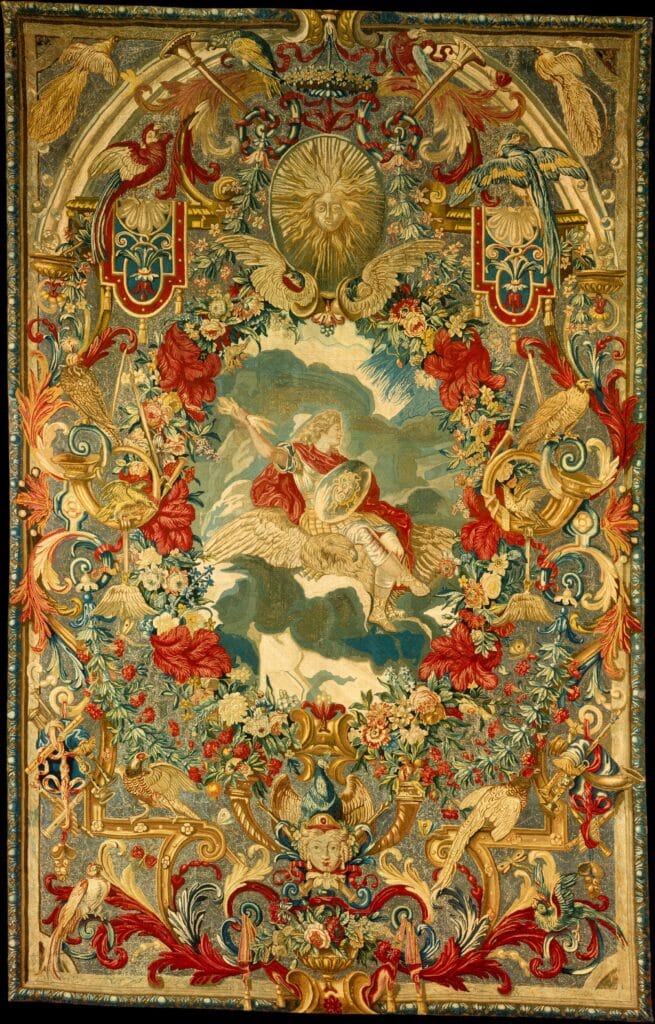
Textiles rival in sumptuousness. Genoa velvet, Lyon damask, brocades woven with gold and silver cover seats, beds, walls. Gobelins tapestries narrate Louis XIV glory in wool and silk. Around 1683, these allegorical embroideries of the Seasons and Elements were probably commissioned by Françoise-Athénaïs de Rochechouart, Marquise de Montespan and made at the convent of the Daughters of Saint Joseph in Paris to glorify Louis XIV’s court. The Air panel shows the king embodying Jupiter, in a composition linked to Versailles decorations attributed to Charles Le Brun’s circle, while other panels represent their children as mythological deities. Executed in metallic threads, these luxurious embroideries illustrate the excellence of royal textile art under the Sun King’s reign.
Creators & Key Figures
Charles Le Brun
Painter and decorator (1619-1690), Le Brun becomes the reign’s artistic director. First Painter to the King from 1662, he directs the Gobelins Manufactory from 1663, controlling all royal artistic production. He conceives the decorations of Versailles – notably the Hall of Mirrors –, designs furniture, tapestries, silverware. His authority imposes a coherent and unified style. His death in 1690 marks the end of pure grand Louis XIV style.
André-Charles Boulle
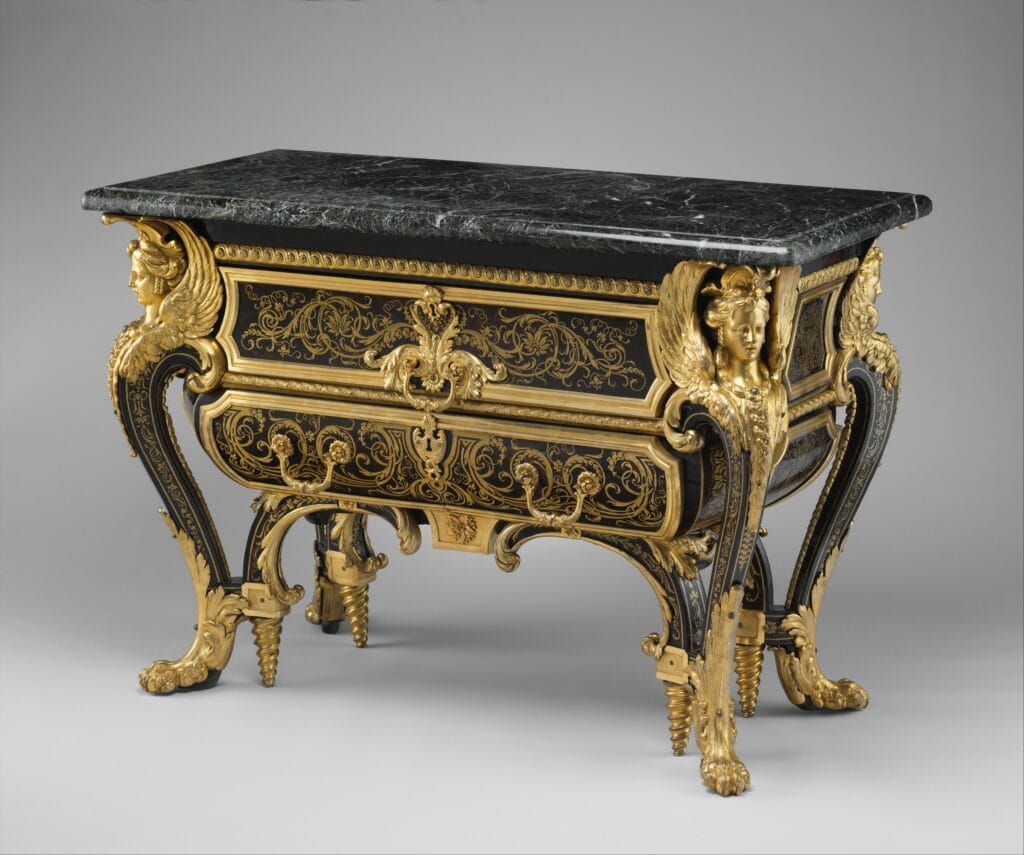
Brilliant cabinetmaker (1642-1732), Boulle revolutionizes furniture through his technique of tortoiseshell and brass marquetry. He applies superimposed brass sheets and tortoiseshell plates, cuts them simultaneously according to a design, then assembles the elements in première partie (brass on tortoiseshell) or contre-partie (tortoiseshell on brass). This technique, enriched with tin, tinted horn, precious woods, creates decorations of stunning richness.
Boulle furniture – armoires, commodes, cabinets, desks – become veritable symbols of royal luxury. Their gilt bronzes, chiseled by the best bronze workers, their monumental forms, their perfect execution make them absolute masterpieces. Boulle works for Louis XIV, princes, European aristocracy. His style influences cabinetmaking for a century.
Louis Le Vau
Architect (1612-1670), Le Vau builds Château de Vaux-le-Vicomte for Fouquet (1656-1661), a masterpiece that inspires Versailles. Louis XIV, jealous of this splendor, imprisons Fouquet and appropriates his team. Le Vau then transforms the Louvre (colonnade, eastern facade) then enlarges Versailles by enveloping Louis XIII’s château. His majestic architecture establishes monumental Louis XIV classicism.
Jules Hardouin-Mansart
Architect (1646-1708), Mansart succeeds Le Vau as king’s architect in 1675. He creates the most emblematic achievements: the Hall of Mirrors at Versailles (1678-1684), the Royal Chapel (1699-1710), the Grand Trianon (1687), Place Vendôme in Paris (1699). His sober and monumental style, his perfect proportions embody French classicism at its peak. Mansard roofs (broken roofs) bear his name.
André Le Nôtre
Gardener and landscape architect (1613-1700), Le Nôtre creates the French garden that becomes a European model. At Vaux-le-Vicomte then Versailles, he designs gardens where rigorous geometry and theatrical perspective transform nature into a work of art. Embroidered parterres, regular basins, rectilinear alleys, architectured groves create an idealized nature, subjected to royal order. His gardens become as famous as the palaces they surround.
Jean-Baptiste Colbert
Minister (1619-1683), Colbert organizes royal artistic policy. He transforms Château de Versailles into a permanent construction site employing thousands of artisans. He creates the Royal Manufactories, protects artists and artisans through privileges, imposes quality standards. His mercantilist vision makes art and luxury instruments of economic and political power. Without Colbert, Louis XIV style would not have achieved this coherence and splendor.
Architecture & Interior Decoration
Château de Versailles
Versailles embodies Louis XIV style in its totality. The château, enlarged by Le Vau then Mansart, becomes Europe’s largest palace. Its regular facade 680 meters long, its symmetrical wings, its marble courtyard establish overwhelming monumentality.
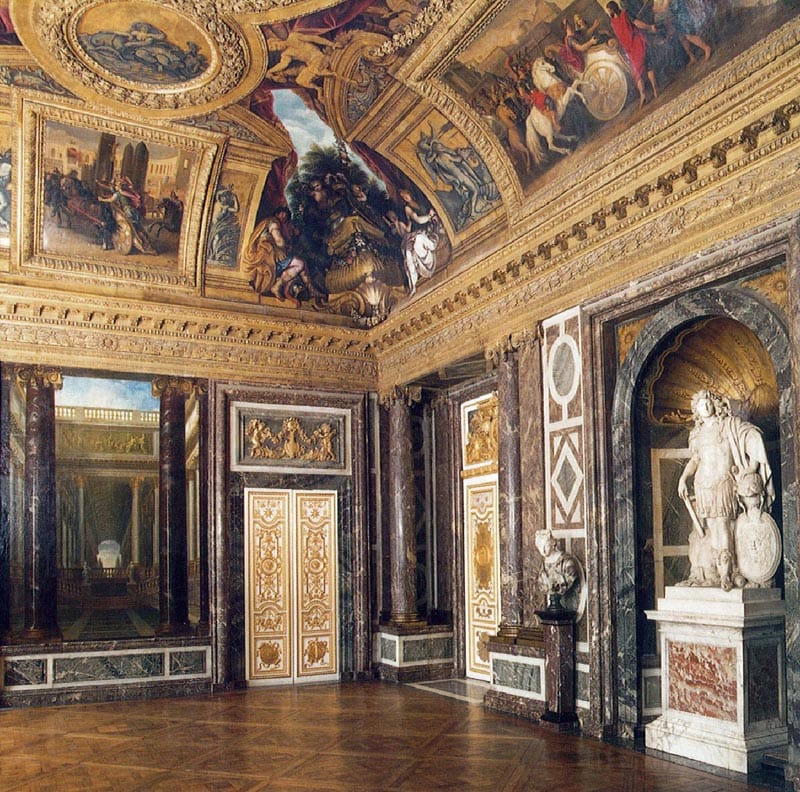
The Hall of Mirrors (1678-1684) represents the style’s apogee. 73 meters long, 12 meters high, it aligns 357 mirrors facing the windows, infinitely multiplying the garden light. The ceiling painted by Le Brun glorifies royal victories. Red marble pilasters, gilt bronze capitals, monumental candelabras create decoration of stunning richness. This gallery, theater of royal ceremonies, impresses foreign ambassadors and sovereigns.
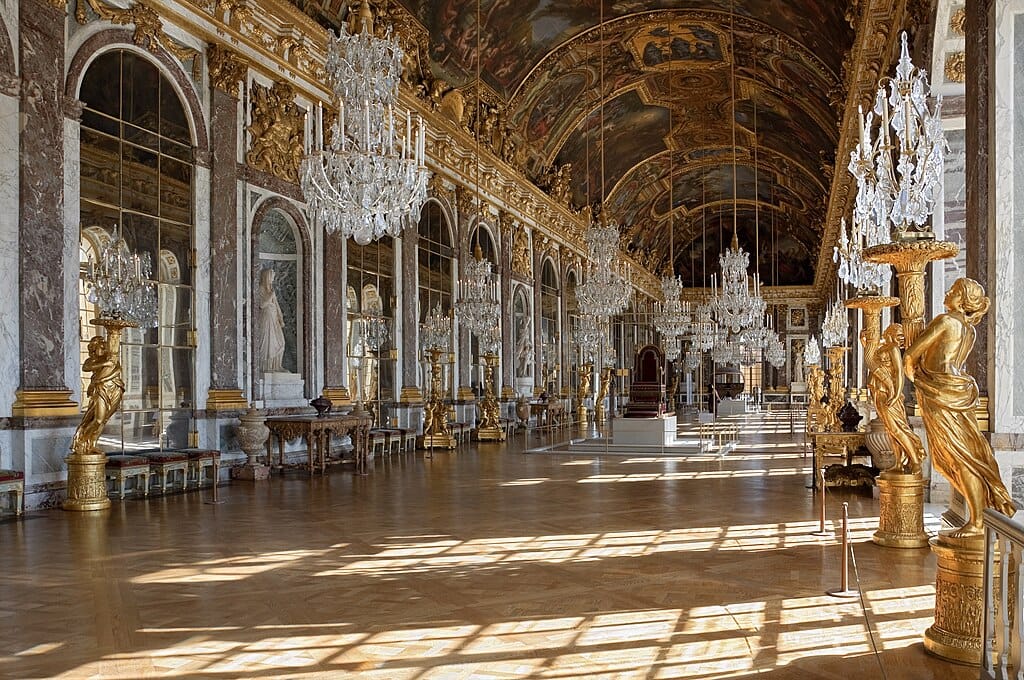
The Grand Apartments decline royal splendor: Salon of Hercules, Salon of Abundance, Salon of Venus, Salon of Diana, Salon of Mars, Salon of Mercury, Salon of Apollo. Each room, dedicated to a deity associated with the king, presents painted ceilings, polychrome marbles, gilded stucco, monumental fireplaces. The solid silver furniture (melted in 1689 to finance wars) attested to extraordinary wealth.
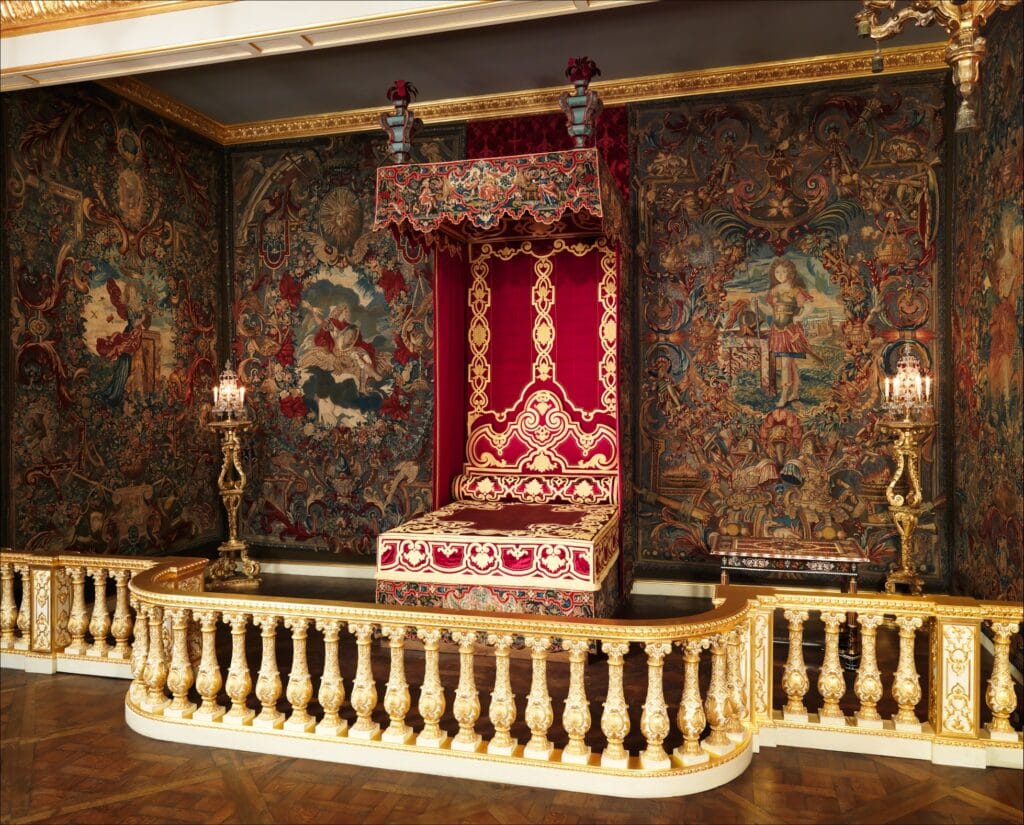
The King’s Chamber, symbolic center of the palace, opens to the east to welcome the rising sun. The king’s rising and retiring ceremonies become codified ceremonies where nobility crowds. The canopied bed, isolated by a gilded balustrade, sits like an altar of monarchical cult.
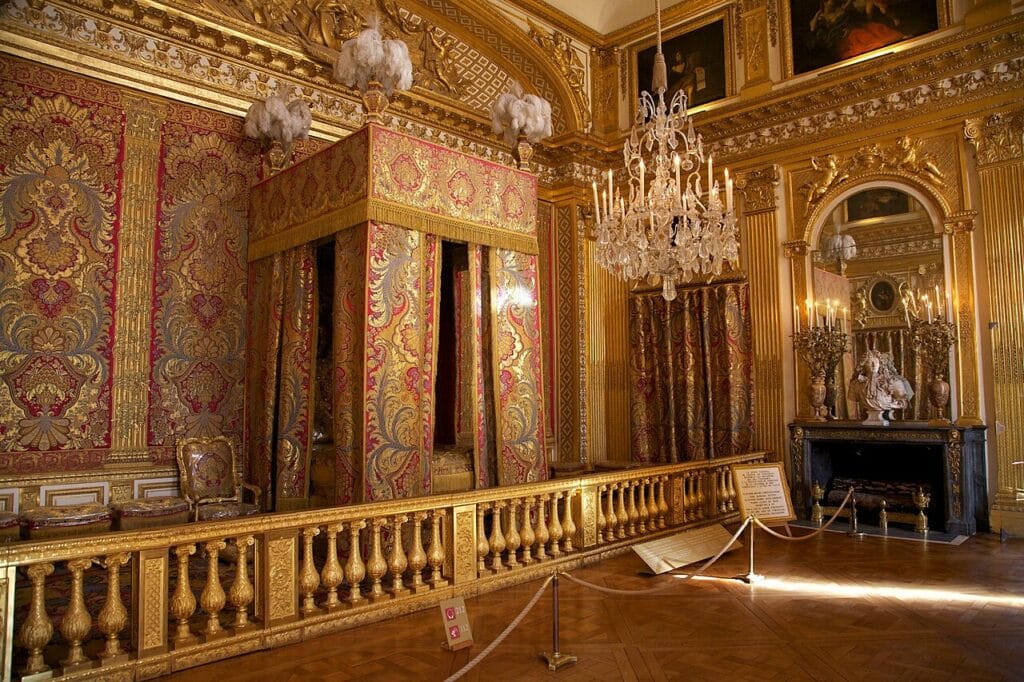
Monumental canopy, embroidered textiles and gilding, the bed as domestic throne.
The Grand Apartments
Louis XIV interiors follow strict hierarchical organization. The antechamber filters visitors. The state chamber receives important audiences. The cabinet or studiolo houses collections and private work. Galleries serve for perambulations and art exhibitions.
Ceilings become major decorative surfaces. Trompe-l’œil paintings, gilded stucco, sculpted cornices create illusions of depth and height. Allegorical compositions glorify the sovereign as ancient deities.
Walls disappear under textiles (they are literally covered with fabrics or tapestries), woodwork, marbles. Paneling – carved and gilded woodwork – frames paintings, mirrors, tapestries. Pier glasses (panels between windows) receive mirrors or paintings. This decorative profusion leaves no bare surface.
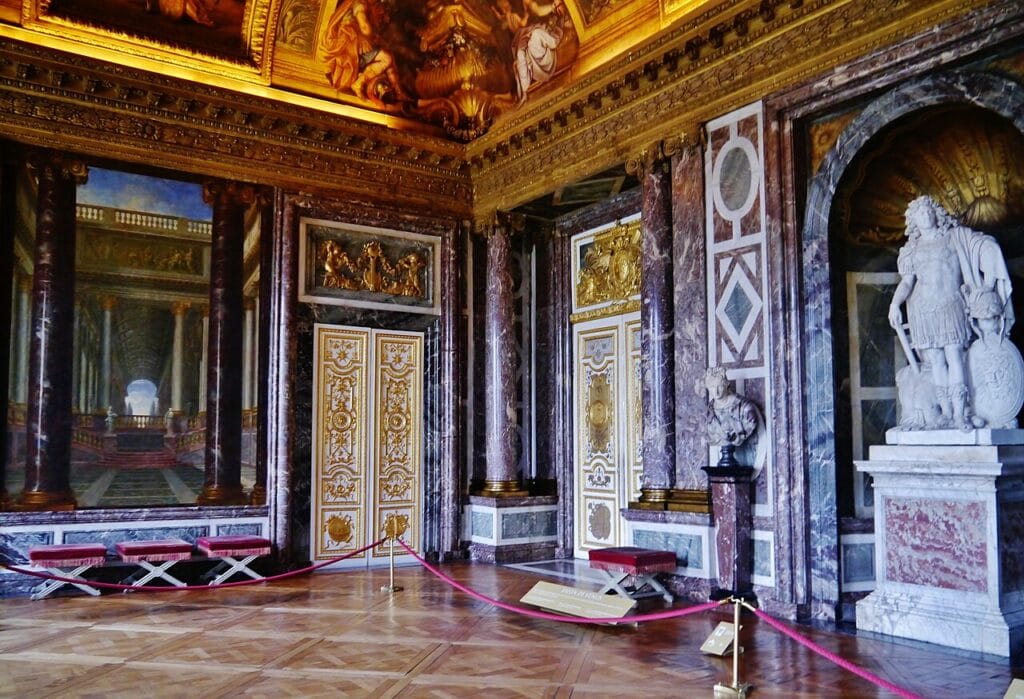
Floors combine geometric parquet (herringbone, Versailles pattern) and polychrome marbles. Savonnerie carpets, hand-knotted according to Le Brun’s cartoons, sometimes cover parquet during grand occasions.
Private Mansions
Parisian aristocracy adopts royal style. Private mansions of the Marais and Faubourg Saint-Germain decline Louis XIV vocabulary at reduced scale. Courts of honor, main buildings, return wings, French gardens reproduce Versailles organization.
Interiors combine pomp and intimacy. Salons for receptions rival in sumptuous decorations. Smaller chambers and cabinets allow more comfortable life. This duality prefigures the evolution toward more intimacy in the 18th century.
Furniture & Decorative Arts
Boulle Furniture
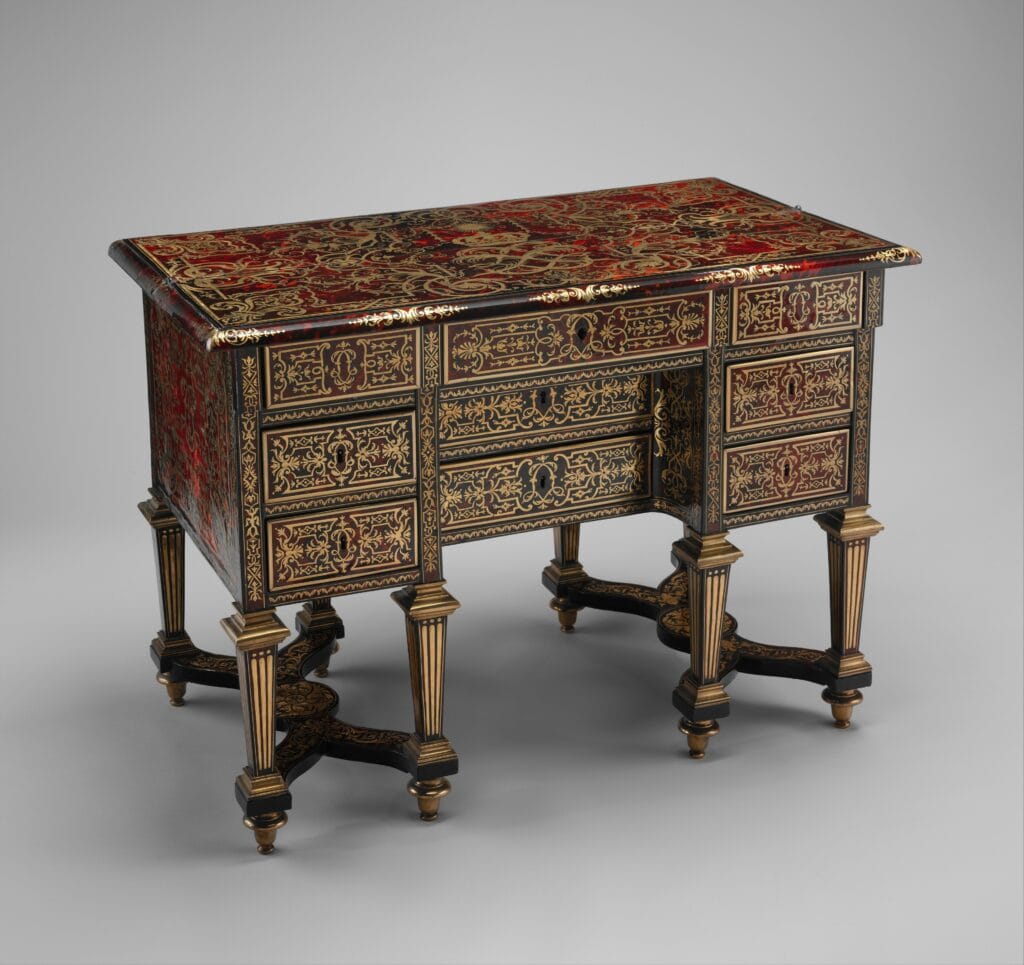
André-Charles Boulle’s furniture represents the summit of Louis XIV furniture. His monumental armoires, his commodes (he invents the type), his desks combine architectural structure, dazzling marquetry, exceptional bronzes.
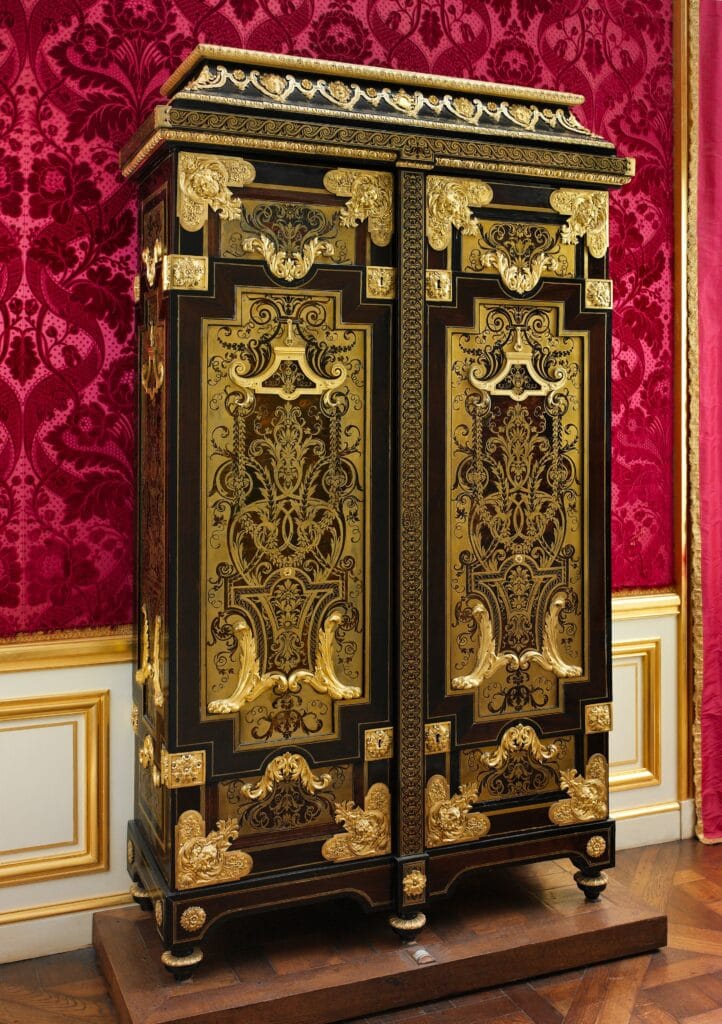
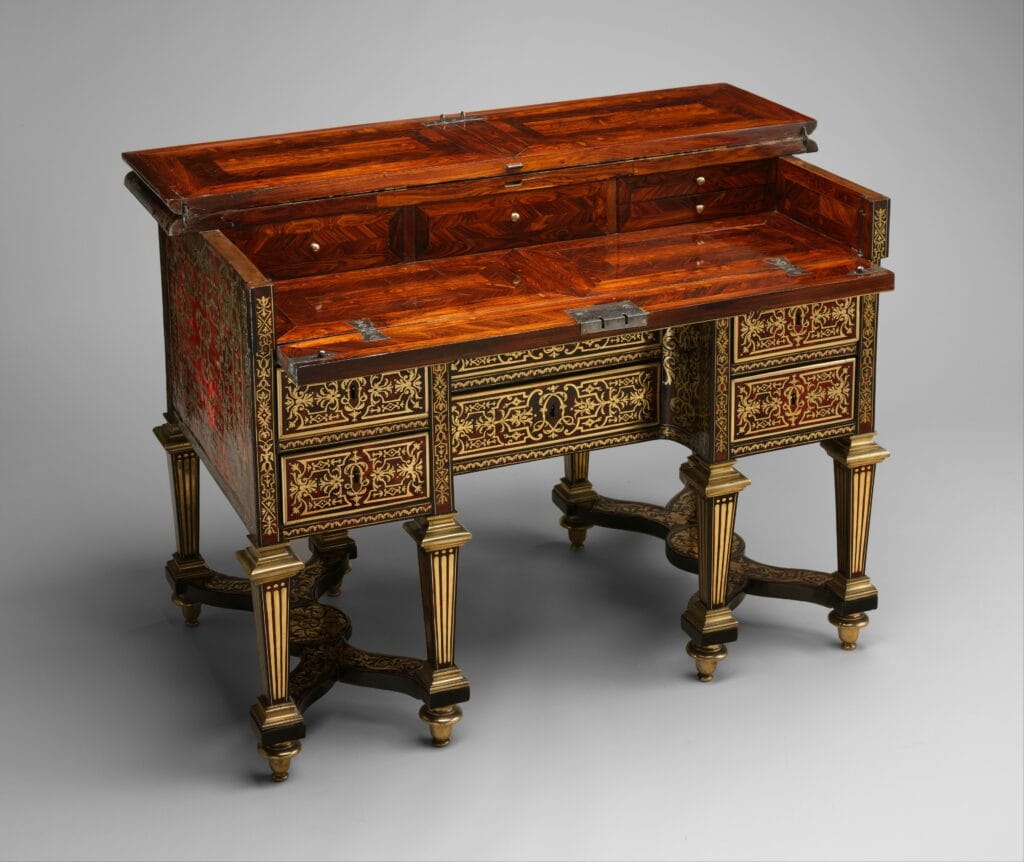
The Boulle technique superimposes tortoiseshell and brass cut according to complex motifs: scrolls, arabesques, grotesques, figured scenes. The tortoiseshell, heated and tinted (red, green, blue), creates colored backgrounds. The brass, engraved and polished, stands out in brilliant relief. The addition of tin, mother-of-pearl, precious woods further enriches the palette.
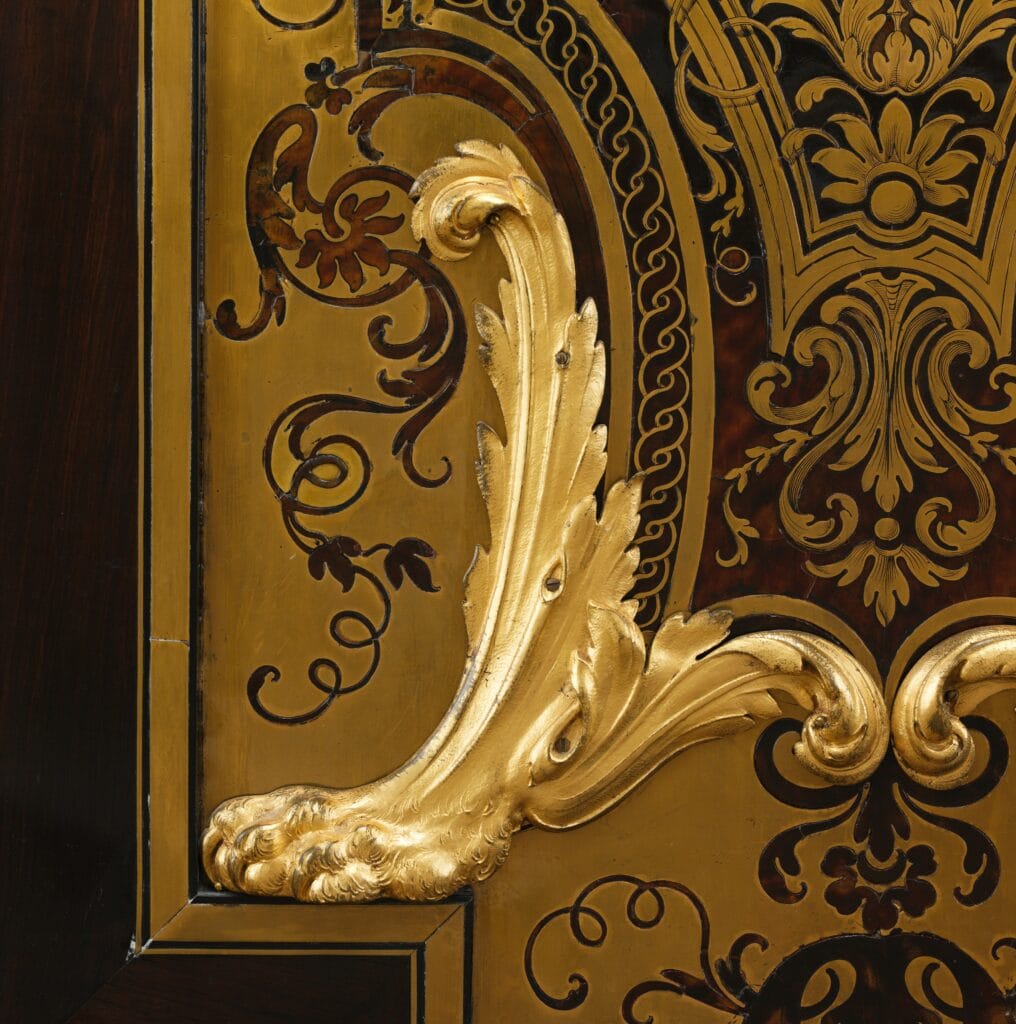
Gilt bronzes – mascarons, drops, sabots, handles – chiseled by master bronze workers, mercury-gilded, reach unequaled quality. These bronzes, functional (protecting edges) and decorative, become the signature of French luxury furniture.
Seating
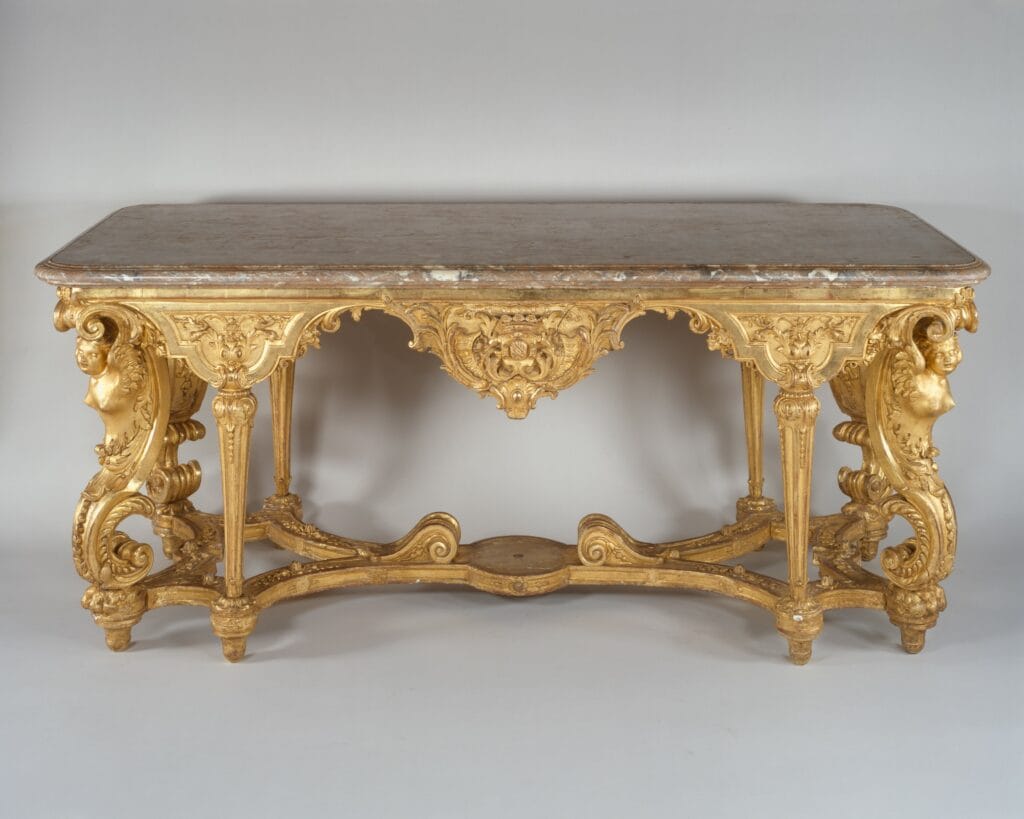
The Louis XIV armchair adopts imposing forms. High and straight back, full armrests (entirely upholstered), richly carved legs in sheath or console form. H or X stretchers, carved and gilded, reinforce the structure.
Upholstery – needlepoint tapestry, velvet, damask, brocade – adorns itself with stylized floral motifs. Visible gilt nails, meticulously aligned, fix fabric while creating geometric decoration. Fringes and gilded braids generously border the ensemble.
Chairs with flat backs, tabourets (stools), benches complete the furnishing. Their multiplication responds to the needs of aristocratic receptions where hundreds of people gather.
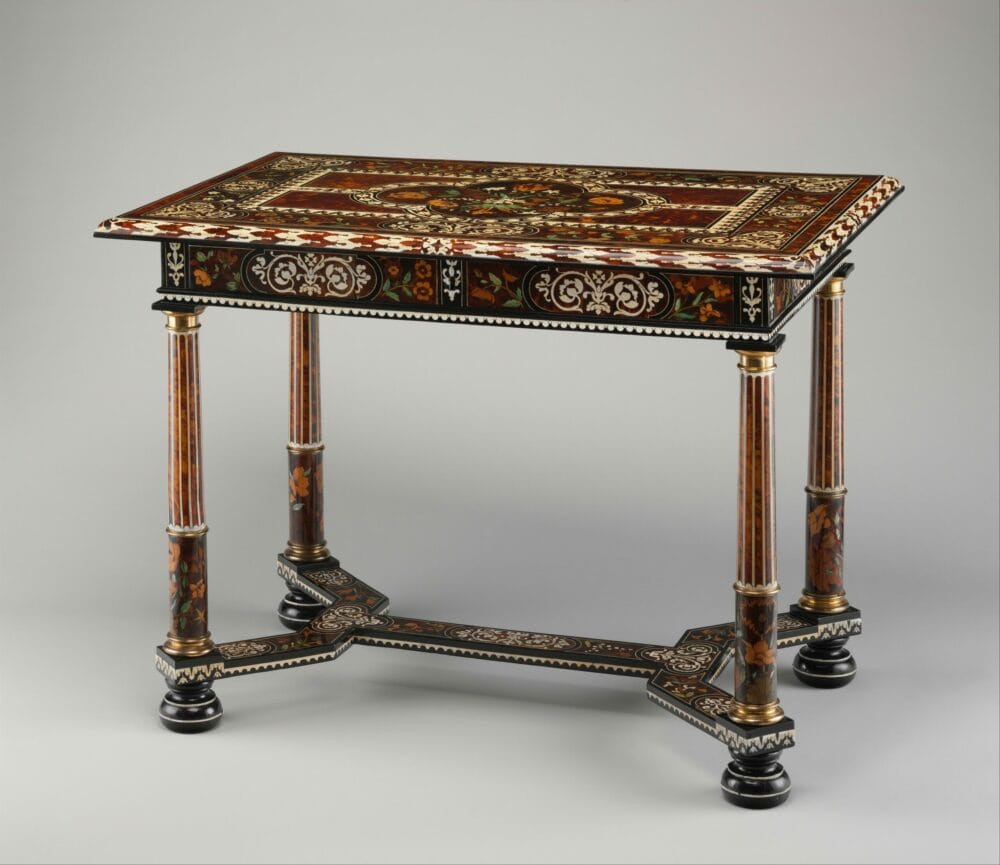
Wall-mounted consoles support candelabras, vases, precious objects. Carved and gilded, often with a single central baroque leg, they participate in wall decoration. The most spectacular, entirely gilded, adorn the Hall of Mirrors.
The Desk under Louis XIV
Under Louis XIV, the desk establishes itself as a piece of power and representation. The main types of desks in use are:
Different Types of Desks
- Bureau plat: large rectangular table, often leather-covered, intended for administrative and diplomatic work.
- Bureau Mazarin: eight-legged desk with side drawers, heir to the 17th century, with very structured architecture.
- Bureau brisé: desk with articulated top, rarer, combining mechanical ingenuity and refined decoration.
- Cabinet-desk: hybrid furniture combining writing surface and storage, designed for ceremonial interiors.
- All are distinguished by luxurious ornamentation (marquetry, gilt bronzes, precious veneers), affirming the owner’s status and authority.
Beds
The à la française bed dominates: parallel to the wall, topped with a canopy (bed ceiling) from which hang curtains and drapes. The headboard, richly carved and upholstered, leans against the wall. Columns at corners, turned or carved, support the canopy.
Textiles – crimson velvet, gold damask, silver brocade – represent major investment. Embroideries, passementerie, gilded fringes enrich the ensemble. The bed, the most expensive piece of furniture, signals the owner’s social rank.
Clocks & Art Objects
Louis XIV clocks, in gilt bronze or Boulle tortoiseshell, become decorative objects as much as timepieces. Allegorical figures, cherubs, trophies adorn the cases. Dials, enameled or engraved, integrate into sculpted compositions.
Candlesticks, torches, girandoles in gilt bronze or solid silver illuminate apartments. Mirrors, set in frames of gilded wood or embossed brass, become essential decorative elements. Vases of oriental porcelain, mounted in gilt bronze by French goldsmiths, merge exoticism and European luxury.
Louis XIII style (1610–1643) rests on an aesthetic of legible structure and constructive rigor. Louis XIV style (1643–1715), on the contrary, affirms an aesthetic of power, hierarchy and staging.
Structure
In Louis XIII furniture, construction remains fully visible. Stretchers are systematic (H or X shape), connecting legs and reinforcing the idea of solidity and permanence.
The furniture openly shows its structural logic.
Under Louis XIV, structure becomes more visually controlled. Stretchers disappear, lighten or are discreetly integrated into lower rails.
Construction serves composition rather than exposing itself.
Turned Legs
The Louis XIII leg is almost always turned. Its most emblematic form is “os de mouton” turning: a rhythmic profile of successive swellings recalling a bone’s articulation.
Balusters, bobbins and spindles visually punctuate the furniture.
Under Louis XIV, this repetitive logic gradually fades. Legs become more straight, carved or architectured, integrated into a monumental composition.
The leg supports visual hierarchy rather than rhythm.
Seats and Backs
Louis XIII seats present straight or very slightly inclined backs, often narrow and elevated. Turned uprights and visible joints dominate; comfort remains secondary.
The seat is an object of posture and rank.
In the Louis XIV period, backs widen and gain more marked inclination. Rails are molded and proportioned, announcing a controlled search for comfort in a ceremonial framework.
The seat participates in the scenography of power.
Moldings and Panels Louis XIII decoration remains geometric and legible: affirmed frames, panels, diamond points and linear articulation inherited from the late Renaissance.
In Louis XIV furniture, moldings become richer and more hierarchized. They organize the reading of the furniture and reinforce its central axis.
Decorative Repertoire Louis XIII style favors a measured vocabulary: stylized foliage, fluting, rhythmic repetitions and Flemish influences.
Louis XIV style imposes a triumphant classical language: acanthus leaves, palmettes, garlands, trophies, cartouches and mascarons compose a decoration conceived as a manifesto of royal power.
Heritage & Influence
Louis XIV style establishes itself as a European reference. All sovereigns imitate it: Schönbrunn in Vienna, Peterhof in Russia, La Granja in Spain reproduce Versailles. French becomes the European diplomatic and cultural language.
In the 19th century, Louis XIV style experiences successive revivals. The Second Empire under Napoleon III celebrates monarchical grandeur. Boulle reproductions furnish bourgeois residences and ministries. The Opéra Garnier (1875) synthesizes Louis XIV splendor and modern technical innovations.
The 20th century maintains ambiguous fascination. Decorators use Louis XIV elements – gilding, marbles, mirrors – in prestige interiors. Luxury hotels, presidential palaces, institutions adopt the grand style vocabulary to affirm respectability and tradition.
Today, Louis XIV inspires luxury design. Gilt bronzes, Boulle marquetry, monumental proportions return in contemporary high-end creations. This style embodies the notion of grand luxury and artisanal excellence that transcends ephemeral trends.
Value & Current Market
Authentic Furniture
Authentic Louis XIV furniture reaches stratospheric prices. A stamped Boulle commode can exceed €500,000. A monumental Boulle armoire: €300,000 to €1,000,000 depending on quality and provenance.
Period seats trade at €8,000 to €50,000 for armchairs, €15,000 to €80,000 per pair. Complete sets (twelve matching armchairs) easily exceed €200,000. Expert authentication is essential: distinguishing authentic Louis XIV from Regency productions or 19th-century copies requires a trained eye.
Specialized antique dealers – Kraemer, Steinitz, Perrin in Paris – guarantee authenticity and restorations according to proper standards. Public sales at Christie’s, Sotheby’s, Artcurial regularly feature exceptional pieces.
Art Objects
Period gilt bronzes – candelabras, clocks, andirons – reach €5,000 to €100,000 depending on chiseling quality. Mirrors in period frames: €8,000 to €80,000. Gobelins tapestries: €30,000 to €500,000 depending on dimensions and condition.
Neo-Louis XIV Style
19th-century reproductions offer quality alternatives. A Second Empire Boulle piece: €15,000 to €80,000. Neo-Louis XIV armchairs: €2,000 to €8,000 per pair. A gilded console: €3,000 to €15,000.
Contemporary reproductions by master cabinetmakers: Boulle commode: €30,000 to €100,000, armchairs: €4,000 to €12,000 per pair. Quality and finishes justify these prices for demanding collectors.
Conclusion
Louis XIV style represents the apogee of French classicism and absolute monarchy. For seven decades, a coherent artistic system unfolds, expressing royal power and national grandeur with unequaled magnificence.
This synthesis produces architectural and decorative masterpieces of extraordinary quality. Versailles and its decorations, Boulle furniture, gilt bronzes, Gobelins tapestries testify to an era when art served the sovereign’s glory while achieving technical and aesthetic perfection.
After Louis XIV, the Regency then Louis XV will introduce curves, lightness, intimacy. But the grand Louis XIV style will remain a reference for majesty and luxury. Its vocabulary – gilding, marbles, symmetry, monumentality – will continue to embody power and prestige.
Because Louis XIV style still speaks today. It reminds us that an era can create a complete and coherent artistic language. That true luxury requires artisanal excellence and noble materials. That aesthetic grandeur can serve a political project while producing timeless beauty. Versailles remains, three centuries later, a universal symbol of monarchical splendor and the triumph of French classicism.
Digital entrepreneur and craft artisan.
My work bridges craftsmanship, design history and contemporary creation, shaping a personal vision of luxury interior design.
Since 2012, I have been based in my workshop on the shores of Lake Annecy, creating bespoke interiors for architects, decorators and private clients.