


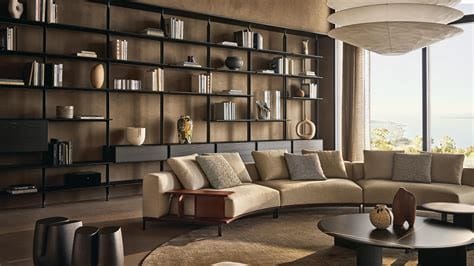
Poliform: Italian design at its most refined
Founded in 1970 in the Brianza furniture district, north of Milan, Poliform is one of the houses that best defines what contemporary Italian design has to offer at its most demanding. No ostentation, no sterile minimalism: a sober, controlled elegance, rooted in a culture of systems and materials that few brands anywhere in the world have pushed this far.
History and Founding Vision
It all begins in 1942, in a small artisan workshop in Brianza, that stretch of land between Milan and Lake Como that Italy has considered the cradle of furniture-making for centuries. Two families work the wood there, craft pieces with care, pass down their know-how from generation to generation. It is from this encounter that Poliform would be born.
In 1970, three cousins, Alberto Spinelli, Aldo Spinelli and Giovanni Anzani, make a founding decision: to transform the family workshop into a modern industry. They choose a name that sums up their ambition: Poliform, a contraction of “polyvalence” and “form”, two words that announce exactly what the brand will become.
The company focuses first on storage systems (wardrobes, walk-in closets, bookcases) with a conviction that was rare at the time: that storage can be a design object in its own right, held to the same aesthetic standards as living room furniture.
Brianza is no geographical accident. It is a unique ecosystem, where dozens of specialist craftspeople (joiners, lacquerers, saddlers, metalworkers…) coexist within a few kilometres of one another. This context generates an emulsion of talent and a standard of execution that few other regions in the world can reproduce at this scale. Poliform is its natural heir and has always claimed as much. Giovanni Anzani prefers to speak of “Made in Brianza” rather than “Made in Italy”.
In 2018, the three founders received the Compasso d’Oro (the highest distinction in Italian industrial design, created by Gio Ponti) in recognition of their entire career. An honour that consecrates not a single piece or collection, but a business philosophy sustained over five decades.
Aesthetic DNA and House Codes
What sets Poliform apart at first glance is a form of sophisticated restraint, what Italians call sobrietà, and it has nothing to do with a lack of ambition. Every Poliform collection is conceived as a system: pieces designed to speak to one another, to articulate with the architecture of a space, to create a coherent whole rather than an accumulation of beautiful isolated objects. This systemic thinking is at the heart of the house’s DNA, and it fundamentally distinguishes Poliform from brands that produce iconic pieces without an overall vision.
The lines are always refined, the proportions generous without being heavy. Poliform has a particular way with volume: seats are deep, backrests measured, armrests of a fineness that seems to defy physics. Materials sit at the heart of every formal decision. Solid wood and noble veneers, matt or gloss lacquers, fabrics and leathers selected with a rigour that borders on perfectionism. The range of finishes Poliform offers is one of the widest in the sector: hundreds of possible combinations, all tested for visual and tactile coherence.
The relationship with architecture is another constant. Poliform does not design furniture for abstract rooms. It designs environments. Its bookcase, walk-in closet and kitchen systems are conceived to integrate with walls, volumes and the real constraints of a lived-in space. It is this architectural dimension that makes it the reference brand for the most demanding interior architects around the world.
Iconic Pieces and Collections
The Poliform catalogue is vast, but five pieces capture its spirit better than any others.
The Bristol sofa, Jean-Marie Massaud, 2013. This is undoubtedly the piece that brought Poliform into living rooms around the world. Designed by French designer Jean-Marie Massaud, one of the house’s most loyal collaborators, Bristol is a sofa that thinks of comfort as architecture: a double enveloping backrest, armrests of an almost immaterial thinness, a generous seat that never tips into softness. Available in fixed or modular versions, with an exceptional range of fabrics and leathers, Bristol has become in ten years an absolute reference in contemporary high-end sofas.
The Wall System, CR&S Poliform. Before sofas, Poliform revolutionised storage. The Wall System is the most accomplished expression of that ambition: a modular bookcase that adapts to any spatial configuration, floor to ceiling, with a precision of assembly and quality of finish that make it more of an architectural element than a storage unit. Decades after its creation, it remains the sector’s benchmark (copied everywhere, equalled nowhere).
The Mad armchair, Marcel Wanders. The collaboration with Dutch designer Marcel Wanders produced one of the most desirable pieces in the catalogue: Mad Chair, a swivel armchair with a sculptural silhouette, on a rotating base, available in velvet, leather or suede. It anchors a room on its own, without ever overwhelming it.
The Kelly bed, Emmanuel Gallina. French designer Emmanuel Gallina, another regular collaborator, signed with Kelly one of the most elegant beds in contemporary production. Sober and enveloping headboard, discreet footboard, wood structure covered in precise upholstery. Kelly is the exact translation of what we call quiet luxury applied to the bedroom.
Varenna kitchens. By acquiring the Italian brand Varenna, Poliform extended its philosophy to the kitchen. Varenna kitchens embody the same standards as the rest of the Poliform catalogue: refined lines, noble materials (marble, solid oak, technical ceramics) and an attention to detail that makes every kitchen an architectural project in its own right. They are among the references cited in the high-end kitchen guide.
Manufacturing Philosophy and Craftsmanship
Poliform manufactures in Italy, almost exclusively in Brianza, and considers this geographical anchoring a condition of its excellence, not a marketing argument. Its workshops employ more than 600 people. Each product line has a dedicated research and development team of architects and engineers working constantly on new technical and formal solutions.
The selection of materials is one of the pillars of the approach. Poliform works with a network of top-tier Italian suppliers (tanners, weavers, lacquerers) whose output is tested internally before any integration into the catalogue. Finishes are constantly reassessed: new shades, new textures, new combinations between materials. This permanent research is why the Poliform catalogue does not age. It simply evolves.
Systemic thinking imposes exceptional manufacturing constraints. A Wall System that must assemble perfectly in any configuration, on walls that are never perfectly straight, in rooms of variable dimensions, demands a precision of machining and tolerances closer to aerospace than to traditional cabinetmaking. It is this technical rigour, invisible to the eye but felt in use, that constitutes the real Poliform luxury.
An Exceptional Network of Designers
Over the decades, Poliform has built a network of collaborators whose geographical and stylistic diversity is itself a sign of the brand’s confidence in its own coherence.
Jean-Marie Massaud brings a refined French sensibility, always stretched between the rigour of line and the generosity of comfort. Emmanuel Gallina cultivates a formal softness that borders on the poetic. Marcel Wanders brought a more baroque, more expressive energy before his passing in 2022.
Also among Poliform’s designers: Carlo Colombo, Vincent Van Duysen, Paolo Piva. Distinct visions, all capable of working within the demanding framework of the house’s system philosophy.
This ability to collaborate with very different personalities without diluting its identity is one of Poliform’s hallmarks and one of the most convincing proofs of the solidity of its DNA. A brand without a vision of its own dissolves into its collaborations. Poliform absorbs them.
Poliform and the Italian Design Legacy
Poliform is part of the great tradition of Italian design, the one that has made the Brianza triangle of Milan, Como and Monza the centre of gravity of high-end furniture worldwide since the 1950s. But it represents a specific evolution: where houses like Cassina or B&B Italia have made the iconic piece their territory, Poliform chose the system as its field of excellence. A less spectacular choice, more discreet, and ultimately more ambitious. Because it means thinking about an entire interior rather than a single object.
Present in more than 90 countries, with over 110 own showrooms and a Contract division that furnishes prestigious hotels and residences worldwide, Poliform is today one of the rare Italian brands to have achieved international expansion without compromising on quality.
It remains what it has always wanted to be: a total interior design house, accompanying its clients from kitchen to bedroom, from walk-in closet to living room, with a formal coherence that makes every space immediately recognisable.