


Gubi: history, iconic collections and the DNA of an exceptional Danish design house
Founded in Copenhagen in 1967, Gubi embodies a vision of design that refuses to choose between memory and invention. As much a publisher as a manufacturer, the house combs the archives of the twentieth century for overlooked pieces, reissuing them with scrupulous fidelity, while collaborating with the most demanding contemporary studios. The result is a catalogue of rare coherence: eclectic on the surface, deeply unified in spirit.
History and Founding Vision
The story begins in late-1960s Copenhagen, at a moment of creative ferment when Scandinavian design was earning its first wave of international recognition. Gubi Olsen (the man whose first name the brand would carry) and his wife Lisbeth established the company in 1967 with a straightforward ambition: to produce beautiful, well-made objects rooted in their own formal sensibility. In those early years, the house focused on its founders’ own designs, exploring modern forms and everyday materials.
The real turning point came with the second generation. When their son Jacob Gubi Olsen joined the company in the 1980s, he recast the business entirely. Where his parents had manufactured, Jacob chose to edit. He understood that Gubi’s value lay not in volume, but in the ability to identify and revive pieces that history had left behind without good reason. That conviction sent him deep into the design archives of the 1930s through the 1970s – from the Bauhaus to the plastic experiments of the Pop decade – in search of forgotten treasures.
It was Jacob, too, who gave Gubi its international dimension: offices in New York, London, Dubai and Shanghai; a headquarters installed in a converted tobacco factory on the Copenhagen docks, a space that has itself become symbolic of the brand’s approach. Preserve what deserves to last. Transform what can be reimagined. Today, present in over 50 countries, Gubi furnishes addresses as emblematic as the Sanders Hotel in Copenhagen and the restaurant Noma.
Aesthetic DNA and House Codes
What strikes you first about Gubi is the absence of dogma. Where some design houses confine themselves to a single formal vocabulary ( absolute minimalism, systematic organicism, perpetual return to a founding movement …) Gubi makes a virtue of curiosity. The catalogue spans different decades, varied geographies, opposing sensibilities. And yet something holds it together: a commitment to formal quality, a preference for lines that have withstood time, and an absolute refusal of the gimmick.
The house’s visual codes are recognisable without being repetitive. Sculptural silhouettes recur – the cocoon of the Beetle Chair, the aerial lightness of the Grasshopper and Satellite lamps – alongside finishes where metal, velvet, boucle and brass coexist without contradiction. Gubi has a particular way with upholstery textiles: a rich palette of wools, mohairs and velvets that transform a restrained form into a genuinely sensory object. It is this dialogue between the rigour of line and the generosity of material that best defines the Gubi aesthetic.
The brand also cultivates what might be called a cultivated eclecticism: the idea that a 1950s reissue and a contemporary creation can share the same room without dissonance, creating depth rather than confusion. This is an editorial proposition in the fullest sense: an invitation to build an interior the way one assembles a library, through successive layers, elective affinities, and conversation between eras.
Iconic Pieces and Collections
Gubi’s catalogue is a constellation in which every piece carries a story. Five of them deserve particular attention.
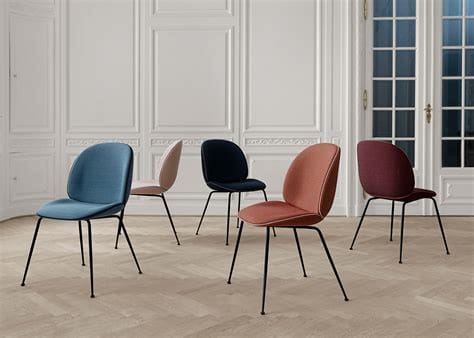
The Beetle Chair, GamFratesi, 2013. Perhaps the piece that best distils the contemporary Gubi. Designed by the Italo-Danish duo GamFratesi – Enrico Fratesi and Stine Gam – it takes its formal cue directly from the morphology of a beetle: hard carapace, organic contours, a two-part moulded plastic shell whose edges are reworked by hand to achieve a softness that machinery alone cannot produce. Deceptively simple in appearance, complex in its making, the Beetle fuses industrial precision with artisanal gesture in a synthesis that few contemporary chairs manage. It is now available in a composite of over 50% recycled plastic a concrete step in the house’s ongoing environmental commitment.
The Bestlite, Robert Dudley Best, 1930. Conceived in 1930 under the direct influence of the Bauhaus, the Bestlite was among the first lamps to articulate functionality and industrial aesthetics with such assurance. Chrome stem, adjustable shade, absolute sobriety: the design anticipated a century. Winston Churchill kept one on his desk which says something about the object’s staying power. Gubi holds the exclusive production rights, and the reissue is faithful to the original in every detail.
The Grasshopper, Greta Magnusson Grossman, 1947. Designed in 1947 by the Swedish designer working in Los Angeles, this floor lamp is a quiet masterpiece of the Mid-Century Modern. Its triangulated silhouette light as its namesake insect handles light with a grace that most contemporary reissues fail to match. Gubi has preserved its soul while meeting current technical requirements, and it has become one of the defining luminaires of the most considered contemporary interiors.
The Satellite, Mathieu Matégot, 1953. The Franco-Hungarian designer Mathieu Matégot is one of Gubi’s great rediscoveries. His Satellite lamp, drawn in 1953, is a meditation on lightness: painted metal rods, a blown-glass diffuser, a balance almost perverse between visual presence and physical weight. In the post-war years, as the space age began to fuel the collective imagination, Matégot captured that upward aspiration in a domestic form of rare elegance. The Gubi reissue does it full justice.
The Pacha, Pierre Paulin, 1975. Pierre Paulin — French master of 1960s and 70s design — always conceived seating as an envelope for the body rather than a mere support. The Pacha is his most generous expression of that idea: deep seat, wide armrests, an enveloping structure that invites you to disappear into it. Reissued by Gubi with extraordinary attention to fabric and finish, it is today one of the most desirable armchairs in the house’s catalogue.
Manufacturing Philosophy and Craftsmanship
Gubi does not manufacture everything in-house — but it selects its production partners with a rigour that commands respect. The house works with specialist manufacturers across Europe, chosen for their technical mastery and their ability to meet the standards of a demanding editorial brand. This network model allows it to combine, within a single piece, techniques that belong to entirely different traditions: precision plastic moulding and hand-finishing for the Beetle; delicate metalwork and blown-glass assembly for the Matégot lamps.
Materials sit at the heart of the Gubi approach. Upholstery fabrics are selected and individually inspected before application, every length of velvet, wool or leather evaluated for its tactile qualities as much as its long-term resistance. All wood products are manufactured in compliance with EUTR regulations; wood composites carry TSCA certification; metal finishes and their suppliers are REACH certified. This is not communication it is a standard of traceability that the house stakes its reputation on with every order.
Repairability is built into the design process: Gubi pieces are conceived to be disassembled, their components sorted and recycled at end of life. The shift toward recycled plastic composites (already in place across the Beetle and Bat collections, with over 50% recycled content) reflects a serious environmental trajectory, far removed from performative gesture.
An Exceptional Network of Creators
Gubi’s strength also lies in the quality of its collaborations. The house has built lasting relationships with studios whose vision resonates with its own: GamFratesi, whose dual Italo-Danish heritage mirrors Gubi’s plural nature; Space Copenhagen, whose contemporary Nordic elegance runs through several lighting and furniture collections; OeO Studio, for its more architectural explorations. At the same time, Gubi has been among the first houses to rehabilitate unjustly forgotten figures like Greta Magnusson Grossman, Mathieu Matégot, Robert Dudley Best, Pierre Paulin, Barba Corsin, names that might never have entered the design canon without the editorial commitment of this Danish house.
This dual logic ( honouring the masters of the past while supporting emerging voices) gives the Gubi catalogue an unusual temporal depth. It positions the brand not as a player in the trend cycle, but as a contributor to the grand history of design which, for a discerning buyer, fundamentally changes the nature of the purchase.
A Scandinavian Heritage, Quietly Reinvented
Gubi is Danish but it is not imprisoned by Scandinavian design tradition. It inherits the formal clarity, the respect for function, the attention to materials and then adds an international dimension, an appetite for colour, texture and measured ornament that sets it apart from its Nordic contemporaries. Where some Scandinavian houses have made minimalism an ideology, Gubi treats it as a starting point; one it allows itself to move beyond when the piece demands it.
That earned freedom is what makes Gubi one of the reference brands for the discerning amateur and the interior design professional alike for anyone building spaces that are dense with meaning, rich in reference, without ever tipping into accumulation. Every Gubi piece knows how to hold its place in a lived-in room. Neither overwhelming it, nor disappearing into it.