

The Biedermeier Style (1815–1848)
Introduction
The Biedermeier style embodies the refined bourgeois elegance of Central Europe in the early nineteenth century. Between 1815 and 1848, across German-speaking regions (Austria, Southern Germany, and Bohemia) a distinctive aesthetic emerged, reflecting the aspirations of a cultivated middle class seeking domestic comfort and accessible beauty.
This style is defined by its elegant restraint and refined functionalism. In contrast to the grandeur of the Empire style or the heaviness of Neo-Gothic revival, Biedermeier favors clean lines, harmonious proportions, and light-colored woods. Beneath its apparent simplicity lies remarkable technical sophistication and a highly sensitive aesthetic language.
Why does this style still matter today? Because it anticipates modern design through its functional approach and formal clarity. Biedermeier reconciles high-quality craftsmanship with the democratization of luxury. It also embodies an art of living centered on family intimacy, domestic culture, and everyday comfort, values that resonate strongly with contemporary interiors.
Historical & Cultural Context
The Biedermeier period begins with the Congress of Vienna (1814–1815), which reshaped Europe following the Napoleonic Wars. Austrian Chancellor Klemens von Metternich established a conservative system prioritizing order and stability. This era of Restoration suppressed liberal and nationalist movements, encouraging the bourgeoisie to retreat into private life.
The term Biedermeier originates from a satirical fictional character — Gottlieb Biedermaier — a caricature of the narrow-minded petit bourgeois created by poets Ludwig Eichrodt and Adolf Kussmaul in the 1850s. Initially pejorative, the term described a mindset focused on domestic comfort and wary of political or artistic ambition. Ironically, it now denotes a style of remarkable elegance and cultural depth.
This period saw the rise of a prosperous urban middle class: civil servants, merchants, and liberal professionals. Without aristocratic wealth but enjoying comfortable incomes, this bourgeoisie aspired to a cultivated and refined lifestyle. They read extensively, attended concerts and theaters, collected prints and watercolors, and cultivated indoor plants and private gardens.
The Vormärz period — the decades leading up to the 1848 revolutions — was marked by increasing tension. Strict censorship pushed intellectual and artistic expression into indirect forms. Culture became privatized: literary salons, domestic concerts, and family readings replaced public forums. Biedermeier furniture furnished these interiors where the bourgeoisie shaped its cultural identity.
Vienna, Prague, Munich, and Berlin became key centers for the production and dissemination of the style. Viennese workshops excelled in refined cabinetmaking. The influence extended as far as Scandinavia — foreshadowing Nordic modernism — and Russia, where the aristocracy embraced Biedermeier sobriety.
Aesthetic Characteristics
The Biedermeier style is immediately recognizable by its formal clarity. Lines are pure and geometric, free from superfluous ornament. When curves appear, they are soft and natural rather than expressive or dramatic. This restraint is not austerity; it reveals the inherent elegance of form and material.
Proportions favor comfort and intimacy. Biedermeier furniture is designed at a human scale, adapted to bourgeois interiors that were more modest than aristocratic salons. This reduction in scale reflects precision and functional relevance rather than compromise.
Light woods dominate: cherry, maple, birch, ash, and pearwood. Their warm honeyed and golden tones create luminous, welcoming interiors. Unlike the dark mahogany of Empire furniture, these woods celebrate brightness and visual lightness. Veneering — thin sheets of fine wood applied over softwood structures — allowed spectacular visual effects at controlled cost.
Marquetry reached remarkable levels of sophistication. Viennese cabinetmakers mastered the art of assembling veneers into geometric or floral patterns. Carefully arranged wood grain in mirrored compositions became decoration in itself. Ebony, used sparingly, accentuated edges and architectural lines.
Surfaces are smooth and meticulously polished. Biedermeier avoids the heavy carving of Empire or Gothic revival furniture. Ornamentation, when present, remains discreet: tapered columns, lyre motifs, and neoclassical palmettes appear with restraint. Gilded bronze mounts — handles, key escutcheons, feet — are sober and functional.
Forms closely follow function. Chairs and armchairs feature gently curved backs for comfort. Tables multiply — guéridons, consoles, sewing tables — responding to domestic activities. Secretaries and desks support reading and correspondence, central aspects of bourgeois life.
Iconic Furniture
Chairs & Armchairs
Biedermeier chairs combine comfort with understated elegance. The backrest, often shaped as a lyre or gondola, follows the natural curve of the body. Front legs frequently take a saber shape, a softened inheritance from the Empire style, while the rear legs remain straight or slightly splayed for stability.
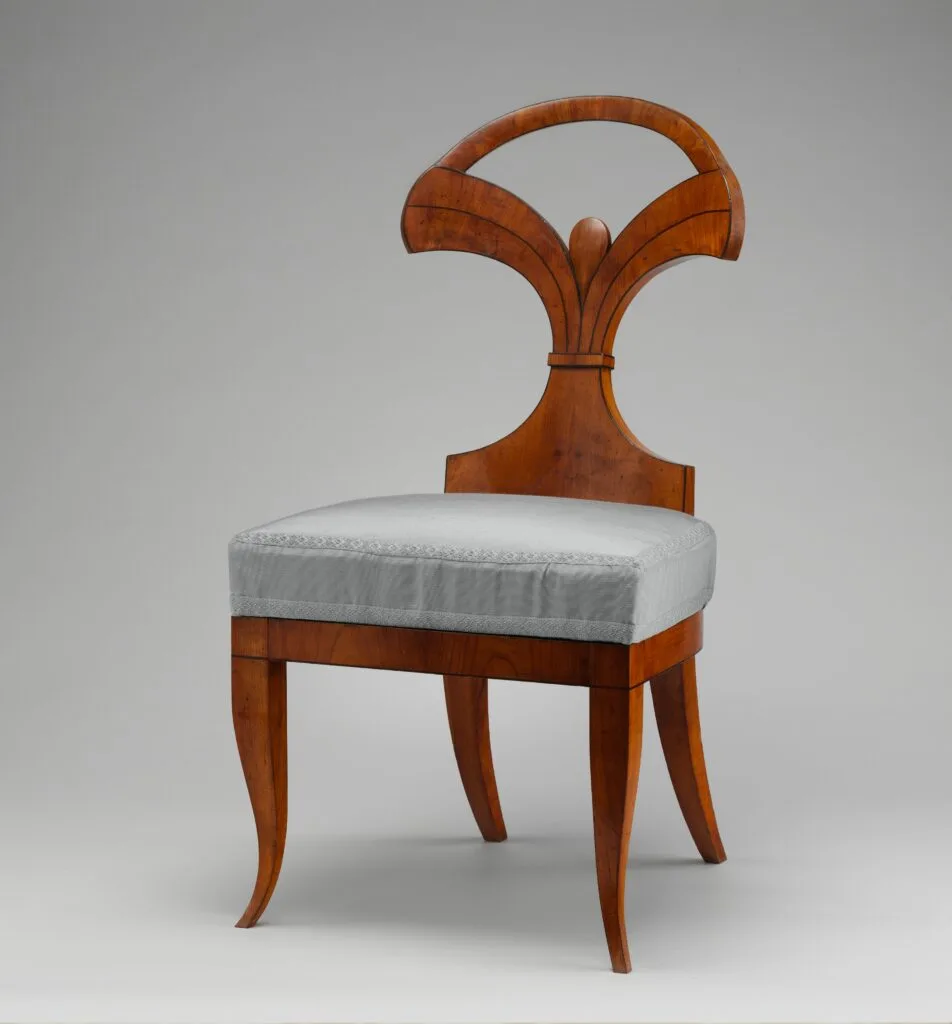
Armchairs were produced in several variants. The Stuhl for everyday use, and the Armlehnstuhl with upholstered armrests for relaxed seating. These armrests descend in a gentle curve toward the seat — a defining feature of the style.
Upholstery materials included silk, velvet, and horsehair, typically in muted tones: cream, olive green, blue-grey, or deep burgundy. Fine stripes, characteristic of Biedermeier textiles, were common. Tufting remained discreet, never exuberant.
Sofas
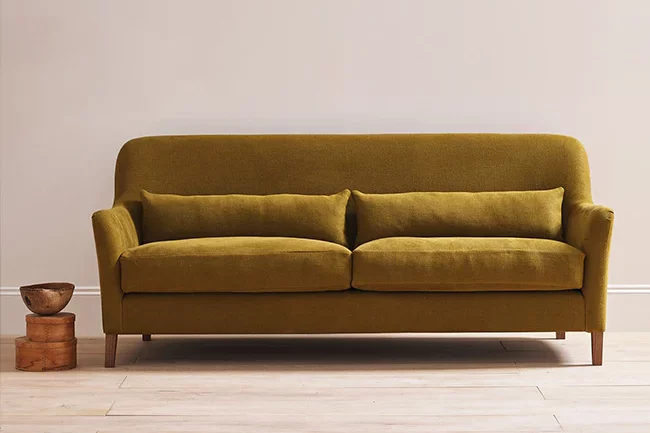
The Biedermeier sofa epitomizes bourgeois comfort. The backrest, often formed as a continuous gondola shape, wraps gently around the sides. Fully upholstered armrests invite repose. Compact proportions suit medium-sized salons.
The récamier — a daybed with an asymmetrical back — became a signature piece. One raised end provides support while the lower end allows reclining. Positioned near windows, these pieces accommodated reading, embroidery, and conversation in an elegant semi-recumbent posture.
Secretaries & Desks
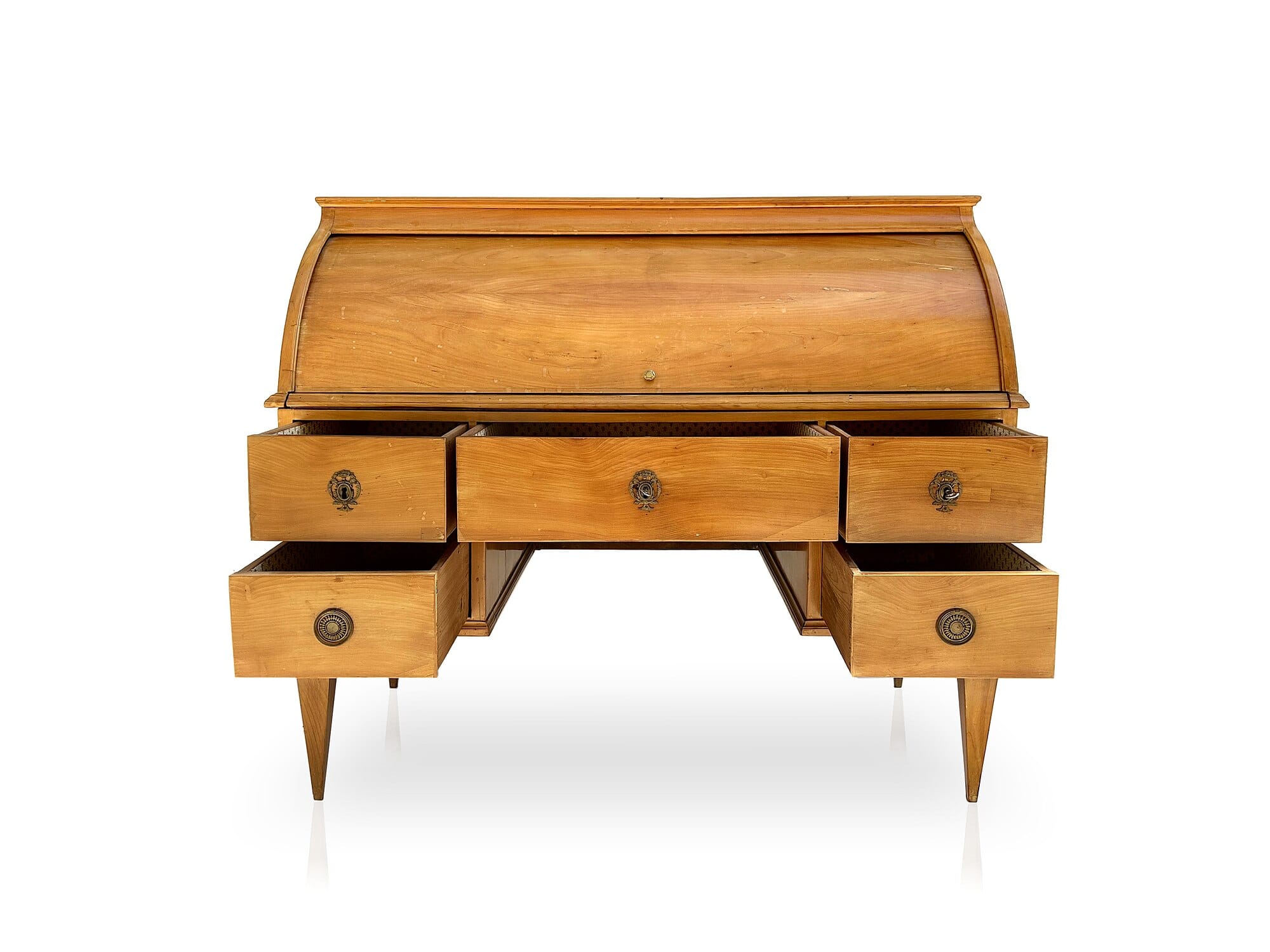
The secretary desk embodied the cultural aspirations of the bourgeois household. Its compact vertical structure suited limited spaces. The fall-front revealed compartments, hidden drawers, and pigeonholes for correspondence. Writing surfaces were often leather-covered, with lower sections containing drawers or cupboards.
Facade marquetry reached exceptional refinement. Symmetrical cherry veneers, ebony stringing, and subtle geometric motifs created visual richness without excess. Tapered columns, sometimes ebonized, framed the composition.
The cylinder desk offered a sophisticated alternative, with a sliding tambour concealing the upper compartments. These finely veneered desks furnished bourgeois studies and private offices.
Chests of Drawers
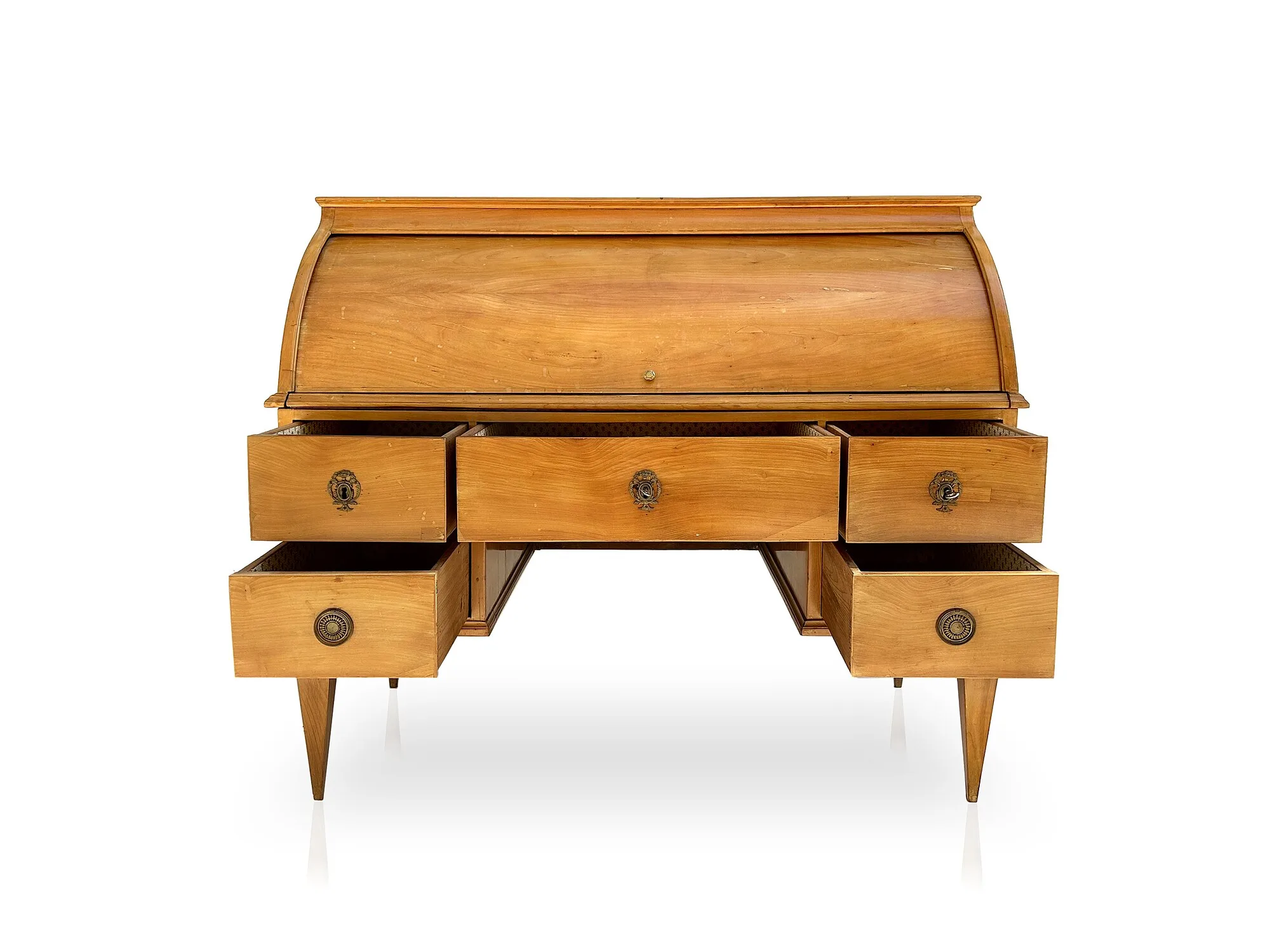
Biedermeier chests of drawers are defined by their clean lines and spectacular veneers. Rectangular structures with three or four drawers feature mirrored cherry or maple veneers arranged in geometric or floral patterns.
Framing columns, a common feature, may be smooth, tapered, ebonized, or gilded. Feet — often flattened balls or turned forms — anchor the piece visually. Marble tops in white, grey, or black frequently complete the composition.
Brass handles — simple rings or knobs — avoid Empire exuberance. Key escutcheons, circular or diamond-shaped, remain discreet and functional.
Tables
Biedermeier tables proliferated to accommodate domestic activities. The round pedestal table dominated reception rooms. A solid central column — often lyre-shaped or tapered — rests on a tripod or quadripod base. Tops were made of light wood or marble.
Extending tables addressed entertaining needs through ingenious mechanisms. Demi-lune consoles could unfold into full round tables — an elegant solution for limited spaces.
Sewing tables, designed for women, featured stacked trays and slender columns, with compartments for thread and tools. These delicate pieces exemplify refined domestic craftsmanship.
Display Cabinets & Bookcases
Display cabinets showcased bourgeois collections — porcelain, glassware, small bronzes, minerals. Light-wood structures with glazing on three sides transformed collections into decorative elements.
Bookcases, low or tall, with glazed or solid doors, housed family libraries. Their restrained architecture emphasized the books themselves rather than ornament.
Beds
Biedermeier beds abandoned monumental canopies in favor of simpler forms. The boat bed, with matching curved head- and footboards, became emblematic of the style. Construction relied on finely veneered light woods, sometimes accented with corner columns.
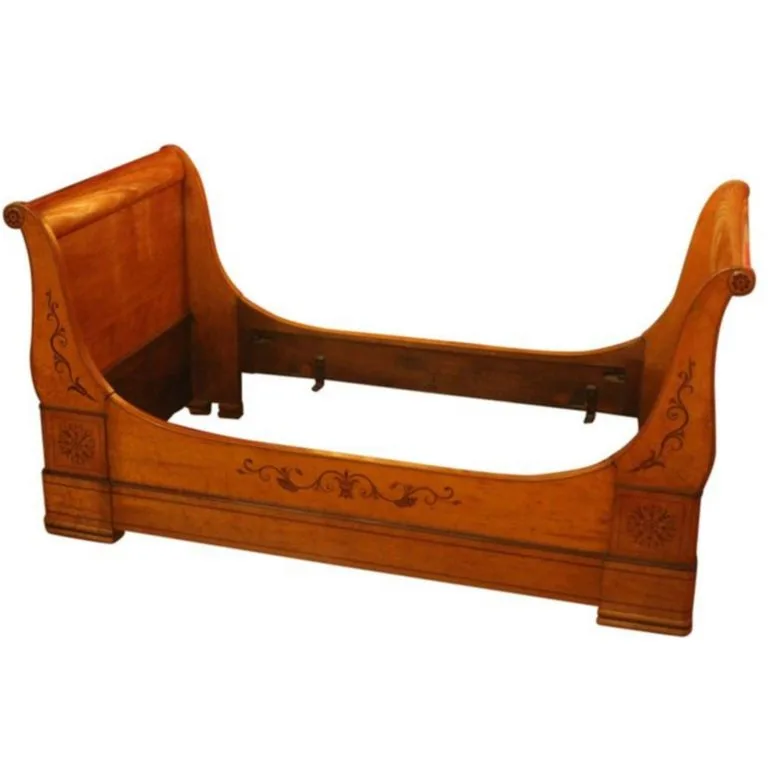
Placed against walls or in alcoves, these beds saved space in modest bedrooms. White embroidered linen bedspreads and printed cotton pillows completed the restrained elegance.
Interior Decoration
Biedermeier interiors emphasize light and harmony. Walls were painted in pale tones — off-white, soft yellow, pearl grey, water green — providing neutral backdrops for furniture. Discreet wallpapers with fine stripes or small floral motifs occasionally adorned principal rooms.
White ceilings, sometimes enriched with simple stucco rosettes, enhanced height and brightness. Moldings remained restrained, avoiding Empire or Baroque excess.
Windows played a crucial role. Large and numerous, they flooded interiors with natural light. Curtains in white linen, muslin, or printed cotton softened the light without darkening spaces. Carved wooden or gilded valances sometimes crowned the openings.
Wooden floors in oak or pine were complemented by area rugs defining seating or work zones. Wall-to-wall carpeting was absent.
Lighting combined daylight with candles. Crystal or brass chandeliers remained relatively simple. Candlesticks adorned tables and mantelpieces, while oil lamps supported evening reading.
Decorative objects were carefully curated: framed watercolors, silhouette portraits, Viennese or Meissen porcelain, Bohemian glass, and indoor plants — palms and ferns — in ceramic pots.
The piano, typically upright to conserve space, occupied a central place in the salon. It served as a focal point of cultivated domestic sociability.
Craftsmen & Centers of Production
Viennese workshops dominated Biedermeier production. Josef Danhauser (1780–1829) stands among the most celebrated cabinetmakers. His workshop employed up to 300 craftsmen and produced furniture of exceptional quality, balancing formal restraint with technical mastery.
Berlin developed its own variant — the Berliner Biedermeier — more austere and rigorously linear. Architect and designer Karl Friedrich Schinkel exerted a decisive influence on this interpretation.
Prague and Bohemia excelled in fine marquetry and complex veneers. Bohemian glassware complemented furniture in these interiors.
Munich and Bavaria introduced slightly more rounded forms and decorative richness, foreshadowing Romanticism.
Scandinavia adopted Biedermeier aesthetics early. The Swedish Karl Johan style and the Danish Empire shared its sobriety, light woods, and functional clarity — a lineage that explains the foundations of modern Nordic design.
Legacy & Influence
The Biedermeier style exerted lasting influence on European design. Its functionalism, formal restraint, and respect for materials anticipated modernist principles. Designers associated with the Bauhaus acknowledged this debt.
Scandinavian modernism directly inherited Biedermeier values. Alvar Aalto, Arne Jacobsen, and Hans Wegner extended its legacy of light woods, organic forms, and human-centered design.
In the interwar period, Biedermeier experienced a revival. Viennese Art Deco absorbed its sobriety, while Josef Hoffmann and the Wiener Werkstätte reinterpreted its elegance through modern craftsmanship.
Today, Biedermeier continues to captivate collectors and interior designers. Its timelessness allows it to coexist seamlessly with contemporary design. The warmth of light woods softens minimalist interiors, confirming its enduring relevance.
Market & Current Value
Authentic Pieces
Period Biedermeier furniture (1815–1848) remains highly sought after. A Viennese cherrywood chest of drawers ranges from €8,000 to €35,000, depending on marquetry quality and provenance. A secretary may reach €6,000 to €25,000. A pair of chairs typically sells for €2,000 to €8,000.
Armchairs and sofas range from €3,000 to €15,000, depending on upholstery condition. Round pedestal tables command €3,000 to €12,000. Display cabinets range from €4,000 to €18,000. Boat beds sell between €3,000 and €12,000.
Provenance significantly impacts value. Pieces attributed to Danhauser or other renowned workshops command premiums. Original condition — intact veneers, period hardware, and authentic upholstery — greatly enhances value.
Specialized auction houses such as Dorotheum (Vienna), Nagel (Stuttgart), Christie’s, and Sotheby’s regularly feature Biedermeier furniture. Viennese and German dealers remain key sources.
Reproductions
Late 19th–early 20th century reproductions offer solid quality: chests of drawers range from €2,000 to €8,000, while chairs sell for €400 to €1,500 per pair.
Contemporary reproductions by traditional cabinetmakers command higher prices: €6,000 to €18,000 for a chest of drawers and €5,000 to €15,000 for a secretary, justified by craftsmanship and material quality.
Industrial reproductions are more accessible — €800 to €3,000 for chests and €200 to €800 for chairs — though construction quality and materials should be carefully assessed.
Conclusion
The Biedermeier style represents a pivotal moment in which the European bourgeoisie forged a distinct cultural identity. Over three decades, Central European craftsmen created furniture reflecting new social values: domestic comfort, accessible culture, and understated elegance.
This synthesis produced furniture of exceptional quality and modernity. Light woods, clean lines, balanced proportions, and refined functionalism render Biedermeier timeless. Its anticipation of modern design principles explains its lasting appeal.
Following Biedermeier, the revolutions of 1848 transformed Europe. Second Rococo and Victorian historicism temporarily eclipsed its restraint. Yet the style endured, periodically rediscovered, and consistently relevant.
Biedermeier still speaks to us today. It reminds us that elegance can arise from simplicity, that beauty and function reinforce one another, and that domestic comfort and aesthetic refinement need not be opposed. Two centuries on, Biedermeier furniture continues to furnish contemporary interiors with quiet authority, a testament to a moment that shaped our modern understanding of design.

Digital entrepreneur and craft artisan.
My work bridges craftsmanship, design history and contemporary creation, shaping a personal vision of luxury interior design.
Since 2012, I have been based in my workshop on the shores of Lake Annecy, creating bespoke interiors for architects, decorators and private clients.