


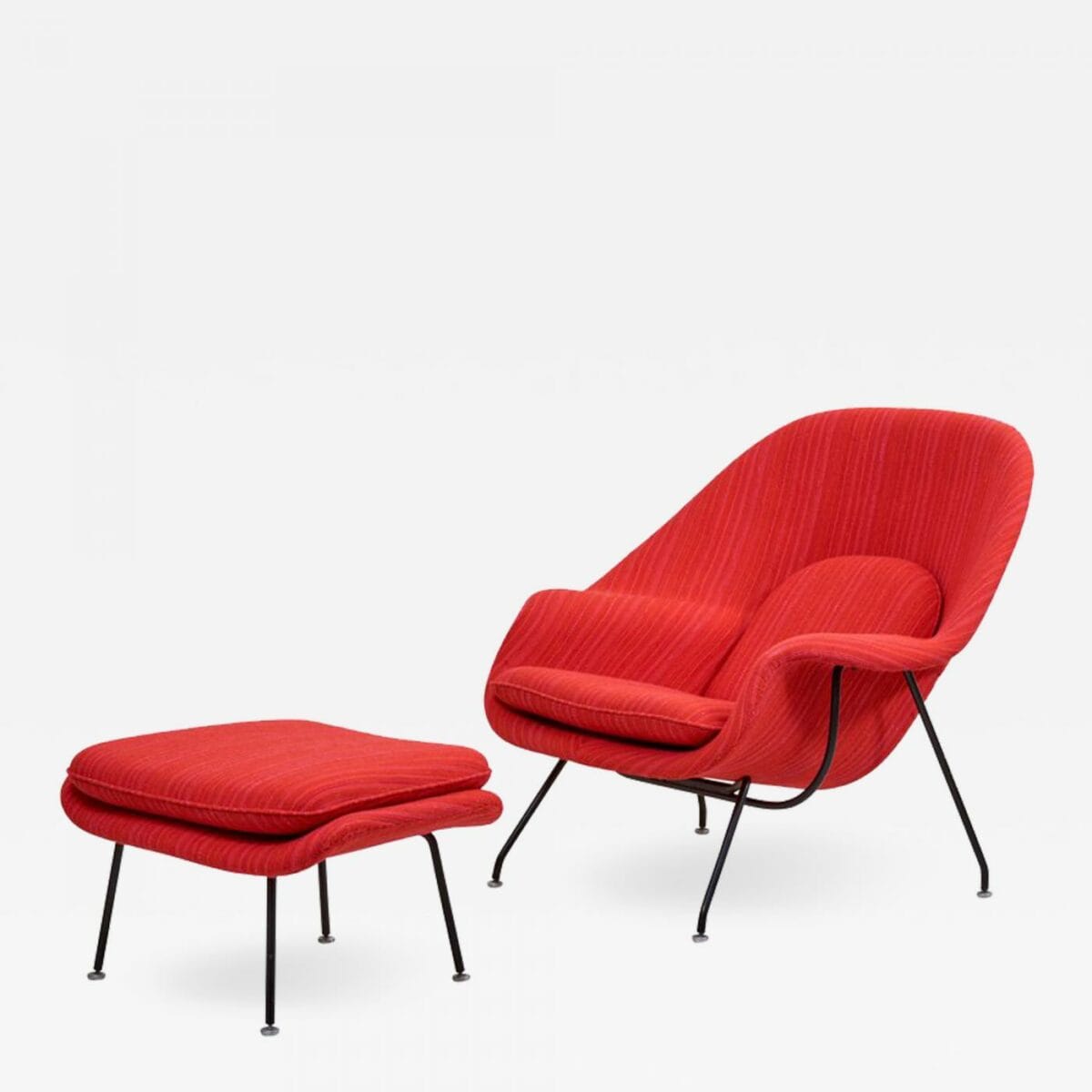
Knoll: Architecture in Furniture Form
Founded in 1938 in New York by Hans Knoll and later structured by Florence Knoll, Knoll stands as one of the most rigorous embodiments of international modernism.
At the intersection of architecture, industrial design and spatial planning, the brand helped formalise the aesthetics of Mid-Century Modern while establishing a disciplined industrial model that still defines contemporary furniture culture.

A Brand Born from Architecture
Knoll was never conceived as a conventional furniture company. From its earliest years, it functioned as an architectural extension, furniture designed not as decoration, but as structure.
Hans Knoll, trained in Germany and influenced by European modernist culture, understood that 20th-century furniture needed to abandon ornament and historical references. It had to serve evolving lifestyles: smaller apartments, rationalised offices, fluid domestic circulation.
This transition echoes the philosophy of the Bauhaus, where furniture became an instrument of spatial organisation rather than a symbolic object. Form was no longer decorative, it was structural.
Florence Knoll and the Invention of a Method
Florence Knoll transformed the company fundamentally. Educated under Mies van der Rohe and closely connected to the Saarinen circle, she introduced not just designs, but a system.
Her concept of the Planning Unit redefined interior architecture in post-war America. Furniture was no longer selected piece by piece, it was orchestrated. Circulation, lighting, posture, density, acoustics… everything was considered.
In this sense, Knoll developed a structural approach to modern interiors that parallels, yet differs from, the organic explorations seen at Herman Miller. While Herman Miller embraced fluid ergonomics and sculptural experimentation, Knoll asserted architectural discipline and proportional authority.
Knoll as Editor of European Modernism in America
Knoll played a crucial role in institutionalising European modernism on American soil. Rather than merely importing ideas, the company stabilised and legitimised them through precise industrial production.
Major collaborations formed a modernist canon:
Ludwig Mies van der Rohe – Barcelona Chair and steel collections (structural clarity, tension, minimal authority)
Eero Saarinen – Tulip Chair and Pedestal Tables (unity of base, sculptural rationalism)
Harry Bertoia – Diamond Chair (structure as drawing, metal as vibration)
Marcel Breuer – tubular steel seating (direct Bauhaus lineage)
Through these editions, Knoll did not simply participate in modernism, it institutionalised it. This editorial authority can be compared to the European model embodied by Cassina, though within a distinctly American corporate context.
For a broader contextual reading, this evolution belongs within the larger history of 20th-century design, where modernism transitioned from avant-garde ideology to dominant spatial language.
The Modern Office: Knoll’s Strategic Territory
Unlike many modernist brands associated primarily with domestic interiors, Knoll built much of its influence in professional environments.
Modernism, for Knoll, was not merely aesthetic, it was organisational. Offices became laboratories for spatial efficiency, modular systems, hierarchy of use and clarity of movement.
This systemic logic explains why Knoll occupies a central place within any serious analysis of high-end design furniture brands. Its authority lies in coherence, not ornament.
Materials and Industrial Precision
Knoll’s modernism is never austere in quality — only in excess. Its material authority rests on precision.
Signature materials include:
– Chromed steel (reflection, tension, structural expression)
– Aluminium (lightness and industrial refinement)
– Full-grain leather (depth, longevity, patina)
– Marble (particularly in Saarinen tables, balancing sculptural bases)
– Premium wood veneers (controlled warmth, architectural continuity)
This relationship between material and structure resonates directly with HART’s broader investigation into materials and finishes within contemporary design culture.
Knoll Today: Living Modernism
Now part of the MillerKnoll group, Knoll continues to edit its modernist icons while developing contemporary collections aligned with its architectural DNA.
Within today’s global design landscape — where some brands emphasise heritage re-edition (such as Cassina) and others cultivate cultural ecosystems (like Vitra) — Knoll maintains a distinct position: modernity as system.
Why Knoll Remains Essential
Knoll represents a precise idea of modernism: structure.
Structure of lines, structure of space, structure of use. While some modernist brands built domestic mythology around iconic lounge pieces, Knoll constructed a disciplined, architectural language applicable to collective environments.
This is the reason for its longevity. Knoll does not produce trends. It edits a system.