


Kartell: The Plastic Revolution in Italian Design
Founded in 1949 in Milan by Giulio Castelli, Kartell turned a material long confined to industry into a true cultural medium.
At the intersection of chemical innovation, moulding engineering and bold creative partnerships, the house developed an instantly recognisable language: colour, transparency, modularity, and a distinctly Italian idea of modernity.

1949: From Industrial Chemistry to Design
Kartell was born in post-war Italy, as the country rebuilt its economy and accelerated its modernisation. Giulio Castelli, a chemical engineer, quickly understood that polymers were not merely practical materials; they represented a new industrial horizon.
Unlike brands rooted in cabinetmaking and woodcraft, Kartell begins in the laboratory. Where Cassina formalises a heritage-led modernism through editorial practice, Kartell chooses a different path: modernity driven by material, process and serial production.
This trajectory belongs to the broader story of Italian design (1950–1980), when Italy became the place where industry began to speak the language of lifestyle. For Kartell, plastic is not an economic substitute; it is a forward-looking material able to absorb colour, gloss, transparency and one-piece forms.
Kartell and Italy’s Economic Boom
To understand Kartell is to understand an era. In the 1950s and 1960s, Italy experienced rapid expansion: new infrastructure, rising consumption, the emergence of an urban middle class. Interiors evolved as well: more compact, more mobile, more modular.
In this context, furniture became a strategic object. It had to be functional, accessible and reproducible, while also carrying a strong visual identity. Kartell embodies this shift perfectly: a company that thinks in industrial standards while fully embracing the cultural dimension of design.
This logic echoes the idea of “democratic design” found elsewhere in the history of international modernism, from the Bauhaus in Europe to Mid-Century Modern in the United States.
Plastic as a Cultural Manifesto
From the 1960s and 1970s onwards, Kartell turned plastic into a visual manifesto. While Italian design was shaped by the tensions of Radical Design, the brand proposed a distinct approach: experimentation without breaking with industry.
Bold colours, smooth surfaces, continuous volumes: plastic made it possible to move beyond traditional systems (wood frames, joinery, layered upholstery). The object is no longer built piece by piece; it is moulded, like industrial sculpture.
Where some radical projects remained largely manifestos, Kartell managed to produce and distribute at scale. This ability to make the experimental reproducible became one of the house’s defining strengths.
1950s–1960s: Modularity, Stacking, New Uses
In its early decades, Kartell developed a typology of objects that followed domestic change: mobile storage, stackable modules, compact pieces suited to urban living. Plastic allowed for efficiency and intelligent everyday use.
Cylindrical volumes, modular parts and interlocking systems introduced a new grammar: simple assembly, intuitive storage, flexibility.
This is precisely where Componibili (1967), designed by Anna Castelli Ferrieri, belongs. It is not just a cult object; it is a prototype for modern living: modular, rational, adaptable, almost architectural.
Philippe Starck: Global Icon Status and Transparency as a Language
Kartell’s global turning point comes with its collaboration with Philippe Starck from the 1990s onwards. The brand changes scale: it becomes a worldwide symbol of Italian design, recognised for turning moulding technology into an icon.
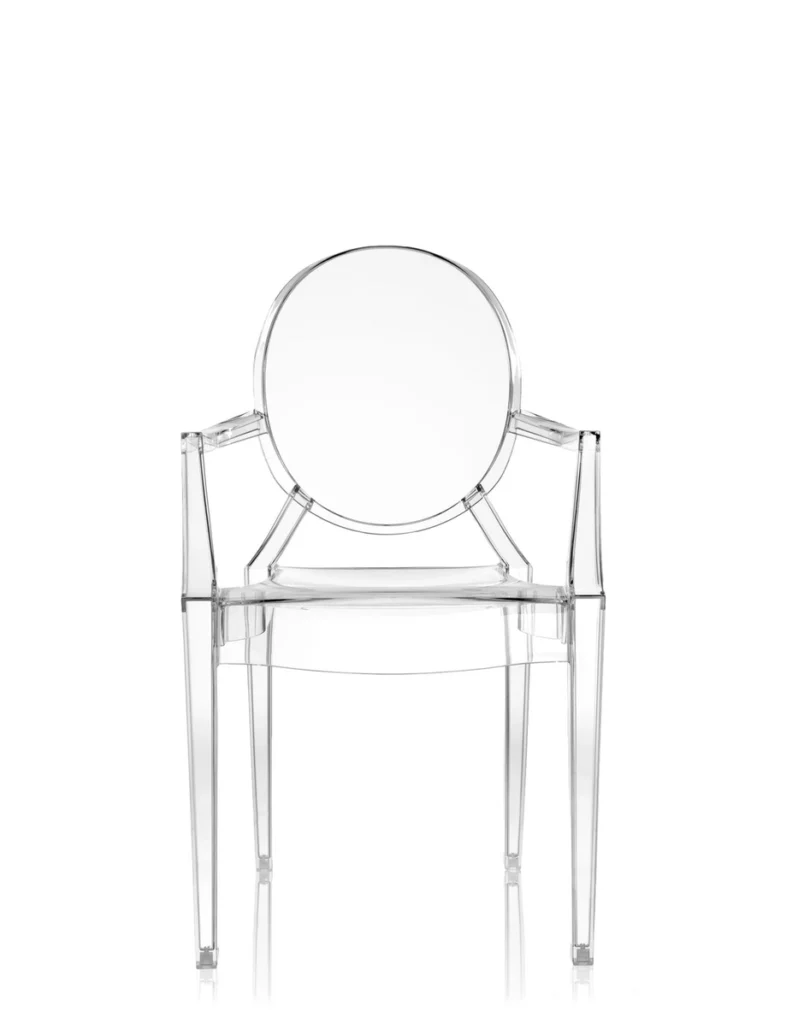
The Louis Ghost (2002) is the clearest example. It references history (Louis XV vocabulary) yet translates it into a radically contemporary material: transparent polycarbonate, injection-moulded in a single piece. Here, the technique is not hidden; it becomes the object’s beauty.
Transparency has a major spatial effect: the chair occupies volume without weighing it down, merges with architecture and plays with light. In a contemporary interior, it reads as a light presence, almost immaterial, far from the codes of heavy or purely decorative furniture.
Key Designers Associated with Kartell
Kartell built its strength through collaboration. The brand operates like an industrial editor: it welcomes diverse voices, then anchors them in a coherent material and production culture.
Among the most emblematic designers and creative directors:
Anna Castelli Ferrieri: a founding figure, modular and domestic thinking (Componibili).
Joe Colombo: experimentation and a futuristic vision of furniture (in dialogue with our broader reading of design history).
Philippe Starck: iconic transparency (Louis Ghost, La Marie, Masters).
Patricia Urquiola: surface sensitivity, colour, material hybridisation.
Antonio Citterio: architectural rigour and contemporary comfort (see also his role at B&B Italia).
Ferruccio Laviani: artistic direction, luminous objects and a strong visual identity.
This range of voices confirms Kartell’s singularity: it absorbs different visions while remaining faithful to an industrial DNA built on polymers.
Iconic Pieces
Certain creations capture the “Kartell method”: a clear form, controlled technology and immediate visual impact.
– Componibili (Anna Castelli Ferrieri)
– Louis Ghost
– Masters
– La Marie
– Bookworm
The Bookworm bookshelf is especially revealing: it proves that plastic can become a flexible load-bearing structure without losing stability. It blurs the line between furniture and architectural gesture, much as Artemide does in another register when material becomes a support for light.
Materials and Preferred Technologies
At Kartell’s core is the mastery of polymers and transformation processes. The brand prioritises ongoing research into transparency, resistance and the stability of form.
Key materials:
– Polycarbonate (clear or mass-tinted)
– PMMA (acrylic)
– ABS (coloured, durable, suited to complex shapes)
– Polypropylene (lightweight, robust, ideal for serial production)
– Technopolymers and composites (high resistance, intensive use)
– Recycled and bio-based polymers (contemporary direction)
One-piece injection moulding makes it possible to produce complex forms in a single mould. The result is fewer joints, fewer weak points and total formal continuity. This industrial logic aligns with our analysis of engineering-led houses such as B&B Italia.
On a design level, the consequence is decisive: the material is no longer a surface treatment, it becomes the drawing itself.
Lighting and Experimentation: Plastic as a Luminous Surface
Kartell does not stop at furniture. The house has developed a significant body of work in lighting, where polymers become filter, diffuser and structure.
Certain lamps exploit plastic’s ability to capture and redistribute light through ribbed surfaces, coloured transparencies and sculpted volumes. Here, material does not simply “hold” light; it shapes it.
This approach reflects a broader reading of Italian design: an object culture in which surface, reflection, diffusion and colour function as architectural elements.
Sustainability: What Happens to a Polymer-Driven House?
The ecological transition raises a central question: how can a brand historically linked to plastics address contemporary challenges without losing its identity?
Kartell answers through several directions: recycled materials, research into biopolymers, optimisation of industrial processes and improved repairability for certain models.
The challenge is strategic: preserving the language of transparency and colour while reducing material impact. This tension between industrial heritage and contemporary responsibility is now a key issue across the design world.
Kartell Today
Present in over 130 countries, Kartell remains one of the most instantly recognisable Italian design signatures. The brand keeps production strongly anchored in Italy and maintains tight control over its industrial chain.
Its catalogue combines iconic re-editions and contemporary releases, confirming its place in the history of international design and in today’s reading of author-led furniture.
To explore official collections:
Kartell official website
Why Kartell Still Matters
Kartell did not simply popularise plastic furniture.
It changed the hierarchy of materials in design history.
By turning polymers into cultural objects, the brand expanded the vocabulary of modernism beyond wood, steel and glass. It represents the chemical and luminous side of Italian modernity: lighter, more mobile, more audacious.
In the panorama of major houses, Kartell holds a singular position, complementing heritage-led editors such as Cassina, comfort-and-engineering leaders such as B&B Italia, and light-architecture houses such as Artemide.