


Herman Miller: The Pillar of American Modernism
Founded in 1905 in Michigan, Herman Miller stands as one of the structural pillars of modern American design.
Through its collaborations with Charles and Ray Eames, George Nelson and Isamu Noguchi, the company helped shape the aesthetic of Mid-Century Modern and established an industrial model that became a global benchmark.

From Craft Origins to Modernist Vanguard
Originally founded as a manufacturer of traditional furniture, Herman Miller was not born modern. Its defining strength lies in its ability to pivot early from decorative tradition toward functional clarity, and from functionality toward cultural influence.
In the 1930s, under the leadership of D.J. De Pree, the company made a radical shift. It no longer aimed simply to sell furniture. It sought to accompany a societal transformation, redefining how people lived and worked.
The collaboration with architect Gilbert Rohde proved decisive. Rohde introduced a revolutionary idea: produce furniture suited to contemporary life, stripped of historical references and adapted to lighter, more fluid interiors.
This transition positioned Herman Miller at the heart of American modernism, in dialogue with European developments such as the Bauhaus. Both movements shared a commitment to clarity, use and industrial precision.
Charles & Ray Eames: The Organic Revolution
The partnership with Charles and Ray Eames represents one of the most significant chapters in modern furniture history. Herman Miller did not merely manufacture their pieces; it provided the industrial infrastructure that allowed their ideas to reach a global audience.
With moulded plywood shells and later fibreglass seating, the company introduced a new aesthetic language: fluid, ergonomic and industrial, yet never cold.
Seating became anatomical, shaped to support the human body rather than constrain it.
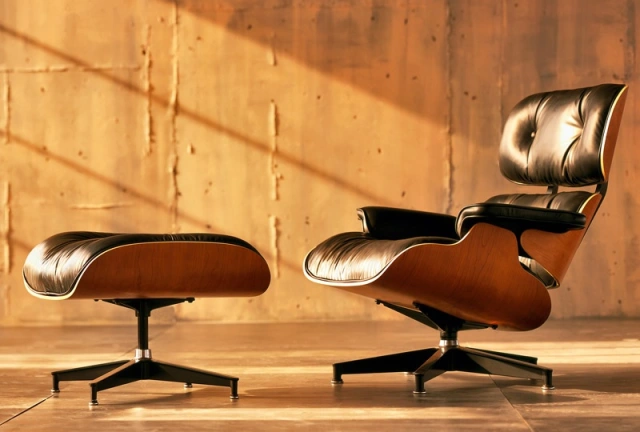
Iconic pieces such as the Lounge Chair & Ottoman, the Plastic Chairs and the Aluminium Group became emblems of organic design.
They also demonstrated that comfort is engineered, not accidental.
This dialogue between technical research, industrial precision and visual refinement firmly anchored Herman Miller within the history of 20th-century design and among the leading references in high-end design furniture.
George Nelson and Editorial Identity
Appointed Director of Design in 1945, George Nelson structured what can be described as an editorial vision. Herman Miller was no longer simply producing collections. It was constructing a coherent philosophy.
Nelson designed objects such as the Marshmallow Sofa and the Ball Clock, but more importantly, he defined a system. Furniture became part of a broader modern lifestyle, reflecting open plans, new domestic patterns and evolving social behaviours.
This “editor plus industry” model explains why Herman Miller’s pieces maintain relevance decades later. They are not nostalgic artefacts. They are architectural responses to evolving ways of living.
Isamu Noguchi: Art Meets Function
The collaboration with Isamu Noguchi blurred the line between sculpture and utility.
The Noguchi Coffee Table demonstrated that a functional object could embody sculptural presence without becoming purely conceptual.
This hybridisation between art and industry distinguishes Herman Miller from stricter European interpretations of modernism.
It reflects a uniquely American fluidity between culture, design and everyday life.
Ergonomic Innovation: From Home to Workplace
Herman Miller’s influence extends beyond domestic furniture.
From the 1970s onward, and particularly in the 1980s and 1990s, the company redefined office environments through ergonomic research.
The question became central: how does a chair influence posture, energy and productivity?
Furniture was no longer decorative. It became physiological.
The Aeron Chair, designed by Bill Stumpf and Don Chadwick, transformed workplace seating standards through breathable mesh, structural clarity and biomechanical adjustment.
Herman Miller moved from producing icons to shaping a comprehensive understanding of contemporary work environments.
Materials and Industrial Mastery
Herman Miller’s identity rests on continuous experimentation guided by rigorous industrial standards:
– Moulded plywood
– Fibreglass
– Aluminium
– Technical mesh textiles
– High-resistance injection-moulded plastics
Innovation is not pursued for novelty alone. The focus remains on longevity, repairability and structural coherence.
This material research aligns with our broader analysis of materials and finishes in contemporary design, where durability and precision remain central values.
Herman Miller Today
Now part of the MillerKnoll group, Herman Miller continues to produce its historic icons while developing contemporary collections grounded in the same principles of research and performance.
The brand remains a key reference within the international design landscape, alongside European houses such as Cassina and Vitra, each representing distinct interpretations of industrial modernism.
Why Herman Miller Remains Essential
Herman Miller did more than manufacture furniture.
The company helped define a modern, industrial and democratic way of living.
Its legacy continues to shape our understanding of American design and the evolution of Mid-Century Modern, not as a style, but as a method grounded in clarity, structure and long-term relevance.