



B&B Italia: Italian Industrial Modernity
Founded in 1966 in Lombardy by Piero Ambrogio Busnelli, B&B Italia has established itself as one of the defining forces of contemporary Italian design.
At the intersection of industrial innovation, technological research and formal experimentation, the company has profoundly reshaped modern furniture.

1966: The Birth of an Industrial Laboratory
B&B Italia emerged in 1966 at a time when Italy was undergoing significant cultural and economic transformation.
Between the Italian design miracle of 1950–1980 and the experiments of Radical Design, furniture became a field of formal and technological innovation.
Piero Ambrogio Busnelli quickly understood that the future of design depended on industrial mastery.
The introduction of cold-moulded polyurethane foam represented a major technical breakthrough.
Unlike traditional wooden frames and spring systems, this technology allowed for continuous, organic forms and structurally ambitious seating.
Where houses such as Cassina institutionalised historic modernism through editorial practice, B&B Italia chose to explore the future through engineering.
This positioning transformed the company into a true industrial laboratory, where design and technology evolved together.
Busnelli’s Strategic Vision
Busnelli was more than an entrepreneur. He introduced a new organisational model within the Italian design landscape, structuring the company around research, prototyping and rigorous quality control.
He understood that high-end furniture could no longer rely solely on drawing.
It had to be supported by controlled, reproducible and durable production processes.
This hybrid structure, positioned between a creative studio and an engineering centre, became the structural signature of B&B Italia.
Formal Innovation and Architectural Comfort
During the 1970s, the brand collaborated with Mario Bellini, Gaetano Pesce, and later Antonio Citterio.
Comfort was no longer secondary. It became an architectural issue.
Seating grew deeper, more modular and freer in use.
This transformation mirrored broader social changes as formal living rooms gave way to more fluid domestic spaces.
This period reflects the tensions within Italian design, eventually intersecting with the experimental provocations of the Memphis Group, which further challenged established formal codes.
Iconic Pieces
Several creations embody this transformation:
– Le Bambole
– Up Series
– Charles
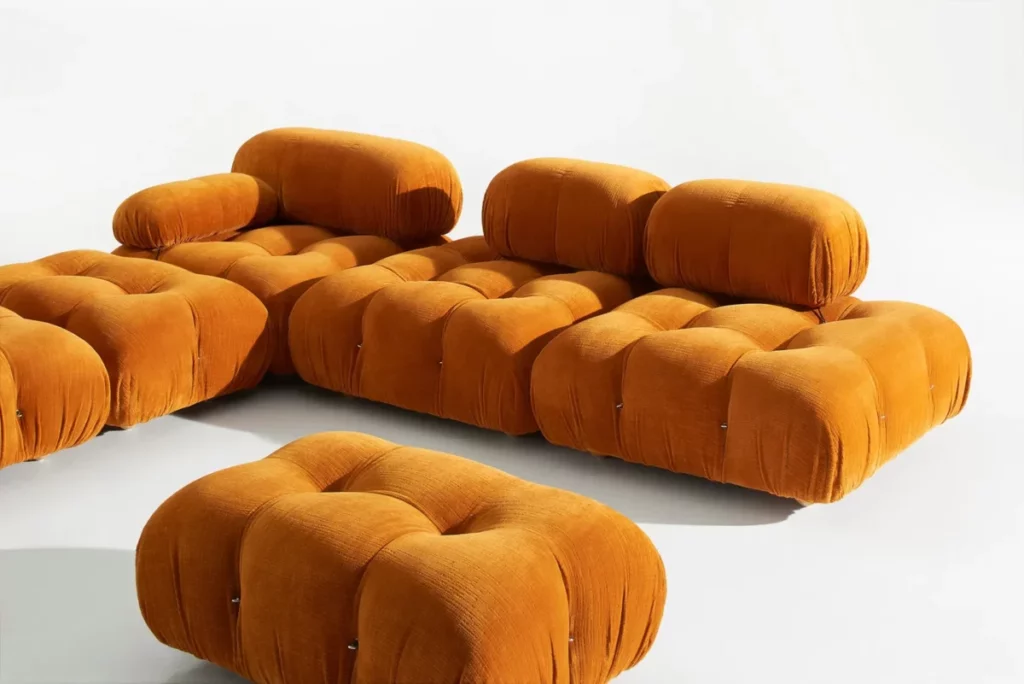
– the Camaleonda, now a benchmark in the contemporary high-end sofa segment.
These models place B&B Italia at the centre of premium design furniture.
The modularity of the Camaleonda in particular anticipated the transformations of contemporary living.
Modules connect, shift and reconfigure according to spatial needs.
Iconic Designers Associated with B&B Italia
Since its foundation, B&B Italia has collaborated with some of the most influential designers in the international landscape.
The brand operates not merely as a manufacturer, but as a catalyst for creative visions supported by rigorous industrial engineering.
Among the key figures:
Mario Bellini
A central figure of 1970s Italian design, he created Le Bambole, a manifesto of sculptural and informal comfort.
Gaetano Pesce
Creator of the Up Series, he introduced narrative and anthropomorphic dimensions into industrial furniture.
Antonio Citterio
A defining presence in the contemporary catalogue, he developed an elegant and architectural language through models such as Charles.
Patricia Urquiola
She brought a strong textile sensibility and an experimental approach to surfaces, contributing to the brand’s contemporary renewal.
Zaha Hadid
With pieces such as Moon System, she demonstrated B&B Italia’s ability to translate complex architectural forms into controlled industrial objects.
Naoto Fukasawa, Vincent Van Duysen, Philippe Starck and other international designers have further expanded the brand’s formal vocabulary.
This diversity of voices confirms B&B Italia’s distinctive strength: the ability to absorb radically different visions while maintaining a strong industrial coherence.
Architecture and Industrial Culture
Architecture has deeply influenced the brand.
As early as the 1970s, B&B Italia collaborated with Renzo Piano and Richard Rogers to design its industrial headquarters.
This architectural dimension shaped the company’s identity through precision, structural clarity and technical coherence.
Furniture becomes the extension of an architectural reasoning.
International Expansion and Influence
From the 1980s onwards, B&B Italia developed a strong international network.
The brand became a reference for both residential and contract projects worldwide.
This expansion confirmed the robustness of its industrial model.
Italian design moved beyond a local phenomenon to become a global standard.
Preferred Materials and Manufacturing Technologies
B&B Italia’s identity rests on advanced mastery of industrial materials.
Unlike houses rooted in traditional cabinetmaking, the brand builds its language around technological processes.
Cold-moulded polyurethane foam remains its foundational innovation.
This material allows continuous volumes, deep seating and controlled ergonomics without visible rigid frameworks.
Internal structures often combine tubular steel, aluminium and engineered composites, ensuring durability and structural stability.
Upholstery and surface materials also play a strategic role.
B&B Italia develops high-resistance technical textiles while working with full-grain leathers, structured wools and innovative fabrics adapted to contemporary living configurations.
The brand continues to invest in recyclable materials, component separation systems and production optimisation, progressively integrating environmental considerations into its industrial model.
This articulation between engineering, material research and visual comfort forms the foundation of its industrial authority.
B&B Italia Today
Now part of Design Holding, B&B Italia continues its research into modular systems, innovative materials and evolving domestic typologies.
The catalogue combines iconic heritage and contemporary creation without compromising its industrial identity.
To explore official collections, visit the website of B&B Italia.
Why B&B Italia Matters
Within the international design landscape, B&B Italia represents the technological and experimental dimension of Italian luxury.
Where some houses consolidate modernist heritage, B&B Italia builds a modernity in motion, driven by engineering and innovation.
Its role is fully embedded in the cultural history of Italian design, documented by institutions such as the ADI Design Museum.