

Orient Express 2027: A Masterpiece of Design and Luxury by Maxime d’Angeac
Can a train be a work of art? Since 1883, the Orient Express has answered with a resounding yes. More than a mere means of transport, it embodies a certain idea of travel, one where every mile becomes contemplation, where the journey matters as much as the destination.
After decades of silence, this rolling legend is about to be reborn. In 2027, under the artistic direction of Maxime d’Angeac, seventeen restored carriages will once again travel the legendary route from Paris to Istanbul. Not a copy of the past, but a conversation between two eras.
Birth of a legend
On October 4, 1883, a quiet revolution set off from the Gare de l’Est. Georges Nagelmackers, a visionary Belgian engineer, had just invented luxury rail travel. His Orient Express did more than connect Paris to Constantinople: it transformed travel into a celebration. For the first time, crossing Europe became a complete sensory experience with gourmet meals, sumptuous cabins and landscapes gliding past ornate windows.
The train emerged at a pivotal moment in art history. Art Nouveau was flourishing, Art Deco loomed on the horizon. The boundaries between fine arts and applied arts wavered, then collapsed entirely. In this effervescent context, the Orient Express carriages became laboratories of innovation. Glassmakers signed frozen poetry into their work. Cabinetmakers sculpted miniature palaces. René Prou, René Lalique, Christofle: the greatest names of the era converged to create a harmony that has never been matched since.
The Polish miracle
The story could have ended there, frozen in books and Agatha Christie films. But in 2015, near the border between Poland and Belarus, Arthur Mettetal, Orient Express historian, made a stunning discovery. On a forgotten siding, seventeen carriages from the 1920s and 1930s lay dormant under layers of dust. A treasure no one had expected to find.
The miracle lay in the details. Against all odds, the interiors had survived the passage of time. The Morrison and Nelson marquetry still traced their arabesques across the walls. The Lalique panels, engraved with “blackbirds and grapes” motifs, still diffused their opalescent light. An intact heritage, ready to live again. In 2018, after two years of negotiations, the Accor group acquired this treasure. An exceptional convoy escorted by police brought the carriages back to France. The renaissance could begin.
The architect of dreams
René Lalique had established a unique visual grammar for the original train. His frosted glass panels, with their vegetal motifs and stylized railway symbols, transformed light into a noble material. Glass ceased to be transparent and became poetic substance, halfway between technical prowess and pure emotion. His creations for the Orient Express remain unmatched peaks where utility and beauty merge into one.
To extend this legacy without betraying it, Orient Express called upon Maxime d’Angeac. The French architect built his reputation for excellence with houses like Daum, Hermès and Guerlain, whose Champs-Élysées flagship he restored. Passionate about the Italian Renaissance as much as Art Deco, a collector of travel narratives, d’Angeac immediately rejected the idea of mere restoration. His ambition: a creative conversation between eras. A bold achievement that firmly places him among the most iconic designers of our time.
“By stepping into the shoes of its creators, from René Prou to Suzanne Lalique, I tried to reinterpret the history of this legendary train. Without any nostalgia, but with the desire to extend its story, to transport us elsewhere. As in a dream.” The original Lalique panels will be preserved, but they will now dialogue with contemporary creations.
Thirty master craftsmen, one total project
Reinventing the Orient Express required assembling the elite of French craftsmanship. Maxime d’Angeac brought together around thirty master artisans, heirs to centuries-old skills. Rinck and Paul Champs handle the cabinetwork. Ateliers Jouffre create the upholstery. Ateliers d’Offard produce exceptional wallpapers. Atelier Moderne Pulsatil designs the lighting. The Manufacture de Tapisseries de Bourgogne weaves unique pieces.
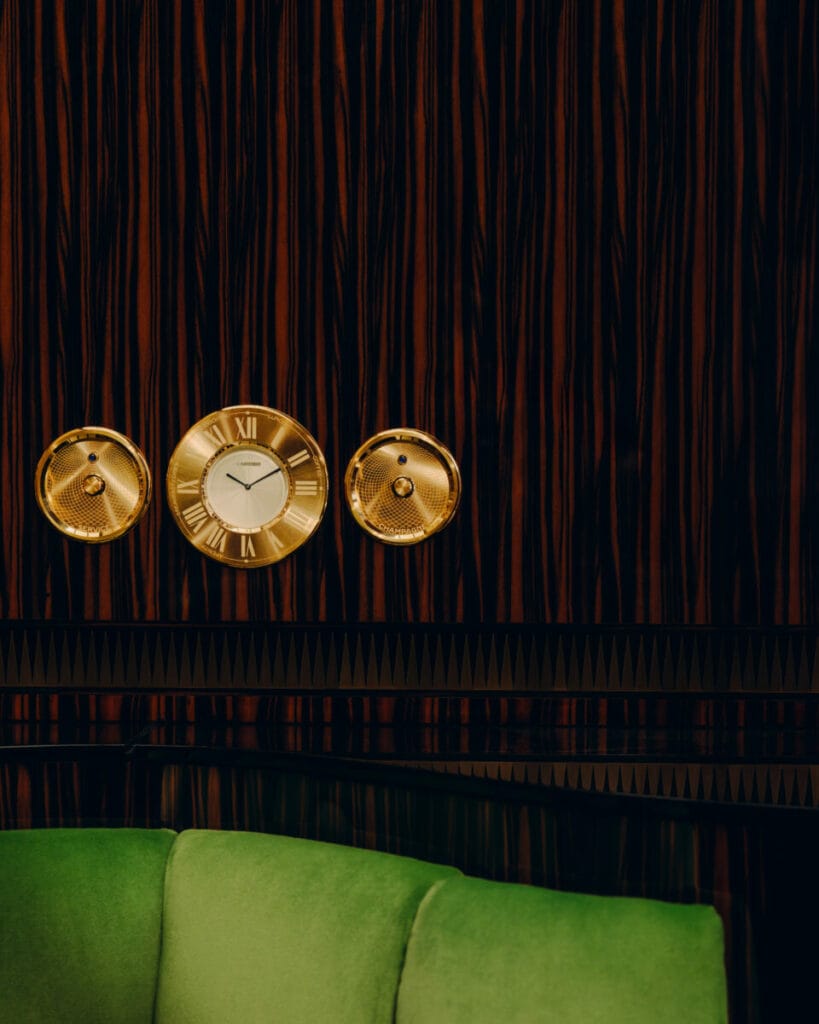
These artisans are joined by the great historic houses. Lalique perpetuates its heritage with new glass pieces. Cartier creates the clocks that will mark time aboard. Embroiderers, sculptors, watchmakers, metalworkers, glassmakers: each specialty finds its place in this symphony of craftsmanship. The materials match the ambition. Burr elm, mahogany, velvet, silk, beveled mirrors, crystal, marble. Each embroidered headboard requires nearly 300 hours of work. True luxury is not declared: it is made, gesture by gesture.
The poetry of detail
What sets the Orient Express apart from any other luxury train lies in one obsession: absolute coherence. Nothing is left to chance. The curves of the armchairs follow the swaying of the carriage. The ceilings rise generously, offering a sense of space despite the narrowness of the cars. Even the screws are stamped with the Orient Express monogram.
The colour palette embraces bold richness. Deep greens converse with bronze and gold. Cream-white marble contrasts with dark woods: rosewood, mahogany, ebony. Fine marquetry, mother-of-pearl inlays, carved woodwork, gold leaf gilding, chiseled bronzes. Every technique employed belongs to a repertoire that industrial production has nearly erased. A striking paradox: the most modern train of its time becomes the conservatory of an endangered craft.
A journey through spaces
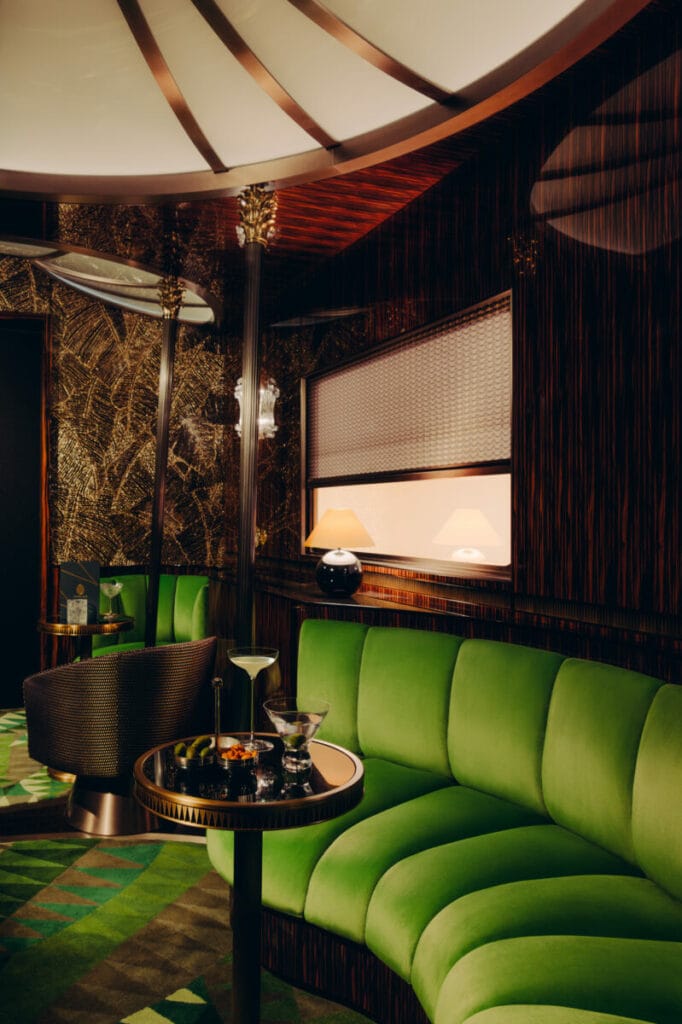
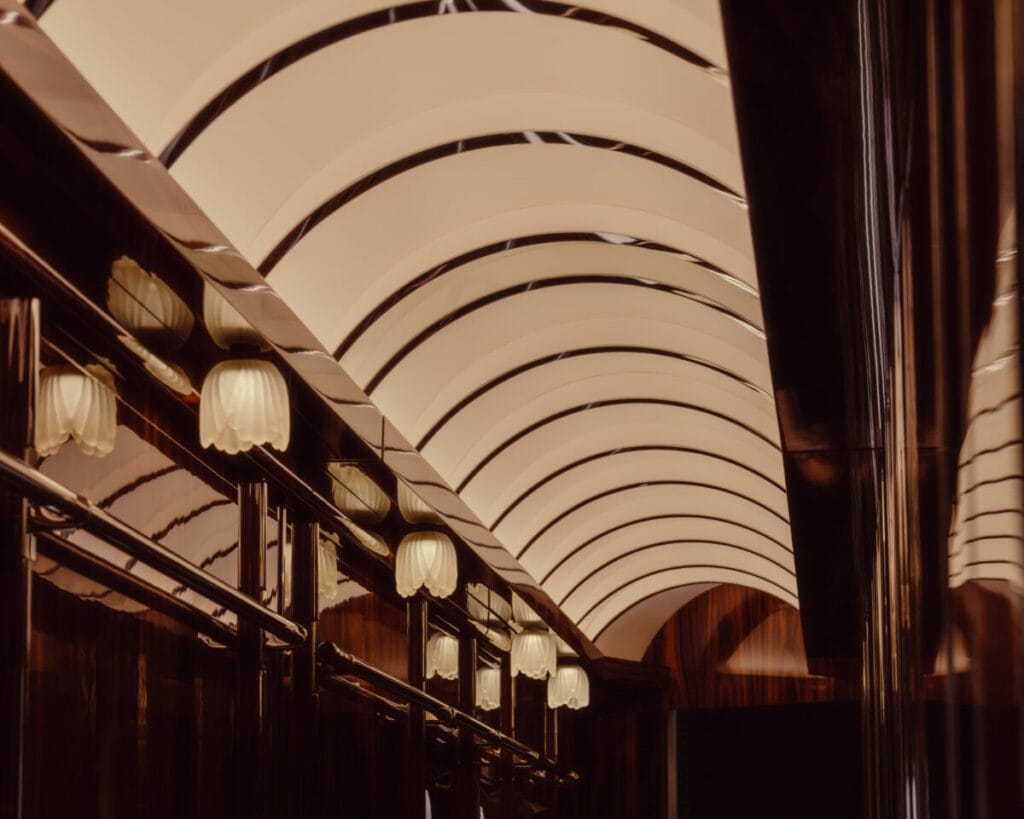
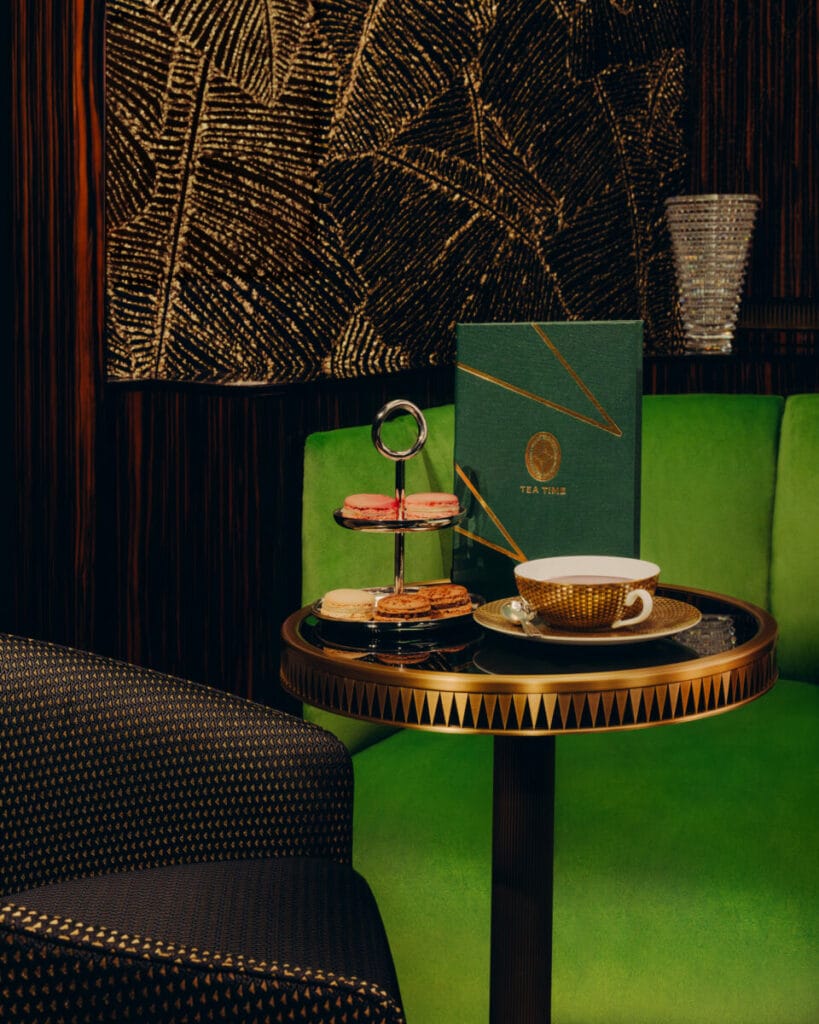
The Bar Car sets the tone from the moment you enter. A spectacular green envelops the space, punctuated by massive Second Empire-style domes. Four bronze columns support these glass cupolas. The counter, a translucent sculpture, pays homage to Lalique while asserting its modernity. Marble tables, armchairs with welcoming curves, Cartier clocks marking cocktail hour. Every element participates in an invisible choreography of service. Two discreet buttons allow you to call: one for champagne, one for staff. True luxury never flaunts itself.
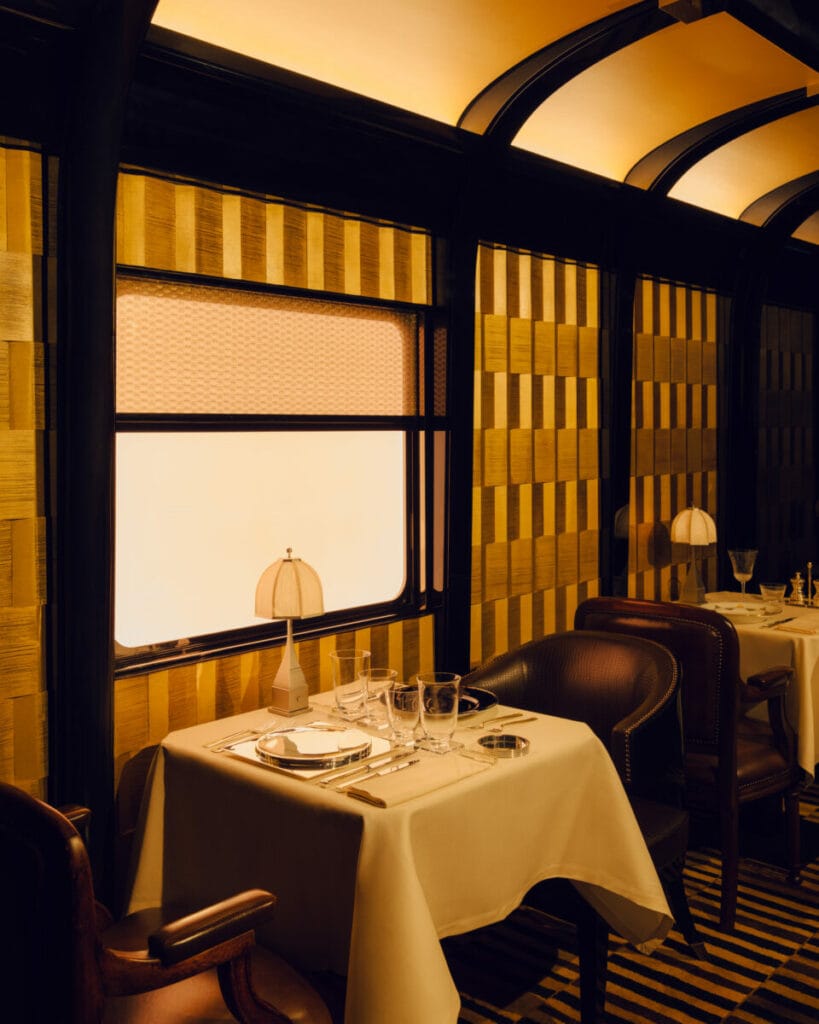
The Restaurant Car surprises with its theatrical grandeur. A mirrored ceiling, crossed by arches that multiply the subdued light, creates an atmosphere of intimate magnificence. The deep, enveloping armchairs invite you to linger. The lamps reinterpret historic models with a contemporary touch. But the major innovation hides at the back: a glass partition reveals the kitchen. No more mysterious service appearing from nowhere. Passengers now witness the chefs’ choreography, a culinary show in real time. A private lounge, adorned with original marquetry panels, reminds us that the project also knows how to preserve what already exists.
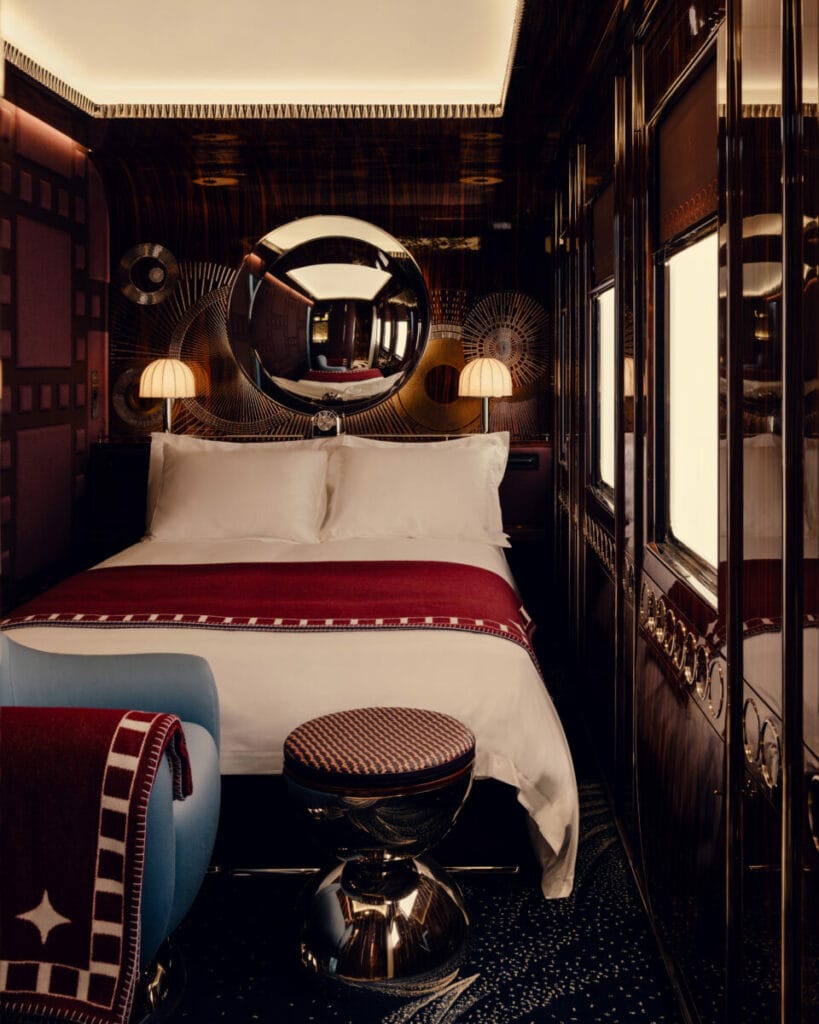
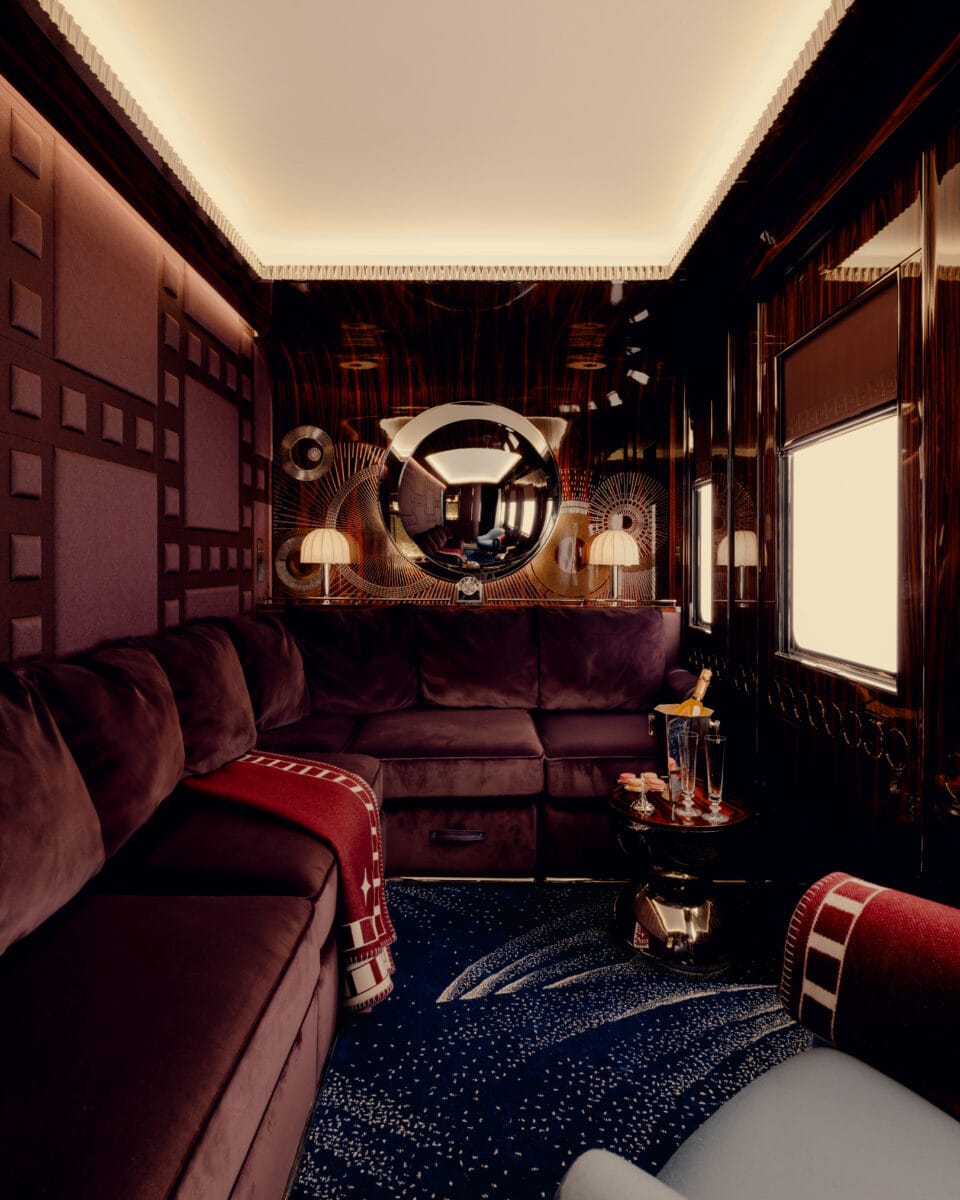
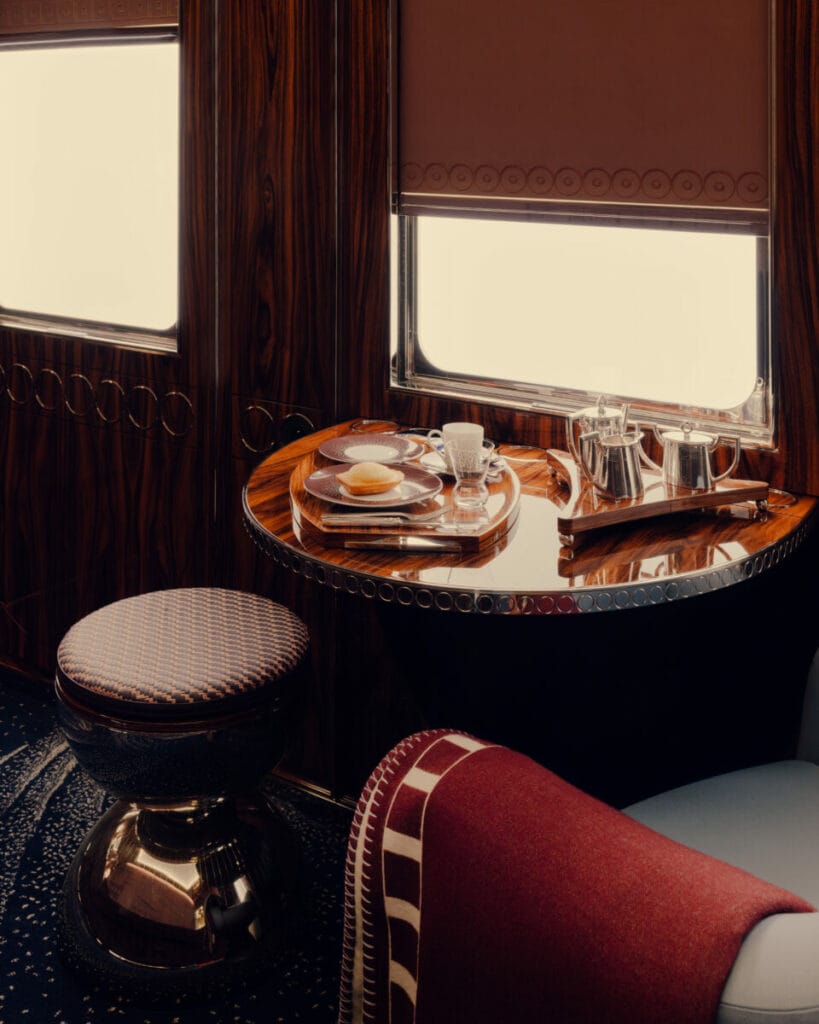
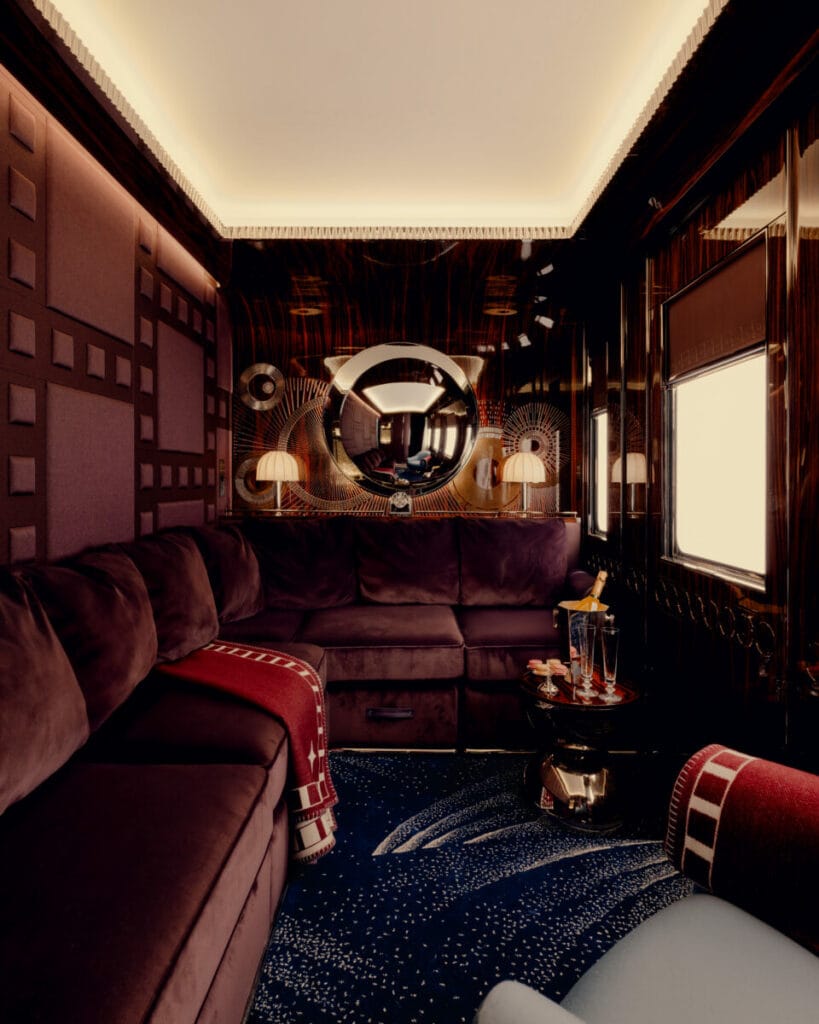
The Suites push refinement to its most intimate. The walls are clad in precious woods and leather, the latter bearing the “rail” motif created by Suzanne Lalique. The headboards, true textile paintings, blend wood embroidery, mother-of-pearl beads and bronze studs. On the floor, the “comet” carpet invites daydreaming. Niches house restored Lalique panels. Elliptical shelves offer elegant rests for a book or a glass of wine.
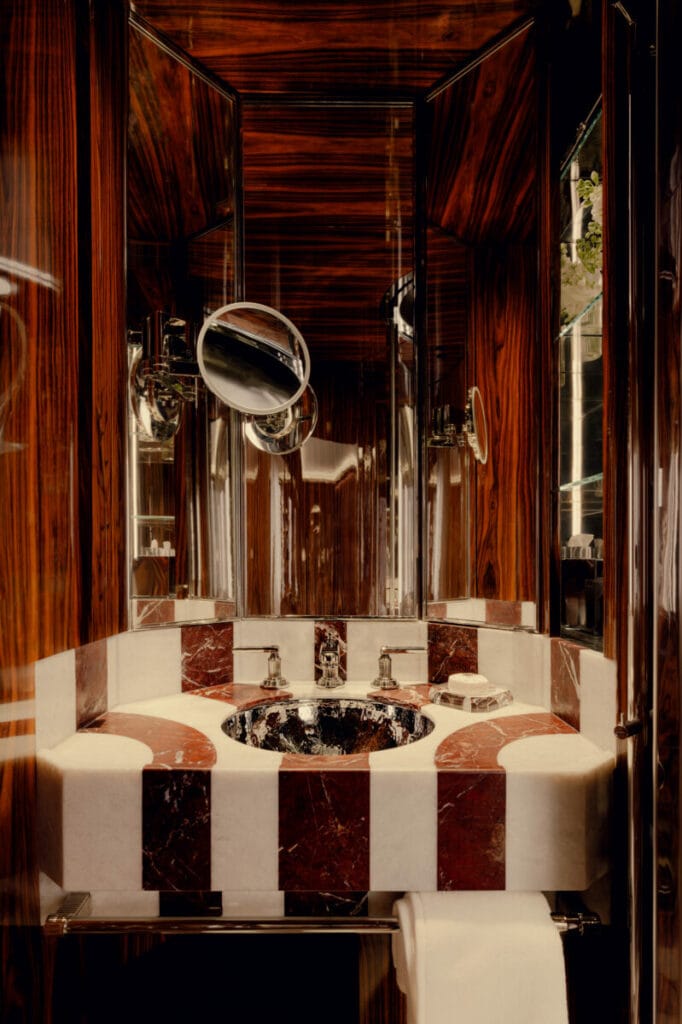
The magic happens at nightfall. Through an ingenious system, the Grand Transformation takes place: the daytime lounge gives way to a bedroom with a double bed measuring 2 × 1.40 metres. A sliding door reveals a private bathroom in red and white marble, with custom chrome fittings. The Orient Express is no longer a train: it is a mobile apartment, a travelling retreat crossing Europe.
At the summit of the hierarchy, the Presidential Suite occupies an entire carriage. Fifty-five square metres of absolute splendour, accessible through a private entrance. The ultimate fantasy of rail travel takes its definitive form here: space, light, silence, and Europe unfolding behind the windows.
See the train before it departs
No need to wait until 2027 to get close to the legend. Until April 26, 2026, the Musée des Arts Décoratifs in Paris hosts the exhibition “1925-2025, A Hundred Years of Art Deco“. In the museum’s monumental nave, three full-scale mock-ups reveal the future interiors: bar, restaurant and suite. Facing them, an authentic cabin from the Étoile du Nord dating from 1926 establishes a dialogue between eras.
The exhibition offers a chance to discover Maxime d’Angeac’s sketches, material samples and films shot in the artisans’ workshops. A rare immersion behind the scenes of an extraordinary project. Nearly a thousand Art Deco works (furniture, Cartier jewellery, objets d’art) complete the journey and place the Orient Express in its historical context: an era when luxury rhymed with creative audacity.
Practical information
Musée des Arts Décoratifs, 107 rue de Rivoli, Paris 1st
From October 22, 2025 to April 26, 2026
Admission: €15 (free for under 26s)
Metro: Palais-Royal, Pyramides or Tuileries
The essence of travel
Why does the Orient Express still fascinate, when planes connect Paris to Istanbul in three hours? Precisely because it offers what speed forbids: awareness of movement. On board, the traveller does not teleport from one point to another. They traverse. Alpine landscapes, Hungarian plains, the changing lights of the Balkans. Every hour brings its share of discoveries. Time, compressed everywhere else, reclaims its rights here.
In 2027, the train will resume its mythical route. Three thousand kilometres from Paris to Istanbul, via Venice, Vienna and Budapest. Three thousand kilometres to relearn that travelling is not just about arriving, it is also about departing, crossing, contemplating. The Orient Express has always known how to marry function and beauty. Maxime d’Angeac’s project extends this wisdom by demonstrating that a masterpiece is never frozen. It evolves, dialogues with its time, reinvents itself without losing its soul.
As long as the human aspiration for beauty exists, as long as travel is seen as inner transformation, the Orient Express will remain the benchmark against which all mobile luxury is measured. Not a relic of the past, but an ever-renewed promise.
Further reading
- Orient Express: official website for the 2027 project
- “1925-2025, A Hundred Years of Art Deco” exhibition at the Musée des Arts Décoratifs, Paris
- Maxime d’Angeac: portfolio of the architect and artistic director

Independent interior architect and project manager, I combine technical expertise with aesthetic sensibility. From structural work to finishing touches, I have developed an in-depth knowledge of materials, which I share through writing to convey my passion for design and architecture.